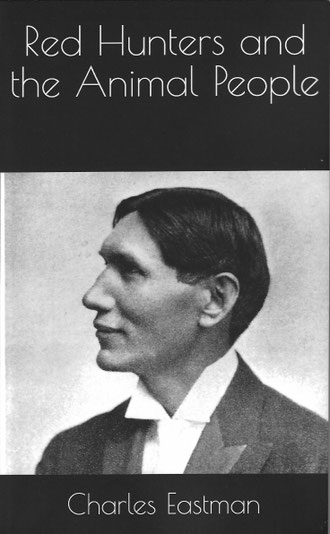
Geschichten von Leben, Tod und Respekt
Charles Eastman (Ohíyesa)
„Red Hunters and the Animal People“ 1904
Scroll down for English version
Weiße Leser haben ein ganz spezielles Verhältnis zu Tieren: Haustiere wie Hund und Katze sind Schmusewesen. Dass auch Kühe und Schweine mitunter als Haus- statt als Schlachttiere definiert werden, mutet seltsam an, jedenfalls sitzt bei mir kein Ferkel auf der Couch (na ja). Die wilden Tiere dagegen nutzen wir für Rehbraten, Zoo oder Safari, jedenfalls stehen „wir“ immer auf der höheren Stufe, sind intelligenter, sozial differenzierter und überhaupt die Krone der Schöpfung. Doch unsere Perspektive wird von anderen Ethnien nicht unbedingt geteilt.
Das spezielle Verhältnis nordamerikanischer Indianer zu Tieren hat der Santee Dakota Sioux Charles Eastman (1858-1939) in den Erzählungen „Red Hunters and the Animal People“ (1904) beschrieben – zehn Tier- und zwei Geschichten über indianische Jäger. Die einmalige Sammlung gibt Aufschluss über die Ambivalenz von Leben und Tod bei Lebewesen, die einander fremd sind, aber sich den Lebensraum teilen. Indianer haben Tiere gejagt, getötet, materiell genutzt. Ihre Tipis waren aus Bisonhaut, ihre Kleidung aus Hirschleder, ihre Schlaflager aus Büffel- oder Bärenfell, und Fleisch war Hauptnahrungsmittel der Präriebewohner. Hunde und Pferde könnte man als ihre Haus- und Nutztiere bezeichnen, aber grundsätzlich wurden Tiere als Mitbrüder angesehen, einfühlsam beobachtet, oft hoch geehrt, als Vorbild für eigenes Verhalten genommen – und dennoch getötet.
Der irritierende Widerspruch war angesichts der Lebensverhältnisse unumgänglich, Lebensverhältnisse, die bei Mensch und Tier ähnlich prekär waren: stets bedroht von Hunger, Verletzungen, Krankheiten, Naturkatastrophen. Wer überleben wollte, musste lernen zu töten – ein „humaneres“ Verhalten kann man sich nur leisten, wenn man Ackerbau und Viehzucht als pervertierte Nahrungsmittelindustrie im Hintergrund weiß. Man könnte die zwölf Geschichten einfach als ethnisches Kuriosum herunter lesen, wobei man die spirituelle Basis übersehen würde, die indianischem Denken zugrunde liegt und sich nie als leeres Fantasiegespinst äußert. Indianische Spiritualität ist stets an belebte materielle Wirklichkeit gebunden, sie ist geradezu fundamentaler Ausdruck von Lebensenergie, so dass den Tieren der gleiche spirituelle Wert zugestanden wird wie Menschen, Pflanzen, Steinen, Erde, Sonne… sie alle sind spirituell lebendig.
Eastman (indianischer Name Ohíyesa = Sieger) nimmt beispielhaft Puma, Wolf, Mäuse, Waschbär, Büffel, Adler, Präriehunde, Mufflon , Bär, Biber und „Elk“ (= Wapiti) heraus, große und kleine, fliegende, laufende und schwimmende Völker, und beobachtet sie als selbständige Individuen, die in einigen Fällen in enger Beziehung zu Menschen stehen. Er identifiziert sich mit ihnen ähnlich, wie man einem Kollegen oder Nachbarn begegnen würde, deren Nöte und Sorgen, soziale Position, Erfolge und Niederlagen man verstehend zur Kenntnis nimmt. Es ist stets eine Empathie aus Distanz, nie wird ein Tier vermenschlicht, als süß, niedlich, putzig dargestellt, nicht einmal Mäuse werden in ihrem Rang verkleinert. Dabei trifft mitunter ein Strahl liebevoller Nähe ins Herz des Lesers, etwa in der Erzählung „The Wolf Mountain“, in der Wolfsrüde Manitoo in schicksalhaftem Pech einsam umherstreift und fast verhungert, weil er seine Jagdgefährten verloren hat. Mitten in seiner Depression, es ist auch noch kalt und stürmisch, kommt ein hübsches Wolfsmädchen vorbei, sie sehen sich an und bleiben beieinander „during their lifetime“.
Die Schicksalhaftigkeit der Lebensumstände von Tieren und indianischen Menschen ähnelt sich bis zur Identität. Schon in der Anfangserzählung „The Great Cat’s Nursery“ wird das deutlich. Puma-Mutter Igmútanka hat ihren Lebensgefährten durch den Tod verloren und muss nun wenigstens ihre beiden Babys retten. Sie selbst wird aber auch von einem Jäger getötet, der das eine Baby mitnimmt. Das andere, einziger Überlebender der vierköpfigen Familie, wird zufällig von Igmútankas Cousine gefunden.
Tiere – Mitgeschöpfe, die respektiert und getötet werden
Egal auf welche Weise Indianer sich Tiere zunutze machen – Tiere werden geachtet. Ein alter Pawnee erklärt einer vorwitzigen Jungsgruppe, die sich einen Spaß aus der Mäusejagd macht, dass man fairerweise nicht die angreifen darf, die sich verstecken, und dass man keinesfalls weiterjagen darf, wenn eine weiße Maus als Chief hervorkommt, dem man den Respekt nicht versagen darf. Insgesamt ist das Verhältnis roter Jäger zu den Tiervölkern von kaum definierbarer Komplexität. In der Erzählung „Wechah the Provider“ scheint eine Beziehung wie bei Weißen zu ihren Haustieren zu bestehen, doch Waschbär Wechah bleibt ein Vertreter der Wildnis. Wasula, das Mädchen, dass ihn aufgezogen hat, stellt sogar fest, wie wilde Tiere sprachlich miteinander kommunizieren - der Kommunikation von Tieren widmet sich auch das gesamte Schlusskapitel.
Die Ambivalenz zwischen Liebe und Freiheit, Verantwortung und Selbstbewusstsein im Verhältnis Mensch-Tier beschäftigt den Leser lange. Als ich das rund 200 Seiten schmale Bändchen bekam, hielt ich die Lektüre für eine Sache weniger Tage, inzwischen sind Jahre vergangen, in denen das spezielle Verhältnis von indigenen Menschen und Wildtieren immer wieder als Thema aufkam. Leider gibt es Störfaktoren hinsichtlich der Edition. So fehlt die Paginierung – ich habe einen fotomechanischen Reprint. Wer eine Erstausgabe von 1904 findet, sollte sie behalten!
Aber auch inhaltlich entstehen Bedenken. Ohíyesa heiratete 1891 die intellektuell anspruchsvolle, weiße Lehrerin Elaine Goodale, die ihn unterstützte in dem Bemühen, indianisches Denken weißen Lesern zu vermitteln. Aber sie lektorierte und tippte Ohíyesas Texte zur Publikation ab, so dass nicht mehr festzustellen ist, welche Passagen authentisch von ihm sind. Mit Sicherheit hat sie darauf gedrängt, die Mentalität christlicher weißer Leser zu berücksichtigen, so ist gelegentlich einschränkend die Rede von „indianischem Aberglauben“ – für radikale nichtweiße Äußerungen war die Zeit nicht reif. Die Spannungen in der Ehe führten 1921 zur Trennung, Ohíyesa hat danach nichts mehr publiziert. Seine Position als Arzt, Vortragsreisender und sozialpolitischer Berater zwischen Weißen und Indigenen ist dennoch von historischer Bedeutung, und seine Bücher sind einzigartige Zeugnisse indianischen Denkens. Und die Sammlung "Red Hunters and the Animal People" ist vielleicht das Schönste und am tiefsten Indigene, was Ohìyes'a geschrieben hat - offenbar ganz aus sich selbst heraus ohne Zugeständnisse für weiße Leser.
Hier eine Zusammenfassung der einzelnen Geschichten als Übersicht:
The Dance of the Little People
Wild Animals from the Indian Stand-Point
Stories of Life, Death, and Respect
Charles Eastman (Ohíyesa) "Red Hunters and the Animal People" (1904)
White readers have a very particular relationship with animals: pets like dogs and cats are cuddly companions. The idea that cows and pigs might sometimes be defined as household pets rather than livestock seems strange—after all, I don’t have a piglet sitting on my couch (well...). Wild animals, on the other hand, we utilize for venison roasts, zoos, or safaris; in any case, "we" always occupy the higher rung—we are more intelligent, socially more complex, and, all in all, the crown of creation. Yet this perspective is not necessarily shared by other ethnic groups.
Charles Eastman (1858–1939), a Santee Dakota Sioux, described the special relationship between North American Indians and animals in the stories collected in *Red Hunters and the Animal People* (1904)—a volume comprising ten animal tales and two stories about Indian hunters. This unique collection sheds light on the ambivalence surrounding life and death for living beings that are foreign to one another yet share the same habitat. Indians hunted, killed, and made material use of animals. Their tipis were made of bison hide, their clothing of deerskin, and their bedding of buffalo or bear fur; meat was the staple food of the Plains inhabitants. While dogs and horses might be classified as domestic or working animals, fundamentally, animals were viewed as fellow beings—observed with empathy, often held in high esteem, and looked to as models for human behavior—and yet, they were killed.
This unsettling contradiction was unavoidable given the prevailing living conditions—conditions that were similarly precarious for both humans and animals, constantly threatened by hunger, injury, disease, and natural disasters. To survive, one had to learn to kill; one can only afford "humane" behavior when backed by agriculture and animal husbandry—systems that should be viewed as a perverted form of the food industry. One could simply read through these twelve stories as an ethnic curiosity, yet doing so would mean overlooking the spiritual foundation of Native American thought—a spirituality that never manifests as mere fantasy. Native American spirituality is inextricably linked to a living material reality; it is a fundamental expression of life energy, granting animals the same spiritual worth as humans, plants, stones, the earth, and the sun—for all of them are spiritually alive.
Eastman (whose Native name, Ohíyesa, means "Winner") singles out specific examples—cougar, wolf, mice, raccoon, buffalo, eagle, prairie dog, bighorn sheep, bear, beaver, and elk—representing peoples that fly, run, or swim, both large and small. He observes them as autonomous individuals, some of whom share close bonds with humans. He relates to them much as one would to a colleague or neighbor, acknowledging their hardships and worries, social standing, triumphs, and defeats with understanding. His approach is always one of empathetic distance; animals are never anthropomorphized or portrayed as merely cute or cuddly—even mice are accorded full dignity. Yet, at times, a ray of loving closeness strikes the reader’s heart—such as in the story "The Wolf Mountain”, where Manitoo, a male wolf, wanders alone and near starvation after a stroke of ill fate separates him from his hunting companions. Amidst his despair—compounded by cold and stormy weather—a lovely female wolf appears; they lock eyes and remain together “during their lifetime”.
The fates of animals and Native Americans are strikingly similar—at times, virtually identical. This becomes evident as early as the opening story, "The Great Cat’s Nursery." Igmútanka, a mother cougar, has lost her mate to death and must now try to save at least her two cubs. However, she herself is killed by a hunter who carries off one of the cubs. The other—the sole survivor of the family of four—is discovered by chance by Igmútanka’s cousin.
Animals—fellow creatures to be both respected and killed
No matter how Native Americans make use of animals, the animals are held in high regard. An elderly Pawnee man explains to a group of mischievous boys—who are having fun hunting mice—that it is unfair to attack creatures that are hiding; furthermore, the hunt must cease immediately if a white mouse emerges as a "Chief," a figure to whom respect is due. Overall, the relationship between Native American hunters and the animal nations is one of indefinable complexity. In the story "Wechah the Provider," the bond resembles that between white people and their pets, yet Wechah the raccoon remains a creature of the wild. Wasula, the girl who raised him, even observes how wild animals communicate with one another—a theme of animal communication that also forms the focus of the entire concluding chapter.
The ambivalence between love and freedom, responsibility and self-awareness in the human-animal relationship engages the reader for a long time. When I first received this slim volume of around 200 pages, I thought it would be a quick read of just a few days; yet years have since passed—years during which the unique relationship between Indigenous peoples and wild animals has repeatedly surfaced as a topic of discussion. Unfortunately, there are issues regarding the edition itself. For instance, page numbers are missing—I own a photomechanical reprint. Anyone who finds a first edition from 1904 should hold onto it!
However, concerns also arise regarding the content. In 1891, Ohíyesa married Elaine Goodale, an intellectually sophisticated white teacher who supported his efforts to convey Native American thought to white readers. Yet, because she edited and typed up Ohíyesa’s texts for publication, it is no longer possible to determine exactly which passages are authentically his. She almost certainly urged him to consider the mindset of white Christian readers; consequently, one occasionally encounters limiting references to "Indian superstition"—the times were not yet ripe for radical non-white expressions. Marital tensions led to their separation in 1921, and Ohíyesa published nothing further after that. Nevertheless, his position as a physician, traveling lecturer, and socio-political advisor bridging the white and Indigenous worlds remains historically significant, and his books stand as unique testaments to Native American thought. The collection *Red Hunters and the Animal People* is perhaps the most beautiful and deeply Indigenous work Ohíyesa ever wrote—seemingly created entirely from within himself, without concessions to white readers.
Here is an overview summarizing the individual stories:
The Dance of the Little People
Wild Animals from the Indian Stand-Point
Translation by Google
Foreword
Scroll down for English version
Ohíyesa lokalisiert die Tiergeschichten in die Gegend, die er selber kennt, in den Nordwesten des Kontinents zwischen Minnesota und die Dakotas, in die Bad Lands und die Gegend des Little Rosebud River. Er bezieht sich auf die Zeit vor 1870, als es noch Büffel gab und Indianer ihr authentisches Lebens verfolgten: „… and the red men lived the life I knew as a boy.“ Was erstaunlich ist - dass es zwei Herangehensweisen gab in der Mensch-Tier-Beziehung, die des Jägers und die der spirituellen Suche. Die vorliegenden Tiergeschichten handeln von Jägerbeziehungen. Aber da alle Tiere Erscheinungen des Great Mystery sind und entsprechend behandelt werden müssen, ist die spirituelle Dimension noch eine andere Erfahrungsebene. Bei der “spirit hunt” begegnet man dem Tier mit anderer Identifikation, deren Erkenntnisse nicht für die normale Jagd benutzt werden dürfen: „If you wish to know (the secrets of an animal) you must show him that you are sincere, your spirit and his spirit must meet on common ground… and that is impossible until you have… entered into perfect accord with the wild creatures.“ Ein solch spirituelles Einverständnis erfordert vom Menschen eine temporäre Selbstaufgabe – er muss sein Zuhause, seine menschlichen Sozialkontakte, seine Waffen und jeden Gedanken an die Beutejagd zurücklassen. Allein gelassen in der Wildnis begegnet er dem Tier als fremder, ebenbürtiger Instanz. Die „spirit hunt“ ist nicht Thema der Jägergeschichten. Mir ist auch kein indigener Text dazu bekannt, und weiße Leser sollten immer bedenken, dass es eine spirituelle Basis außerhalb von Worten gibt: Dinge, die sich nicht mitteilen lassen.
Foreword
Ohíyesa sets these animal stories in the region he knew firsthand: the northwestern part of the continent, spanning Minnesota, the Dakotas, the Badlands, and the area around the Little Rosebud River. He draws upon the era prior to 1870, a time when buffalo still roamed and Native Americans lived their traditional way of life: “… and the red men lived the life I knew as a boy.” What is remarkable is that there were two distinct approaches to the human-animal relationship: that of the hunter and that of the spiritual quest. The animal stories presented here deal with the hunter’s relationship to the animal. Yet, because all animals are manifestations of the Great Mystery and must be treated accordingly, the spiritual dimension represents a different plane of experience. In the “spirit hunt,” one encounters the animal through a different form of identification—one yielding insights that must not be applied to the ordinary hunt: “If you wish to know (the secrets of an animal) you must show him that you are sincere, your spirit and his spirit must meet on common ground… and that is impossible until you have… entered into perfect accord with the wild creatures.” Such spiritual communion requires a temporary surrender of the self; the individual must leave behind his home, his human social ties, his weapons, and any thought of the hunt for prey. Left alone in the wilderness, he encounters the animal as an entity that is both alien and an equal. The “spirit hunt” is not the subject of these hunting stories. I am unaware of any Indigenous texts describing it, and white readers should always bear in mind that there exists a spiritual foundation beyond words—things that cannot be communicated.
Translation by Google
The Great Cat’s Nursery
Scroll down for English version
Einige Tage im Leben von Igmútanka, einer Puma-Mutter am Bear-Runs-in-the-Lodge River, einem Nebenfluss des Smoking Earth River in den Bad Lands. Es ist eine tragische Geschichte, schrecklich und prekär wie die Natur selbst. Igmútanka hat zwei Babys zu versorgen, allein, denn ihr Gefährte Igtín wurde wahrscheinlich von einem Jäger getötet. Die Reste der letzten Jagd, bei der sie Igtín verlor, sind verzehrt, sie muss die Babys allein lassen und neue Nahrung suchen. Sie erlegt geschickt ein Rehkitz, kann fürs erste den Hunger stillen und deckt den Rest der Mahlzeit zu, versehen mit einer Duftmarke: Das hier gehört mir! Auf dem Rückweg zur Höhle der Babys hat sie eine ungeschützte Passage und stellt fest, dass seit dem Vortag in der Ebene unter ihr eine Menge Tipis aufgestellt wurden - menschliche Jäger sind eine Lebensgefahr: „There are the homes of those dreadful wild men! They always have with them many dogs, and these will surely find my home and babies.“
Sie muss einige Biberdämme überqueren – zwischen ihr und dem Bibervolk besteht ein stilles Übereinkommen – keiner stört den andern. Aber dann kommt eine weitere ungeschützte Passage, bei der sie von einem Jäger gesehen und von dessen Pfeil getroffen wird. Sie rennt in Todesangst um ihre Babys weiter und findet die beiden unversehrt in der Höhle, füttert sie und zieht sich den Pfeil aus dem Rücken. Es ist ihr klar, dass der Jäger mit den Hunden ihre Spur verfolgt hat, so dass die Babys in dieser Höhle nicht mehr sicher sind. Sie muss die Kinder wegbringen, aber der Weg zu einer Zwischenstation bei den Bibern ist weit und gefährlich, sie schafft es nur mit dem kleineren Baby im Maul, das kann sie in einem verlassenen Biberbau verstecken. Es ist dunkel geworden, als sie das zweite Baby aus der Höhle holt, und der kürzeste Weg zum Cedar Fluss führt dicht am Camp der Indianer vorbei, die nachts allerdings nicht jagen. Sie kann das Baby auch sicher am Fluss unterbringen, nun muss sie die beiden wieder zusammenführen, denn der Platz im Biberbau ist nur vorläufig. Der Umzug dauert die Nacht lang, am Morgen ist Igmú müde und hungrig, sie erinnert sich an den versteckten Rest ihrer Mahlzeit vom Vortag – aber über die hat sich gerade ein Bär hergemacht. Igmú ist so wütend, dass sie den Mato attackiert – böse und tödlich. Aber sie kann den von ihm zurückgelassenen Rest der Mahlzeit nicht selbst essen, die ist vom Bär verseucht. So macht sie sich für eine erneute Jagd auf den Weg und hat Erfolg bei einem weiteren Kitz.
Inzwischen aber hat eine Cousine von Igmú das eine Baby gefunden, das offenbar Hunger hat – fürsorglich und ahnungslos nimmt sie es mit, um es zusammen mit ihrem eigenen aufzuziehen. Derweil muss Igmú, um das Baby aus dem Biberbau zu holen, noch einmal an ihrer alten Höhle vorbei – betreten wird sie das alte Nest nicht: Pumas würden nie einen Unterschlupf betreten, aus dem sie hatten fliehen müssen – bad spirits! Fast bei den Bibern angekommen, hört sie Hundegebell und Laute von roten Jägern. Als sie vorsichtig die Szene überblickt, sieht sie, dass ihr Baby sich auf einen Baum gerettet hat, unten stehen drei Jäger mit Hunden und schütteln den Baum. Igmú kann sich nicht zurückhalten - sie attackiert die Jäger, greift die Hunde an, rauf auf den Baum, ihr Baby ins Maul, wieder runter und weg. Aber sie wird vom Pfeil eines Jägers getroffen und bricht zusammen, das Baby fällt aus ihrem Maul: „She staggered towards the bank, but her strength refused her, so she lay down beside a large rock. The baby came to her immediately, for she had not had any milk since the day before. She gave one gentle lick to his woolly head before she dropped her own and died.“ Eine Puma-Familie ist ausgelöscht. Der triumphierende Jäger nimmt das Baby mit. Es ist eine Existenz in ständiger Todesgefahr, nur Mut, Geschicklichkeit und Fürsorge ermöglichen ein Überleben, niemand hätte das besser gewusst als ein Indianer.
The Great Cat’s Nursery
A few days in the life of Igmútanka, a puma mother living by the Bear-Runs-in-the-Lodge River—a tributary of the Smoking Earth River in the Badlands. It is a tragic tale, as harrowing and precarious as nature itself. Igmútanka has two cubs to care for—alone, for her mate, Igtín, was likely killed by a hunter. The remains of the last hunt—the one during which she lost Igtín—have been devoured; she must leave the cubs behind to seek fresh prey. She skillfully brings down a fawn, satisfies her immediate hunger, and covers the rest of the meal, marking it with her scent: *This belongs to me!* On her way back to the cubs' den, she must cross an exposed stretch of land and discovers that, since the day before, a multitude of tipis have been pitched on the plain below—human hunters pose a mortal danger: "There are the homes of those dreadful wild men! They always have with them many dogs, and these will surely find my home and babies."
She has to cross several beaver dams—there is a silent pact between her and the beaver folk: neither disturbs the other. But then comes another exposed stretch where she is spotted by a hunter and struck by his arrow. Terrified for her cubs, she runs on, finding the pair unharmed in the den; she feeds them and pulls the arrow from her back. She realizes that the hunter and his dogs have tracked her scent, meaning the cubs are no longer safe in this den. She must move her young to safety, but the journey to a temporary refuge with the beavers is long and perilous; she manages to carry only the smaller cub in her jaws, hiding it in an abandoned beaver lodge. It has grown dark by the time she retrieves the second baby from the den; the shortest route to the Cedar River takes her right past the Indian camp—though the Indians do not hunt at night. She manages to secure the baby safely by the river, but now she must reunite the two, as the beaver lodge is only a temporary shelter. The move takes all night; by morning, Igmú is tired and hungry. She remembers the leftovers from the previous day’s meal—only to find a bear feasting on them. Enraged, Igmú attacks the bear—a vicious, lethal assault. Yet she cannot eat the remains herself; the bear has tainted the meat. So, she sets out to hunt again and successfully catches another fawn.
Meanwhile, however, one of Igmú’s cousins has found the baby—which is evidently hungry—and, caring but unaware of the situation, takes it along to raise alongside her own offspring. To retrieve the baby from the beaver lodge, Igmú must pass by her old den once more, though she will not enter the old nest; pumas never return to a shelter they were forced to flee—bad spirits! Just as she nears the beavers' home, she hears the barking of dogs and the voices of "red hunters." Carefully surveying the scene, she sees her baby has scrambled up a tree to safety, while three hunters and their dogs stand below, shaking the trunk. Igmú cannot hold back: she charges the hunters, attacks the dogs, leaps up the tree, grabs her baby in her jaws, and rushes back down to escape. But she is struck by a hunter’s arrow and collapses; the baby falls from her mouth: “She staggered towards the bank, but her strength refused her, so she lay down beside a large rock. The baby came to her immediately, for she had not had any milk since the day before. She gave one gentle lick to his woolly head before she dropped her own and died.” A puma family is wiped out. The triumphant hunter takes the baby away. It is an existence lived in constant danger of death; only courage, skill, and care make survival possible—and no one knew this better than a Native American.
Translation by Google
On Wolf Mountain
Scroll down for English version
Die Wölfe halten eine große Ratsversammlung, denn die „Männer mit dem Haar im Gesicht“ (die weißen Siedler) zerstören das Land und dezimieren die Tierpopulationen. Dabei sind die Wölfe eigentlich daran gewöhnt, zusammen mit Menschen zu jagen, aber nur mit den Red Hunters, die ihnen auch immer einen ordentlichen Teil der Beute überlassen. Sie begleiten die roten Jäger in einer festgelegten Ordnung bei der Büffeljagd – stets auf der Hut und unter Deckung, aber zu zweit und mit Abstand voneinander in einer Linie. Nur wenn es ans Fressen geht, kann jeder losrennen, wie er will, eine tolle Geschichte über den gemeinsamen Lebenskampf Wolf-Mensch.
Aber es ist November, und es hat begonnen zu schneien. Weiße Schäfer, mit den Gegebenheiten nicht vertraut, haben ihre Herde im Freien gelassen und sich selbst vor dem Schneesturm in ihre Hütte zurückgezogen. Sie hören ein Schaf blöken und glauben, ein Bär habe sich der Herde genähert, und als sie die Tür öffnen, ist in der Dunkelheit draußen nichts zu sehen. Dennoch holen sie ihre Gewehre, ziehen sich die cowhide overcoats an, nehmen Laternen und gehen nach draußen, wo sie merken, dass die meisten Schafe außerhalb des Corrals und zahllose Wölfe eingedrungen sind. Blindes Drauflosfeuern bringt nichts, im Sturm verhallen die Schüsse, während die Schäfer zugleich hören, wie Schafsknochen unter Wolfszähnen zerbrechen, und Hunderte glühender Augen im Laternenlicht aufscheinen. Als sie einen großen alten, einäugigen Wolf zusammen mit einem jungen auf sich zukommen sehen, ergreifen sie die Flucht, die beiden Wölfe folgen ihnen bis in die Hütte, Manitoo, der junge, hat den Siedler Jake am Bein ergriffen und ihm einen Stiefel weggerissen, der alte wird mit einem Feuerhaken erschlagen. Die beiden Männer verbarrikadieren sich in der Hütte und überlassen die Schafe ihrem Schicksal – sie werden alle getötet, entweder von den Wölfen oder durch den Schneesturm. Manitoo hat den Stiefel als Kriegstrophäe zu seinen Gefährten mitgebracht, die sich siegreich zusammenfinden und ein Triumphgeheul ausstoßen im Bewusstsein, dass sie es den haarigen weißen Männern endgültig gezeigt haben.
Ein Indianer bleibt im Schneesturm in der Nähe der Wolfsversammlung mit seinem Pony hängen und findet am Morgen nicht nur den zurückgelassenen Stiefel, sondern auch den wópata – den Kriegsschauplatz der Wölfe mit zahlreichen Schafskadavern. Zuhause in seinem Camp freuen sich alle Indianer über die Lektion der Bruder-Wölfe an den weißen Männern, die hier nichts zu suchen haben: „Let us sing war-songs for the success of our brother!“
Der ruinierte Schäfer macht sich derweil auf zum Handelsposten und beklagt sein Pech. Der Händler, brutal und von weißer Mentalität: „I told you before to take out all the strychnine you could get hold of. We have got to rid the country of the Injuns and gray wolves before civilization will stick in this region!“
Aber damit ist die Geschichte nicht zu Ende. Wolf Manitoo hat seinen Bruder verletzt vorgefunden und will ihn nicht allein lassen. Er lässt das Rudel weiterziehen und bleibt, bis der Bruder stirbt. Dann macht er sich zu spät auf, um seine Gefährten wieder zu finden. Er ist allein, weiße Jäger entdecken seine Spur, Soldaten schießen auf ihn, werden aber aufmerksam auf eine bedrohliche Indianer-Versammlung und kehren vorsichtshalber auf ihren Posten zurück: „So, perhaps, after all, his brothers, the wild hunters, had saved Manitoos life.“ Und Manitoo läuft weiter, frierend und hungrig, denn ohne sein Rudel kann er nicht jagen. Es ist kalt, es schneit, es stürmt, Manitoo kämpft mit einer tiefen Depression aus Hunger und Einsamkeit, es geht ihm just, wie es auch einem menschlichen Jäger gehen würde. Aber zufällig kämpft sich irgendwann ein hübsches Wolfsmädchen durch den Schnee, Manitoo erwacht zum Leben, beide stellen beglückt die buschigen Schwänze hoch und sehen sich an. Und dann bleiben sie beieinander „during their lifetime“.
On Wolf Mountain
The wolves are holding a great council, for the "men with hair on their faces" (the white settlers) are destroying the land and decimating animal populations. Yet the wolves are actually accustomed to hunting alongside humans—specifically the "Red Hunters," who always leave them a fair share of the kill. They accompany these hunters during the buffalo hunt in a set formation—always alert and under cover, moving in a line as pairs spaced apart from one another. Only when it comes time to feed does each wolf dash off as it pleases; it is a remarkable story about the shared struggle for survival between wolf and human.
But it is November, and the snow has begun to fall. White shepherds, unfamiliar with the local conditions, have left their flock out in the open while retreating into their cabin to escape the blizzard. Hearing a sheep bleat and suspecting a bear has approached the flock, they open the door, only to find nothing visible in the darkness outside. Nevertheless, they grab their rifles, don their cowhide overcoats, take up lanterns, and step out—discovering that most of the sheep have wandered outside the corral and countless wolves have moved in. Firing blindly proves useless; the shots are swallowed by the storm, while the shepherds hear the sound of sheep bones snapping under wolf teeth and see hundreds of glowing eyes reflecting the lantern light. When they spot a large, old, one-eyed wolf approaching alongside a younger one, they flee; the two wolves pursue them right into the cabin. Manitoo, the young wolf, grabs the settler Jake by the leg and tears off his boot, while the old wolf is killed with a fire poker. The two men barricade themselves inside the cabin and abandon the sheep to their fate—all are killed, either by the wolves or by the blizzard. Manitoo has brought the boot back to his companions as a war trophy; they gather in victory and let out a triumphant howl, knowing they have finally shown those hairy white men a thing or two.
Meanwhile, a Native American man and his pony become stranded in the blizzard near the site of the wolf gathering; in the morning, he discovers not only the discarded boot but also the *wópata*—the wolves' battlefield, littered with sheep carcasses. Back at his camp, the people rejoice at the lesson the wolf brothers have taught the white men, who have no business being there: "Let us sing war-songs for the success of our brother!"
The ruined shepherd, meanwhile, heads to the trading post to lament his bad luck. The trader, a brutal man with a white mentality, declares: "I told you before to take out all the strychnine you could get hold of. We have got to rid the country of the Injuns and gray wolves before civilization will stick in this region!"
But the story does not end there. Manitoo finds his brother injured and refuses to leave his side. He lets the pack move on and stays until his brother dies. He then sets out to rejoin his companions, but it is too late. He is alone; white hunters pick up his trail and soldiers fire at him, but they are distracted by a threatening gathering of Native Americans and retreat to their post as a precaution: "So, perhaps, after all, his brothers, the wild hunters, had saved Manitoo's life." And Manitoo runs on, freezing and hungry, for without his pack, he cannot hunt. It is cold, snowing, and stormy; Manitoo is battling a deep depression born of hunger and loneliness—experiencing exactly what a human hunter would. But then, by chance, a pretty young wolf maiden makes her way through the snow; Manitoo comes to life, and, overjoyed, both raise their bushy tails and gaze at one another. And then they stay together „during their lifetime“.
Translation by Google
Dance of the Little People
Scroll down for English version
Es geht um das Volk der Mäuse (itúnkala, bei Ohíyesa „he-tunk-a-la“). Die Geschichte gibt tiefen Einblick in die Artenvielfalt, das Alltagsleben alter und junger Indianer sowie in den Reichtum ihres Erzählens, bevor die weißen Siedler zum Zusammenbruch der indigenen Kultur führten.
Nichtsnutzige Jungs sind auf Mäusejagd und teilen aus taktischen Gründen ihre Gruppe: Die einen imitieren Fuchslaute und locken damit die Mäuse aus den Löchern, die anderen fangen sie dann. Zum Schluss geht es darum, wer die meisten geschnappt hat. Aber es besteht das Verbot, dass man nicht die fangen darf, die sich verstecken, sondern nur die unvorsichtigen. (Das scheint generell eine Verhaltensregel indigener Jäger zu sein.) Und man darf auch nicht weiterjagen, wenn der Chief sich gezeigt hat: Einer weißen (Chief-)Maus muss man immer Respekt erweisen. Wer trotzdem weiter machen würde, bekäme Unglück.
Ein alter Pawnee (Padánee) unterrichtet die Jungs, dass es diverse kleine Tiere gibt mit sehr verschiedenem Verhalten und zu verschiedenen Zwecken, etwa dem Zweck, als Nahrung für Füchse zu dienen: „These little folk have their own ways. They have their plays and dances, like any other nation.“ Seine Beobachtungen, die europäischen Lesern völlig fremd sein dürften, bestehen unter anderem darin, dass eine bestimmte Mäuseart bei Vollmond Tänze vollführt. Es sind die kleinsten Mäuse mit der spitzen Nase und dem langen Schwanz, und sie tanzen zu Ehren derjenigen, die „to be cast down from the sky“ stammen, „when the nibbling moon begins“ (abnehmender Mond), denn diese Hetúnkala sind Moon Nibblers. Woraufhin der Pawnee-Großvater mitten in seiner Rede anfängt zu singen und: „Einer von euch muss jetzt tanzen“, denn es ist ja die Rede von tanzenden Mäusen.
Und der Pawnee erzählt weiter: „Einmal hielt der Bär ein Medizinfest und lud alle Medizinmänner der Stämme ein: Was ist eure beste Medizin? Alle erzählten es, nur die kleine Maus nicht.“ –„Das ist mein Geheimnis“, sagte sie. Der Bär wurde wütend und wollte die Maus mit der Pranke zerquetschen, aber sie war weg. Die andern lachten: „Sie ist auf deinem Rücken!“ Der Bär rollte sich auf den Rücken, die Maus auf ihm drauf. Allgemeines Gelächter: „Die wirst du nicht mehr los!“ Der Bär fürchtete, die Maus würde ihm ins Ohr krabbeln und bat die Umstehenden, sie herunter zu schubsen, aber man weigerte sich: „Probier doch selber deine Medizin aus – die Maus wendet ja auch ihre an!“ Der Bär versuchte alles: erfolglos. Dann sagte er der Maus, wenn sie nur von ihm runterginge, würde nie mehr einer seines Stammes Mäuse essen. Da ging sie runter – seither fressen Bären keine Mäuse. Doch nun wurde die Maus von der Eule gepackt: „Jetzt sagst du diesen Leuten, was deine Medizin ist, oder ich wende meine bei dir an!“ Die Maus zitterte und versprach es zu sagen, wenn nur die Eule sie los ließe. Und das ist die Geschichte der Mäuse:
Einst waren sie alle auf dem Mond und rollten ihn herum, und bei jedem Vollmond knabberten sie etwas von seiner hellen, mit Silber bedeckten Oberfläche ab. Manche Mäuse knabberten versehentlich Löcher in den Mond und wurden zur Strafe auf die Erde geschickt, wo viele starben, manche aber sich allmählich zurechtfanden. „We do not know how to work. We can only nibble other peoples‘ things and carry them away to our hiding places… But we still retain our power to stay upon moving bodies, and that is our magic.“
Und der alte Pawnee fährt fort: „It was therefore decreed… that all the animals may kill the hetúnkala wherever they meet them, on the pretext that they do not belong upon earth. All do so to this day except the bear, who is obliged to keep his word.“ Und zu Hunderten tanzen die Mäuse nachts bei Vollmond am Seeufer, sie tanzen im Kreis, manchmal sind zwei allein in der Mitte, und sowie die Hinhan (Eule) herbeifliegt, bleiben die Mäuse bewegungslos wie Steine liegen. Wenn die Eule weg ist, tanzen sie heftiger als zuvor, und manche beißen in den Schwanz ihrer Nachbarn. Einige springen sogar hoch, dem Mond entgegen. Dann aber kommt der Fuchs. „No people know the secret of the dance except a few old Indians and Red Fox.“ Bei dessen Auftreten sind alle plötzlich weg wie nix, und nur die Spuren ihrer Füßchen bleiben wie eine Schrift im Sand.
„Heute Nacht haben wir etwas gelernt,“ sagt einer der Jungs: „Was mich betrifft - ich werde nie wieder die kleinen Völker jagen.“ Der halb aus Beobachtungen, halb aus Erzählfantasie gespeiste Zauber der Geschichte gibt auch Einblick in die indigene Pädagogik: Kinder werden nicht durch Befehle und Bestrafungen erzogen, sondern durch die Stärkung ihrer eigenen Fantasie und ihres Einfühlungsvermögens. Die Geschichte verlockt zur Identifikation mit anders gearteten Lebewesen, sie führt nicht zu einer Erfolgsmentalität von Beute und Besitz.
Dance of the Little People
The story centers on the people of the mice (*itúnkala*—rendered as "he-tunk-a-la" by Ohíyesa). It offers profound insight into biodiversity, the daily lives of young and old Native Americans, and the richness of their storytelling traditions—all from the era before white settlers brought about the collapse of indigenous culture.
A group of idle boys goes mouse-hunting, splitting up for tactical reasons: some imitate the sounds of a fox to lure the mice from their holes, while others catch them. In the end, it is a contest to see who has caught the most. However, there is a rule forbidding the capture of mice that are hiding; only the careless ones may be taken. (This appears to be a general code of conduct among indigenous hunters.) Furthermore, hunting must cease if the "Chief" appears; one must always show respect to a white (Chief) mouse. Anyone who persisted would meet with misfortune.
An elderly Pawnee (*Padánee*) man teaches the boys about various small creatures—each with distinct behaviors and purposes, such as serving as food for foxes: "These little folk have their own ways. They have their plays and dances, like any other nation." His observations—likely entirely unfamiliar to European readers—include the fact that a specific species of mouse performs dances during the full moon. These are the tiniest mice, with pointed noses and long tails; they dance in honor of those who "fell from the sky" and appear "when the nibbling moon begins" (the waning moon), for these *Hetúnkala* are "Moon Nibblers." At this point, the Pawnee grandfather breaks into song in the middle of his speech and declares, "One of you must dance to this part"—for the subject, after all, is dancing mice.
And the Pawnee continues: “A long time ago, the Bear made a medicine feast, and invited the medicine-men… of all the tribes. Of each he asked one question, ‘What is the best medicine (or magic) of your tribe?’” Everyone shared theirs, except for the little mouse. “That is my secret,” he said. The Bear grew angry and tried to crush the mouse with his paw, but he was gone. The others laughed: “He is on your back!” The Bear rolled onto his back, with the mouse still clinging to him. General laughter ensued: “You cannot get rid of him!” Fearing the mouse might crawl into his ear, the Bear asked the onlookers to knock her off, but they refused: “Try your magic on him”—after all, the mouse was using his! The Bear tried everything, but to no avail. Then he told the mouse that if he would just get off him, no one from his tribe would ever eat mice again. So he climbed down—and ever since, bears do not eat mice. But then the mouse was seized by the Owl: “You must tell your charm to these people, or I will put my charm on you!” Trembling, the mouse promised to reveal it if only the Owl would let her go. And this is the story of the mice:
Once, they all lived on the moon and rolled it about; at every full moon, they would nibble away at its bright, silver-covered surface. Some mice accidentally gnawed holes in the moon and were banished to Earth as punishment; many died there, though some gradually adapted to their new surroundings. “We do not know how to work. We can only nibble other peoples‘ things and carry them away to our hiding places… But we still retain our power to stay upon moving bodies, and that is our magic.”
And the old Pawnee continues: “It was therefore decreed… that all the animals may kill the hetúnkala wherever they meet them, on the pretext that they do not belong upon earth. All do so to this day except the bear, who is obliged to keep his word.” And by the hundreds, the mice dance by the lakeshore on moonlit nights; they dance in a circle—sometimes two are alone in the center—and as soon as the *Hinhan* (owl) flies in, the mice lie motionless as stones. When the owl is gone, they dance more vigorously than before, and some bite their neighbors’ tails. Some even leap high, toward the moon. But then the fox appears. “No people know the secret of the dance except a few old Indians and Red Fox.” At his arrival, they all vanish in a flash, leaving behind only the tracks of their tiny feet like writing in the sand.
“We have learned something to-night,” says one of the boys. “As for me—I shall never again go out to hunt the Little People.” The magic of the story—fueled partly by observation and partly by the storyteller’s imagination—also offers insight into Indigenous pedagogy: children are not raised through commands and punishments, but by nurturing their own imagination and capacity for empathy. The story invites identification with creatures of a different nature; it does not foster a mindset focused on prey and possession.
Translation by Google
Wechah the Provider
Scroll down for English version
Wechah ist ein Waschbär, als Baby von Wasulas Vater von einer Jagd mitgebracht und von der jungen Frau wie ein menschliches Wesen aufgezogen. Das heißt - so wie Indianer ihre Kinder aufziehen, mit Strenge, Liebe und gegenseitigem Respekt. Wasula ist ein Einzelkind und eine tolle Person – Waldläuferin, Haushälterin, sie kann Tipis aufbauen, aber auch nähen, sticken, einfach alles, und sie ist eine begehrte Partie unter jungen Männern.
Aber wer auch immer ihr den Hof macht, muss mit Wechah rechnen. Der vorwitzige Waschbär ärgert ihre potentiellen Liebhaber nach Kräften, mopst ihnen Mokassins, Tomahawk, Pfeil und Bogen, zieht sie an den Haaren, reißt ihnen die Decke weg oder die Feder aus dem Haar. Wasula ist es recht, aber als er einmal in seinem Übermut sogar die junge Brut in einem Vogelnest ausraubt, muss sie ihn bestrafen. Sie stülpt ihm einen Beutel aus Büffelleder über, bindet seine Vorderpfoten zusammen, lässt ihn einen Tag lang fasten und in der Nacht von ihrem Hund bewachen. Der Hund allerdings schläft ein, und Wechah ruft leise seine Artgenossen zu Hilfe: Wasula „… had discovered that his people have danger-calls and calls for help quite different from their hunting and love calls.“
Und tatsächlich ist ein großer Waschbär dem Ruf bereits gefolgt – die Dorfhunde erwachen und schlagen an, die Jäger stürzen aus ihren Tipis, und Wasula hat Mühe, sie von Schüssen abzuhalten. Doch sie ziehen lachend ab, als sie Wechas Situation erfahren, und Wasula befreit ihren Liebling und nimmt ihn mit ins Tipi. Der Leser könnte glauben, Wechah sei perfekt gezähmt, aber das trifft nicht zu. Er ist von Streifzügen stets von allein zurückgekommen. Hat er die Möglichkeit geschätzt, bei dem Mädchen seinen Spieltrieb auszutoben? Der besondere Charakter dieser Bindung erweist sich bei einer Katastrophe: Nach einer erfolgreichen Jagdsaison geraten die Männer in eine Auseinandersetzung mit den Ojibwe und werden alle getötet. Es ist Winter, Zeit der Schneestürme. Die Fleischvorräte sind irgendwann verzehrt – und es gibt keine Jäger. Die Dorfgemeinschaft sieht dem Hungertod entgegen.
Wasula greift Bogen, Köcher und Pfeile ihres Vaters, nimmt die Schneeschuhe und macht sich auf, Wechah kommt neugierig mit. Und er ist es, der das Dorf rettet, indem er Wasula Spuren jagdbarer Tiere im Schnee zeigt, die sie nicht hätte finden können. Sie scheinen einander in ständigem Führungswechsel zuzuarbeiten – Wechah entdeckt die Spuren, Wasula erlegt die Tiere, und zum Schluss schnappt der Waschbär auch noch jede Menge Fische zwischen Eisschollen aus einem Fluss. Aus Dankbarkeit beschließen die Dorfbewohner, keine Waschbärfallen mehr aufzustellen.
Als das Frühjahr kommt, tollt Wechah überall herum, die Bewohner sehen seine Spuren, aber ihn selber nicht mehr. Wasula entdeckt ihn schließlich auf einem Baum, von dem er nicht herunter will – da oben sitzt Wechawee, ein Raccoon-Mädchen. Wasula, erleichtert, dass ihr Freund am Leben ist, singt für die beiden ein Hochzeitslied. Die Geschichte zeigt exemplarisch Bindungen in der indigenen Gesellschaft. Bindungen, die mit Besitz und Dominanz nichts zu tun haben, sondern auf der Basis wechselseitiger Anerkennung und Entscheidungsfreiheit funktionieren. Das Füreinandereinstehen geschieht ebenso unspektakulär wie die Lösung aus der Beziehung, ein Teil der Bindung bedeutet auch zu akzeptieren, dass der andere sich löst.
Wechah the Provider
Wechah is a raccoon; Wasula’s father brought him home from a hunt when he was a baby, and the young woman raised him just like a human being—that is, in the way Native Americans raise their children: with a blend of strictness, love, and mutual respect. Wasula is an only child and a remarkable person—a skilled woodsman and homemaker who can pitch tipis, sew, embroider, and do just about anything; she is also a highly sought-after match among the young men.
But any suitor courting her has to reckon with Wechah. The mischievous raccoon torments her potential lovers however he can: he swipes their moccasins, tomahawks, and bows and arrows; he pulls their hair and snatches away their blankets or the feathers from their headdresses. Wasula doesn't mind this, but when his high spirits lead him to raid a bird's nest and steal the fledglings, she is forced to punish him. She slips a buffalo-hide bag over him, ties his front paws together, makes him fast for a day, and has her dog guard him overnight. The dog, however, falls asleep, and Wechah quietly calls out to his fellow raccoons for help—Wasula “…had discovered that his people have danger-calls and calls for help quite different from their hunting and love calls.”
Sure enough, a large raccoon has already answered the call; the village dogs wake up and start barking, hunters rush out of their tipis, and Wasula struggles to keep them from firing their weapons. Yet they walk away laughing once they realize Wechah’s predicament; Wasula frees her beloved pet and takes him back into the tipi. The reader might think Wechah is perfectly tamed, but that is not the case. He always returned from his forays of his own accord. Did he perhaps value the chance to give free rein to his playful nature with the girl? The unique nature of this bond is revealed during a crisis: after a successful hunting season, the men become embroiled in a conflict with the Ojibwe and are all killed. It is winter—a time of snowstorms. Eventually, the meat supplies run out, and with no hunters left, the village community faces starvation.
Wasula grabs her father’s bow, quiver, and arrows, puts on her snowshoes, and sets out; Wechah curiously tags along. It is Wechah who saves the village by pointing out tracks of game in the snow—tracks Wasula would not have been able to find on her own. They seem to work in tandem, constantly trading the lead: Wechah spots the tracks, Wasula brings down the animals, and in the end, the raccoon even snatches plenty of fish from the river amidst the ice floes. Out of gratitude, the villagers decide to stop setting raccoon traps.
When spring arrives, Wechah frolics everywhere; the villagers see his tracks but no longer catch sight of him. Wasula finally discovers him up a tree, refusing to come down—for sitting up there is Wechawee, a raccoon maid. Relieved that her friend is alive, Wasula sings a wedding song for the pair. The story exemplifies the nature of bonds within Indigenous society—bonds that have nothing to do with possession or dominance, but instead function on the basis of mutual recognition and the freedom to choose. Standing by one another happens just as unassumingly as the eventual breaking of the bond; part of the connection involves accepting when the other moves on.
Translation by Google
The Mustering of the Herds
Scroll down for English version
Büffeldame Hinpoha hat ein Kälbchen geboren – ein weißes! Es ist die Color of Royalty, das scheinen die Büffel ebenso zu wissen wie die Lakota, denen einst die Weiße Büffelkalbfrau die Spiritualität der Canunpa, der Sakralpfeife, brachte. Hinpoha versteckt ihr Baby im hohen Gras und begibt sich zurück zu ihrer Herde, die sie wegen der Geburt verlassen hat. Bei der Herde findet eine Trauerfeier statt – die bisherige Königin, die weiße Büffelkuh Ptesanwee, ist gestorben, alle kommen daher zusammen, Bisonkühe und die Bullen, und erweisen der Toten die Ehre.
Die große Herde weckt aber auch die Aufmerksamkeit der Indianer, die zur Frühjahrsjagd aufrufen – der Medizinmann Old Buffalo Ghost bereitet die Zeremonie vor, mit der das Jagdglück beschworen wird. Die Zeremonie besteht nicht nur aus dem Gebrauch der Canunpa, sondern auch aus Tänzen für die Büffelspirits, damit sie den Weg in die Spirit-Welt antreten können: Die Identifikation mit den Lebewesen, die man töten will, endet nicht mit deren Tod. Die Jagdstrategie sieht vor, die Büffel in großen Scharen zum Shaeyela River zu treiben, dem abschüssigen Ufer des Cheyenne River, wo drei Gruppen der Jäger sie angreifen können.
Zum Erstaunen der Indianer lässt sich die Herde aber nicht geschlossen treiben, sondern teilt sich in verschiedene Richtungen, manche Tiere laufen in den Wald, einige brechen durch die Linien der Jäger, andere laufen gar nicht weg, sondern tun sich zusammen und bilden einen Verteidigungsring. Einige Jäger reiten gegen den Ring vor mit Hunden und Gesängen, aber als der Anführer „hanta, hanta yo!“ (dann mal los) ruft und ein Reiter vorprescht, wird der von einem Riesenbullen sofort auf die Hörner genommen und bleibt tot liegen.
So ein Büffelverhalten haben die Jäger noch nie beobachtet – gegen Wölfe bilden Büffel mitunter einen Ring, aber gegen Indianer? Doch plötzlich lösen die Büffel den Ring und setzen sich langsam in Bewegung, die Kühe zuerst, die Bullen hinterher, in einer langen Linie. Als sie den Platz freigegeben haben, sehen die Männer die tote weiße Büffelkuh und verstehen alles. Sie nähern sich respektvoll wie auf heiligem Grund und trauern mit, verstreuen Tabak rund um die tote Königin und brechen den Frühjahrsjagdgang ab.
Damit könnte die Geschichte eigentlich zu Ende sein, aber es ist nur die eine Hälfte. Die andere spielt ein paar Monate später, das weiße Kälbchen ist größer und stark geworden und wird von Hinpoha in die Herde eingeführt, wo Mutter und Kind überall mit Staunen und Respekt begrüßt werden. Die Versammlung der Bison-Herde hat die Indianer wieder aufmerksam gemacht, und ein Scout konnte sogar das weiße Kalb ausfindig machen. Das ist eine Sensation, und im Gegensatz zu Behauptungen, die Lakota hätten niemals Jagd auf heilige weiße Büffel gemacht, planen die Männer in Ohíyesas Geschichte genau das – das Erlegen eines weißen Büffels würde dem Stamm Glück und Ehre über Generationen bringen.
Im Teyo-Tipi (Ratstipi) wird diskutiert, wie man das weiße Kalb, diesen „Spirit auf Erdenbesuch“, einfangen könnte, denn die Herde wird es verteidigen. Man zieht also in einen Kampf, Männer und Pferde werden schon mal kriegsbemalt. Dann eines warmen Maimorgens machen sich ein paar hundert Krieger auf zu der riesigen, friedlich grasenden Herde, in deren Mitte das weiße Kalb geschützt wird – die Büffel haben sogar Außenposten aufgestellt. Und mit hokahey preschen die Indianer donnernd vor, während die Büffel ihrerseits staubaufwirbelnd sich wieder zum Kreis formieren – mehrere Tausend Hörnerpaare gegen bemalte Reiter, die den Ring nicht aufbrechen können. Bis ein erfahrener alter Kämpfer zur brennenden Fackel greift, woraufhin die Herde flieht und das Kalb mit dem Lasso eingefangen wird.
Der Rest der Geschichte wird in wenigen Zeilen, aber als Höhepunkt berichtet – für rationale weiße Leser irritierend. Dass die Herde ihrer spirituellen Führung beraubt wurde und das Kalb getötet werden muss, ist nicht der Rede wert. Der Stamm ist überzeugt, dass es „der Wille des Great Mystery“ sei, „to recall the spirit of the white chief,“ womit wohl die Weiße Büffelkalbfrau gemeint ist, die den Lakota die Canunpa und die spirituellen Zeremonien brachte. „Wir werden ihr weißes Fell erhalten, es wird von Generation zu Generation weiter gegeben… wir werden nie mehr hungern, und wo immer sich das Fell befindet, wird es im Überfluss Nahrung geben für die Indianer.“ Es ist eine Art „Gott-Essen“, wie der polnische Literaturwissenschaftler Jan Kott (1914-2001) einst über griechische Tragödien schrieb: Man nimmt die sakrale Instanz in sich auf und nährt sich von ihr, sie ist es letztlich, die den Essenden das Leben sichert. Es ist also nicht nur die materielle Substanz, die in den Körper des Essenden übergeht, sondern auch die spirituelle. Wie geht das noch mal, wenn Katholiken den Leib Christi verspeisen, der in der Eucharistie real anwesend ist?
The Mustering of the Herds
Buffalo lady Hinpoha has given birth to a calf—a white one! White is the color of royalty—a fact the buffalo seem to understand just as well as the Lakota, to whom the White Buffalo Calf Woman once brought the spirituality of the *Canunpa*, the sacred pipe. Hinpoha hides her baby in the tall grass and returns to the herd she had left for the birth. A mourning ceremony is taking place within the herd; Ptesanwee, the white buffalo cow who was their queen, has died. Cows and bulls alike have gathered to pay their respects to the deceased.
However, the massive herd also draws the attention of the Native Americans, who are calling for the spring hunt. The medicine man, Old Buffalo Ghost, prepares the ceremony intended to invoke good fortune for the hunt. The ritual involves not only the use of the *Canunpa* but also dances for the buffalo spirits, ensuring they can make their journey to the spirit world; the bond with the creatures one intends to kill does not end with their death. The hunting strategy calls for driving the buffalo in great numbers toward the Shaeyela River—the sloping bank of the Cheyenne River—where three groups of hunters lie in wait to attack.
To the hunters' astonishment, however, the herd refuses to be driven as a single unit; instead, it scatters in various directions. Some animals run into the woods, others break through the hunters' lines, and some do not flee at all, choosing instead to band together and form a defensive ring. Some hunters charge the ring, accompanied by dogs and chanting, but when the leader shouts "Hanta, hanta yo!" (Let's go!) and a rider surges forward, he is immediately gored by a massive bull and left lying dead on the ground.
The hunters had never witnessed such behavior in buffalo before—while the animals might form a defensive ring against wolves, doing so against Native Americans was unheard of. Yet suddenly, the buffalo broke the circle and began to move slowly—cows leading, bulls following—in a long line. Once the path was clear, the men saw the dead white cow and understood everything. Approaching respectfully, as if on sacred ground, they mourned alongside the herd, scattered tobacco around the fallen queen, and abandoned their spring hunt.
The story could well end there, but that is only half of it. The rest unfolds a few months later: the white calf has grown large and strong, and Hinpoha has introduced it to the herd, where mother and child are greeted everywhere with awe and respect. The gathering of the bison herd had once again drawn the attention of the Native Americans, and a scout had even managed to locate the white calf. It was a sensation; contrary to claims that the Lakota never hunted sacred white buffalo, the men in Ohíyesa’s story planned to do exactly that—believing that killing a white buffalo would bring the tribe good fortune and honor for generations.
Inside the *Teyo-tipi* (council lodge), they debate how to capture the white calf—that "spirit visiting earth"—knowing the herd would defend it. They prepare for battle, painting both men and horses for war. Then, on a warm May morning, several hundred warriors set out toward the vast, peacefully grazing herd, in the midst of which the white calf is being shielded—the buffalo have even posted sentinels. With the cry of *hokahey*, the warriors charge forward like thunder, while the buffalo—kicking up clouds of dust—once again forme a defensive circle: thousands of pairs of horns facing painted riders who cannot break the ring. Until an experienced old warrior grabs a burning torch, causing the herd to flee, whereupon the calf is captured with a lasso.
The rest of the story is recounted in just a few lines, yet serves as the climax—a narrative choice that might strike rational white readers as disconcerting. The fact that the herd has been deprived of its spiritual leader and the calf must be killed is treated as a matter of no consequence. The tribe is convinced that it is "the will of the Great Mystery" to "recall the spirit of the white chief"—a reference, presumably, to the White Buffalo Calf Woman, who brought the *Canunpa* and spiritual ceremonies to the Lakota. "We shall preserve her robe… This robe shall be handed down from generation to generation... We shall never be hungry henceforth for the flesh of her nation, and wherever it is found there will be abundance of meat for the Indian." It is a form of " God eating"—a concept the Polish literary scholar Jan Kott (1914–2001) once discussed in relation to Greek tragedies: one internalizes the sacred entity and draws nourishment from it; ultimately, it is this entity that sustains the life of the one who consumes it. Thus, it is not merely the material substance that passes into the eater’s body, but the spiritual essence as well. How, again, does it work when Catholics consume the Body of Christ, truly present in the Eucharist?
Translation by Google
The Sky Warrior
Scroll down for English version
Noch eine Geschichte, in der Tiere einem Menschen das Überleben sichern. Da ist das Adlerpärchen Hooyah und ihr Ehemann Wambelee (auf Lakota auch: Wanbli). Und da sind die Jäger Opagela und Matoska (eigentlich: Mato Ska = Weißer Bär), die sich auf Bären- oder Hirschjagd machen und auf das Adlerpärchen stoßen, das ebenfalls bei der Jagd ist. Wanbli hat sich eines Rehkitzes bemächtigt und sich auf dessen Rücken verkrallt, und Matoska zückt bereits Pfeil und Bogen, denn Indianer brauchen immer Adlerfedern. Aber Opagela stoppt ihn: „Das sind meine Freunde!“ Wanbli fliegt über sie hinweg, eine Bärenklaue, die an seinem Hals hängt, ist deutlich zu sehen, und Opagela beginnt zu erzählen.
Vor Jahren wurde er bei einem Kampf mit den Ute durch einen Knieschuss verletzt. Seine Gefährten trugen ihn zu dem Bach, der heute deswegen Wounded Knee heißt, aber da kam es zu einer War-Party mit den Crow, und Opagela wurde auf eigenen Wunsch dort gelassen, weil er glaubte, sich am Kampf beteiligen zu können. Aber tagelang lag der verletzte Warrior ohne Nahrung und Wasser im Gebüsch und glaubte sich bereits dem Tode nah inmitten einer Natur, die vor Leben und Nahrung nur so strotzte. Plötzlich sprang eine Hirschkuh über ihn hinweg. Von ihren beiden Kitzen wurde eines von einem riesigen Adler gepackt, bevor es sich retten konnte, und der Vogel begann seine Beute auch gleich zu verspeisen – Opagela kaute und schluckte bei jedem Bissen mit leerem Magen mit, bis er es nicht mehr aushielt und leise „hallo, Freund“ zu dem königlichen Vogel hinüberrief. Der setzte seine Herrschermiene auf und schien überrascht und empört. „Hallo, Freund“, fuhr Opagela fort, „es ist Zeit, einen sterbenden Krieger aufzumuntern…“
Da erblickte der Adler ihn und ließ seine halb verzehrte Beute erschrocken los, so dass Opagela zu ihm herüber humpeln konnte. Adler sind hilflos, wenn sie eine große Beute gefressen haben, sie können dann für Stunden nicht fliegen, und sie sind auch nicht gut zu Fuß, sodass Wanbli mit ausgebreiteten Flügeln vor Opagela liegen blieb. Der band den Vogel mit weitem Lasso an einen Baum und machte sich über den Rest der Beute her, aber da beide den Ort nicht verlassen konnten, fingen sie an, sich aneinander zu gewöhnen: „Little by little we became friends.“
Am zweiten Tag kam Wanblis Frau Hooya angeflogen und schimpfte heftig. Beim nächsten Mal versuchte sie, Opagela anzugreifen, aber der hatte seine Kraft zurück gewonnen und schwang den Bogen über seinem Kopf, so dass sie heftig flügelschlagend davonflog. Das wiederholte sich einige Male. Schließlich blieb Hooya in einiger Entfernung sitzen und beobachtete die Szene, wobei sie mit ihrer Gegenwart dem Ehemann Mut machte. Ein paar Mal kreiste sie über den beiden „Männern“ und rief Wanbli beruhigende Laute zu. Mittlerweile nahm der Adler Fleischstücke aus Opagelas Hand an – und die Brocken, die Opagela Wanblis Frau hinwarf, nahm auch Hooyah an.
Irgendwann konnte Opgela wieder jagen und kurze Strecken gehen, so dass er dem Pärchen erklärte, er müsse nun zurück zu seinen Leuten. Als Dank für die Lebensrettung und zur Besiegelung der Freundschaft hängte er Wanbli eine Bärenklaue aus seinem Halsschmuck um, Hooya erhielt eine kleine Männerfigur, die Opagela aus einem Hirschhuf geschnitzt hatte. Aber die Vögel wollten noch nicht fort, so dass Opagela jedem von ihnen zwei Federn entnahm und sich ins Haar steckte. Dann flogen sie weg, und Opagela machte sich auf. Auf seinem ganzen Humpelweg nach Hause kam Wambelee immer wieder vorbeigeflogen, um nach ihm zu sehen.
Matoska hat fasziniert zugehört. Aber, fragt er, wieso hast du so viele Adler getötet? – „Ich habe keinen einzigen getötet“, erwidert Opagela und berichtet von einer Jagdmethode, die auch bei Scott Momaday überliefert wird: Man gräbt ein tiefes Loch in die Erde, so dass man darin hocken oder stehen kann. Man fängt ein Kaninchen, versteckt sich in dem Loch, das mit Ästen und Zweigen zugedeckt wird, wobei das tote Kaninchen sichtbar darauf liegt. Wenn dann ein Adler die Beute fangen will und aufsitzt, packt man ihn von innen an den Beinen, zieht ihm zwei Schwanzfedern aus und lässt ihn wieder los – bei Momaday wird der Adler getötet. „Aber“, sagt Opagela, „so was macht man mit keinem Adler zweimal, beim zweiten Mal tricksen sie einen aus. Aber diese beiden – wir kennen einander, und ich habe die Geschichte niemand erzählt. Sag es nicht weiter.“
Zwei Dinge faszinieren an dieser kurzen Erzählung – die genaue Verhaltensbeobachtung und die ungewöhnliche Situation. Dass es sich nicht um blanke Fantasie handelt, wird aus dem Verhalten der beiden Tiere deutlich, dem Zögern von Wambelee, als er am Ende freigelassen wird, der Hartnäckigkeit von Hooyah, die ihren Partner in einer so verstörenden Situation findet und ihn zu befreien sucht. Einen wesentlichen Vertrauensschub gewinnt Wambelee sicherlich durch ein Detail – Opagela hält ihn an einem so langen Lasso, dass der Vogel selbst in der Fessel ein Kleintier erlegen kann. Obwohl hier der Mensch das Geschehen vorgibt, gehen die Vögel eine langfristige Bindung ein, ohne gezähmt zu werden. Dass die ebenso lose wie dauerhafte Beziehung etwas Besonderes ist, deutet sich durch Opagelas Bitte an, darüber zu schweigen. Mit dem Schweigen wird eine Beziehung zwischen gleichrangigen Lebewesen der Zeit entrückt und gewinnt eine spirituelle Dauer.
The Sky Warrior
Here is another story in which animals ensure a human’s survival. There is the eagle pair, Hooyah and her husband Wambelee (also known in Lakota as *Wanbli*). And there are the hunters Opagela and Matoska (properly *Mato Ska* = White Bear); while out hunting bear or deer, they encounter the eagle pair, who are hunting as well. Wanbli has seized a fawn and dug his talons into its back, and Matoska is already drawing his bow and arrow—for Native Americans always have a need for eagle feathers. But Opagela stops him: "Long ago he saved my life, and we are friends!" Wanbli flies overhead—a bear claw hanging from his neck is clearly visible—and Opagela begins to tell the story.
Years earlier, he had been wounded in the knee during a battle with the Ute. His companions carried him to the stream that is known today as Wounded Knee because of that event; however, a skirmish with a Crow war party broke out, and Opagela asked to be left behind, believing he could still take part in the fight. Yet for days, the wounded warrior lay in the brush without food or water, convinced he was near death—all while surrounded by a natural world teeming with life and sustenance. Suddenly, a doe leaped over him. One of her two fawns was snatched up by a massive eagle before it could escape, and the bird immediately began to devour its prey. Opagela mimicked the chewing and swallowing motions with every bite on his empty stomach, until he could stand it no longer and softly called out, "Ho, kola!" to the majestic bird. The eagle assumed a regal air, appearing both surprised and indignant. "Ho, kola," Opagela continued, "it is time you should cheer a dying warrior’s heart..."
Just then, the eagle spotted him and, startled, dropped its half-eaten prey, allowing Opagela to hobble over. Eagles are helpless after consuming large prey; they cannot fly for hours and are clumsy on the ground, so Wanbli remained lying before Opagela with wings spread wide. Opagela tethered the bird to a tree with a long loop of rope and helped himself to the remains of the kill; yet, since neither could leave the spot, they began to grow accustomed to one another: "Little by little we became friends."
On the second day, Wanbli’s mate, Hooya, flew in and scolded them fiercely. The next time, she tried to attack Opagela, but he had regained his strength and swung his bow above his head, causing her to fly off while flapping her wings wildly. This happened a few more times. Eventually, Hooya sat at a distance and watched the scene, her presence bolstering her mate's courage. A few times, she circled above the two "men" and called out soothing sounds to Wanbli. By now, the eagle was accepting pieces of meat from Opagela’s hand—and Hooya, too, accepted the morsels Opagela tossed to her.
Eventually, Opagela was able to hunt and walk short distances again, so he explained to the pair that he had to return to his people. In gratitude for saving his life and to seal their friendship, he hung a bear claw from his own necklace around Wanbli’s neck; Hooya received a small male figurine that Opagela had carved from a deer hoof. Yet the birds were not ready to leave just yet, so Opagela took two feathers from each of them and tucked them into his hair. Then they flew off, and Opagela set out on his way. All along his limping journey home, Wambelee kept flying by to check on him.
Matoska listened, fascinated. But, he asks, why did you kill so many eagles? “I have never killed one,” Opagela replies, describing a hunting method also recorded by Scott Momaday in his novel “House Made of Dawn”: You dig a deep hole in the ground—deep enough to squat or stand in. You catch a rabbit and hide in the hole, covering the opening with branches and twigs while placing the dead rabbit visibly on top. When an eagle swoops down to seize the prey and lands, you grab it by the legs from below, pull out two tail feathers, and let it go—though in Momaday’s account, the eagle is killed. “But,” says Opagela, “you will never catch an eagle twice with the same trick. My old friends know all about it, and delight to play with me…I have kept this matter sacred and secret for many years… You will not speak of it?”
Two things are fascinating about this short narrative: the precise observation of behavior and the unusual situation. The fact that this is not mere fantasy is evident from the behavior of the two animals—Wambelee’s hesitation when he is finally released, and Hooyah’s persistence in finding her partner in such a distressing situation and attempting to free him. Wambelee’s trust is undoubtedly bolstered by a specific detail: Opagela holds him on a tether long enough to allow the bird to hunt and kill small prey even while leashed. Although the human directs the proceedings, the birds form a long-lasting bond without ever being tamed. The special nature of this relationship—at once loose and enduring—is hinted at by Opagela’s request that it remain a secret. Through this silence, the relationship between these beings of equal standing is lifted out of time and acquires a spiritual permanence.
Translation by Google
A Founder of Ten Towns
Scroll down for English version
Aber nicht immer stellt sich Harmonie her zwischen Mensch und Tier. Prairie-Dogs sind keine Präriehunde, sondern putzige, emsige, eifrig Höhlen buddelnde Erdhörnchen. Es gibt Leute, die die zutraulichen Kerlchen als Schmusetiere halten, aber das waren in alten Zeiten sicherlich keine Indianer. Bei denen haben sie heute noch einen schlechten Ruf wegen ihrer unglaublichen Vermehrung – Indianer erinnert das an die erschreckende Ausbreitungsrate der weißen Siedler.
Aber Ohíyesa nimmt die Hörnchen mit einfühlsamem Interesse in die Beobachtungen der Animal People auf und berichtet aus dem Leben von Pezpeza, dem Prairie-Dog-Mann, der mit seinen Leuten am Ufer des Owl River eine umfangreiche Erdhöhlen-Stadt gebuddelt hat. Mit Pezpeza assoziiert ist der Kaninchenkauz, die kleine Prairie-Eule Pezpeza ta ayanpahalah, die besseren Weitblick hat und bei Gefahr die Hörnchen warnt, aber auch schon mal eine verlassene Höhle selber bezieht. Die Klapperschlange Sintayhadah wird von Pezpezas Leuten geduldet, sie ist nützlich, weil sie Hörnchenbeutejäger wie Fuchs, Wolf, Koyoten, Wildkatzen und Dachse, aber auch rote Jäger auf Distanz hält. Und die Schlange selbst fühlt sich zwischen den vielen Erdlöchern vor Raubvögeln geschützt.
Wenn allerdings ein Wolf einen Pezpeza erlegt hat, sieht sich die Kolonie nicht mehr sicher, rückt ab und gründet anderswo eine neue Stadt, wobei die mit der Kolonie verbundenen Eulen mitwandern, gelingt es den fliegenden Freunden doch, mitunter nachts sogar Wölfe zu vertreiben. Die suchen nämlich rasch das Weite angesichts des nervtötenden Schnabelklapperns und der vorgetäuschten Sturzflüge der Eulen. Die Pezpezas leben also in lockerer Symbiose mit den kleinen Käuzen, Hörnchen- und Eulenkinder spielen miteinander, und wenn ein Pezpeza auf der Suche nach neuem Lebensraum in Gefahr von Raubvögeln gerät, stößt die Eule einen Warnruf aus, worauf der Pezpeza sich platt auf den Boden legt und „toter Mann“ spielt.
Neue Kolonien wachsen in enormer Schnelligkeit und können innerhalb weniger Tage eine größere Fläche völlig verändern. Wenn die Umgebung leer gefressen ist – die Pezpezas fressen Büffelgras und Kräuter – wird anderswo neuer Lebensraum gesucht. Sobald die Kolonie etabliert und richtig gut drauf ist, findet ein unglaubliches Schauspiel statt: Die Pezpezas hüpfen fröhlich keckernd in die Luft. Zuerst macht es einer, dann hüpfen ein paar mehr, und zum Schluss hopst die ganze Kolonie rauf und runter.
Einmal sind Pezpezas in eine Büffelherde geraten, die den Owl River überquerte. Ein Bulle hatte zuvor direkt neben einem Pezpeza am Erdwall die Hörner in die Erde gestoßen, und einer der flinken Leutchen rettete sich auf den Bullenrücken, die Eule auf einen anderen, und so kamen die Pezpezas über den Fluss und gruben wieder eine Kolonie. Ohíyesas Hörnchenbock fand am andern Ufer ein Weibchen und gründete eine Familie, dann zogen sie weiter, schufen eine neue Kolonie und eine neue Familie… Seine zehnte und letzte Stadtgründung begann Pezpeza nah bei einem Indianerdorf, was er nicht merkte. Pezpeza war inzwischen Witwer und fand in der neuen Stadt ein hübsches Hörnchenmädchen, aber er und seine Leute sahen nicht, dass sie sich bis zu den Totengerüsten der Indianer ausgedehnt hatten. Die Indianer, die in der Nähe auch ihren Sonnentanz veranstalteten, hatten sich bisher nicht gestört gefühlt.
Eines Morgens aber sang ein nackter, schwarz bemalter Indianer unter einem Totengerüst eine laute Klage und störte damit Pezpezas, die ihn anbellten, während empörte Eulen sich sogar auf dem Totengerüst niederließen. Der Mann „sprach lange“ mit den Tieren, die den heiligen Platz entweiht hatten. Am nächsten Tag kam er mit Hunden und weiteren Männern zurück - und dann fand ein tagelanger Pogrom statt: Alle Pezpezas, die Eulen und sogar die Klapperschlagen wurden getötet, wer sich in den Höhlen vergrub, wurde mit verstopften Eingängen festgesetzt, schließlich lösten die Indianer einen Präriebrand aus. Viele Pezpezas konnten nachts fliehen, aber der alte Stadtgründer erlag einem Pfeil unter einem Totengerüst. Seine junge Frau und ihre Eule konnten entkommen… um anderswo eine neue Stadt zu gründen.
Grundsätzlich sind indigene Gesellschaften nach Möglichkeit harmonisch ausbalanciert, das betrifft auch das Verhältnis zwischen Tier und Mensch. Periphere Störungen werden geduldet, zentrale Konfliktsituationen aber nicht. Bei sacred places und gar beim Umgang mit Verstorbenen ist für Indianer eine mentale Basis erschüttert, da wird auch nicht nachgedacht über eine möglichst schmerzfreie Vertreibung der unwissenden Störgeister, da wird die Identifikation mit den Brudergeschöpfen aufgekündigt und jeder Respekt versagt, der normalerweise selbst Spinnen, Schlangen und, wie wir gesehen haben, Mäusen erwiesen wird. Die rücksichtslose Ausbreitung der Pezpezas bringt eine Balance der Lebenssicherheit ins Wanken, die darin besteht, dass alle sich an ihre Grenzen halten. Als weißer Leser kann man nur ahnen, wie furchtbar sich die Kolonisierung auf die Mentalität indigener Gesellschaften ausgewirkt hat – ganz abgesehen von der physischen Vernichtung - nämlich als gestörte Weltordnung.
A Founder of Ten Towns
However, harmony between humans and animals does not always prevail. Prairie dogs are not dogs, of course, but rather cute, industrious ground squirrels that eagerly dig burrows. Some people keep these trusting little creatures as pets, though Native Americans certainly did not do so in the past. To them, the animals still have a bad reputation due to their incredible rate of reproduction—reminding Native Americans of the alarming expansion of white settlers.
Yet Ohíyesa includes these squirrels—with empathetic interest—in his observations of the "Animal People." He recounts the life of Pezpeza, the prairie dog leader who, along with his kin, dug an extensive underground city on the banks of the Owl River. Associated with Pezpeza is the burrowing owl—*Pezpeza ta ayanpahalah*—which possesses superior vision; it warns the squirrels of danger but will also occasionally occupy an abandoned burrow itself. The rattlesnake, *Sintayhadah*, is tolerated by Pezpeza’s people; it is useful because it keeps predators—such as foxes, wolves, coyotes, wildcats, and badgers, as well as human hunters—at bay. For its part, the snake feels protected from birds of prey amidst the maze of burrows.
However, if a wolf manages to kill one of Pezpeza’s kin, the colony no longer feels safe; they abandon the site to establish a new city elsewhere. The owls associated with the colony migrate along with them, for these winged friends sometimes succeed in driving off wolves—even at night. The wolves quickly beat a hasty retreat, unnerved by the owls' incessant beak-clacking and their mock-dive attacks. So, the Pezpezas live in a loose symbiosis with the little owls; the young squirrels and owls play together, and if a Pezpeza—while searching for new territory—finds itself in danger from birds of prey, the owl lets out a warning call, prompting the Pezpeza to flatten itself against the ground and play dead.
New colonies grow at an astonishing rate and can completely transform a large area within just a few days. Once the surrounding vegetation has been grazed bare—Pezpezas feed on buffalo grass and herbs—they seek out new territory elsewhere. Once the colony is established and thriving, an incredible spectacle unfolds: the Pezpezas leap into the air, chattering happily. First one does it, then a few more join in, and finally, the entire colony is hopping up and down.
On one occasion, a group of Pezpezas found themselves caught up with a herd of buffalo crossing the Owl River. A bull had previously driven its horns into the earth right next to a Pezpeza on a mound of soil; one of the nimble little creatures saved itself by scrambling onto the bull's back, while an owl took refuge on another, and in this way, the Pezpezas crossed the river and dug a new colony. Ohíyesa’s male squirrel found a female on the opposite bank and started a family; then they moved on, establishing a new colony and a new family... Pezpeza began founding his tenth and final town near an Indian village—without realizing it. By this time, Pezpeza was a widower and found a pretty girl squirrel in the new town, but neither he nor his kin noticed that they had expanded right up to the Indians' burial scaffolds. The Indians, who were also holding their Sun Dance nearby, had not been bothered by them up to that point.
One morning, however, a naked Indian painted in black sang a loud lament beneath a burial scaffold, disturbing the *pezpezas*, which barked at him, while indignant owls even perched upon the scaffold itself. The man "talked long at the little people” that had desecrated the sacred site. The next day, he returned with dogs and other men—and a days-long pogrom ensued: all the *pezpezas*, the owls, and even the rattlesnakes were killed; those that burrowed into their holes were trapped by blocked entrances; and finally, the Indians ignited a prairie fire. Many *pezpezas* managed to flee under cover of darkness, but the old founder of the colony succumbed to an arrow beneath a burial scaffold. His young wife and her owl managed to escape... to found a new colony elsewhere.
In principle, Indigenous societies strive for a harmonious balance whenever possible, and this extends to the relationship between humans and animals. Minor disturbances may be tolerated, but major conflicts are not. When it comes to sacred sites—and especially the treatment of the deceased—a fundamental mental boundary is breached for Indigenous people; there is no thought given to driving away these unwitting nuisances as painlessly as possible. Instead, the bond of kinship with fellow creatures is severed, and they are denied the respect normally accorded even to spiders, snakes, and—as we have seen—mice. The unchecked proliferation of the *pezpezas* destabilizes a balance of security based on the premise that all beings respect their boundaries. As a white reader one can only surmise how terribly colonization affected the mindset of indigenous societies—quite apart from their physical annihilation—namely, as a disrupted world order.
Translation by Google
The Gray Chieftain
Scroll down for English version
Die Szene spielt im Innern der Bad Lands in South Dakota, in stark zerklüftetem, fast unzugänglichen Terrain am Cedar Butte. Schroffe Felswände, enge Schluchten und Kamine machen die Gegend nicht nur für indigene Jäger, sondern sogar für die meisten Tiere gefährlich – wer da einmal bei der Verfolgung einer Fährte eine falsche Route wählt, findet sich an einem Ort, an dem es keine Umkehr gibt. Wenn man aus- oder abrutscht, fällt man womöglich in einen tiefen Kamin, aus dem man nicht mehr hochkommt. Einzig die Spoonhorns sind an diesen Lebensraum angepasst…und indigene Jäger stellen ihnen nach wegen ihrer Hörner. Spoonhorns = Löffelhörner sind Dickhornschafe (Ovis canadensis), die auf fast senkrechten Felsen klettern können. Die Böcke tragen Hörner, die sich mit zunehmendem Alter eindrehen, bis zu 30 Pfund schwer und bis zu 80 cm lang werden können. Ohíyesa berichtet aus einer von Weißen unberührten Vergangenheit – heute sind die Bad Lands ein Nationalpark, die Spoonhorns waren 1925 ausgerottet, werden aber seit 1964 wieder angesiedelt, immerhin sollen dort inzwischen wieder 80 Tiere leben.
Die Böcke hatten wegen der schweren langen Hörner mitunter Probleme, ans Weidegras zu kommen, sie mussten den prachtvollen Kopfschmuck immer mal abschaben, Ohíyesa notiert, dass sie dies diskret abseits der Herde an geheimem Ort taten. Die beiden kühnen Indianer, die offenbar neue Löffel brauchen (aus den Hörnern wurden auch andere Gegenstände geschnitzt), können an einer Stelle hören, dass lautstark Hörner abgeschabt werden – sie sind also auf dem richtigen Weg: „This chipping-place is a monastery to the priests of the spoonhorn tribe. It is their medicine-lodge.“
Die Geschichte wird aus zwei Perspektiven erzählt, die aufeinander zulaufen und mit dem Zusammenstoß enden: Da ist einmal das Spoonhorn-Paar, und da sind zum andern die beiden ortskundigen Freunde auf Beutesuche. Die Männer: geschickte, gelenkige Jäger mit Erfahrung, was das Gelände sowie das Verhalten der Tiere betrifft. Die beiden Spoonhorns: Sie bringt auf einem schmalen, etwas bewaldeten Vorsprung ein Lämmchen zur Welt. Er ist der Chieftain, ein älterer, erfahrener Herrscher, der sich seiner Würde bewusst ist.
Die beiden Männer haben sich lautlos angeschlichen, die Morgendämmerung steht bevor, und plötzlich sehen sie ihn da stehen hoch oben auf einer Terrasse, der Chieftain des Cedar Butte, der sein Reich überblickt, nicht ahnend, dass er beobachtet wird. „Soll ich ihn erschießen?“ fragt Wacootay. „No, do not do it“, sagt Grayfoot, „he is a real chief. He looks mysterious and noble… We have plenty of buffalo meat… All we want is spoons…” Dann sehen sie die große Spur des Muttertiers und entdecken sogar das Lämmchen, weil es nach der Mutter ruft. Wacootay will es töten, aber Grayfoot: nein, wir brauchen ja kein Fleisch, wir brauchen nur Horn für Schöpflöffel. Wacootay, gewöhnt zu jagen ausschließlich wegen der Fleischversorgung, akzeptiert den Standpunkt des Freundes, der ihm erklärt: „I believe they are people as much as we are… Although they do not speak our tongue, we often seem to understand their thought. It is not right to take the life of any of them unless necessity compels us to do so…”
Und Grayfoot lehrt ihn die Erfahrungen und Beobachtungen, die er mit den Spoonhorns gemacht hat, wie sie miteinander kämpfen, ihre Jungen erziehen, wie Generationen wechseln, wie sie sich in dem Gelände behaupten, in dem um ein Haar eben auch Wacootay abgestürzt wäre… Auch die Animal People können sich gegen die Jäger schützen: “How often we are outwitted by the animals we hunt! The Great Mystery gives them this chance to save their lives by eluding the hunter, when they have no weapons of defence.”Und danach handelt jetzt das Mutterschaf, das die beiden Jäger durchaus wahrgenommen hat, es nimmt sein Baby und verlässt den Ort, um weiter unten die Herde zu informieren, die sich auf die Flucht begibt.
Aber der Chieftain hat die Gefahr noch immer nicht bemerkt. Er ist müde vom Schaben und legt sich noch mal hin für ein Nickerchen. Die Jäger sehen ihre Chance. Grayfoot: „Shoot now! A warrior is always a warrior – and we are looking for horn for spoons.” Der alte Chief schreckt auf, aber zu spät -Wacootays Pfeil trifft ihn tödlich. „My friend, the noblest of chiefs is dead!“ sagt Grayfoot, und die Männer “stood over him, in great admiration and respect for the gray chieftain.”
Alter, Selbstüberschätzung und mangelnde Vorsicht haben den Chief das Leben gekostet. Das klingt für weiße Leser nach Bestrafung, aber es handelt sich nicht um Schuld. Der Chief ist sozusagen abgestürzt an sich selber – ein Chief, der nicht mehr wachsam ist, kann seine Herde nicht schützen und steht auf der Kippe, von einem helleren Kopf ersetzt zu werden. Für die beiden Jäger ist es große „Medizin“, den Bock gerade noch auf dem Gipfel seines Lebens getötet zu haben – der Tod setzt immer auch Energien frei. Mangelnde Wachsamkeit in einem Lebensraum, in dem jeder das eigene Überleben durch das Leben anderer sichern muss, ist bereits die Schwelle zum Lebensverlust. Jedes Lebewesen hat eine Chance, sich zu behaupten - temporär. Die beiden Indianer sind nicht ohne Mitgefühl, Grayfoot hat Mitgefühl bis zur Empathie, und die Lebensleistung des Chiefs fordert beiden Respekt und Bewunderung ab. Aber sein Leben muss jeder selber schützen. Wie anders hätte der Chief wohl seines beendet – durch einen Absturz und jämmerliches Verenden in einer Schlucht? Durch den Riss eines Pumas, den Biss einer Schlange? Vielleicht war es kein schlechter Tod für ihn, über den Tod hinaus respektiert zu werden.
The Gray Chieftain
The scene unfolds deep within the Badlands of South Dakota, amidst the rugged, nearly inaccessible terrain of Cedar Butte. Jagged rock faces, narrow ravines, and deep, chimney-like crevices make the area perilous not only for Indigenous hunters but even for most animals; a single wrong turn while tracking a trail can lead one to a point of no return. A slip or a fall could send a traveler plunging into a deep crevice from which there is no escape. Only the "spoonhorns" are adapted to this habitat—and Indigenous hunters pursue them for their horns. "Spoonhorns" are bighorn sheep (*Ovis canadensis*), capable of climbing near-vertical rock faces. The rams bear horns that curl inward with age, weighing up to 30 pounds and reaching lengths of up to 80 centimeters. Ohíyesa recounts a time before the arrival of white settlers; today, the Badlands are a national park. Although the spoonhorns were wiped out by 1925, reintroduction efforts began in 1964, and the population is now estimated at around 80 animals.
The rams sometimes struggled to reach the grazing grass due to their heavy, long horns and had to scrape down their magnificent headgear from time to time; Ohíyesa notes that they did this discreetly, away from the herd in a secluded spot. Two daring Indigenous hunters—who evidently need new spoons (the horns were also carved into other objects)—hear the loud sound of horns being scraped at a nearby location, signaling that they are on the right track: "This chipping-place is a monastery to the priests of the spoonhorn tribe. It is their medicine-lodge."
The story is told from two perspectives that converge, culminating in a confrontation: on one side, a pair of Spoonhorns; on the other, two friends who know the terrain well and are out hunting for spoils. The men are skilled, agile hunters experienced in both the landscape and animal behavior. As for the Spoonhorns: she gives birth to a lamb on a narrow, lightly wooded ledge, while he—the Chieftain—is an older, seasoned ruler fully aware of his own dignity.
The two men have crept up silently as dawn approaches; suddenly, they spot him standing high on a terrace—the Chieftain of Cedar Butte—surveying his realm, unaware that he is being watched. "Shall I shoot him now?" asks Wacootay. "No, do not do it," says Grayfoot. "He is a real chief. He looks mysterious and noble... We have plenty of buffalo meat... All we want is spoons..." Then they spot the mother’s large tracks and even discover the lamb, which is calling out for its mother. Wacootay wants to kill it, but Grayfoot says no: we don't need meat; we only need horn for ladles. Wacootay, accustomed to hunting solely for meat, accepts his friend’s perspective, who explains to him: “I believe they are people as much as we are… Although they do not speak our tongue, we often seem to understand their thought. It is not right to take the life of any of them unless necessity compels us to do so…”
Grayfoot shares the insights he has gained from observing the Spoonhorns—how they fight, raise their young, pass the torch to new generations, and hold their own in the very terrain where Wacootay himself just nearly fell to his death. The “Animal People,” too, can protect themselves against hunters: “How often we are outwitted by the animals we hunt! The Great Mystery gives them this chance to save their lives by eluding the hunter, when they have no weapons of defence.” Acting on this, the ewe—who has clearly spotted the two hunters—takes her lamb and leaves the spot to warn the herd further down, prompting them to flee.
Yet the chieftain remains unaware of the danger. Weary from scraping, he lies down for another nap. The hunters see their chance. Grayfoot urges: “Shoot now! A warrior is always a warrior—and we are looking for horn for spoons.” The old chief starts up, but it is too late; Wacootay’s arrow strikes a fatal blow. “My friend, the noblest of chiefs is dead!” Grayfoot says, and the men “stood over him, in great admiration and respect for the gray chieftain.”
Old age, overconfidence, and a lack of caution have cost the chief his life. To white readers, this might sound like punishment, but it is not a matter of guilt. The chief has, in a sense, fallen victim to his own limitations: a chief who is no longer vigilant cannot protect his herd and stands on the verge of being replaced by a sharper mind. For the two hunters, it is powerful "medicine" to have killed the buck just as he was at the peak of his life—death always releases energy, too. A lack of vigilance in a habitat where everyone must secure their own survival at the expense of others' lives—that is already the threshold of losing one's own life. Every living being has a chance to assert itself—albeit temporarily. The two Native Americans are not without compassion; Grayfoot possesses compassion bordering on empathy, and the Chief’s life achievements command respect and admiration from both of them. Yet, each individual must protect their own life. How else might the Chief’s life have ended—by plunging and perishing miserably in a ravine? By the mauling of a cougar or the bite of a snake? Perhaps it was not a bad death for him—to be respected even beyond death.
Translation by Google
Hootay of the Little Rosebud
Scroll down for English version
Es ist die vielleicht leiseste, unaufgeregteste und folgenreichste Erzählung der Sammlung. Sie spielt am Little Rosebud River (heute Rosebud Creek) in South Dakota, und Ohíyesa beschreibt eine von Weißen unberührte Landschaft aus Wasser, Hügeln, Wäldern und Lichtungen, in der ein alter Chief nach kampffreudiger Karriere seinen Lebensabend verbringt: Hootay, Kurzkralle, ein Grizzlybär. Eine ganze Reihe von Sioux-Männern hat er das Leben gekostet, etliche Kampfverletzungen und zwei fehlende Krallen an einer Pfote konnten ihm nichts anhaben, nun ist er alt und ein bisschen rheumatisch, aber immer noch gefährlich. High Head, Häuptling über eine Band von elf Männern, sichert demjenigen, der Hootay erlegt, die Ehre einer Warbonnet zu, einer großen Federhaube.
Hootay hatte sich im Herbst an geschützter Stelle eine kuschelige Höhle für den Winter gegraben, aber bevor der Frühling kommt, ereilt ihn das Pech. Endlose Schneefälle, Stürme und Unwetter haben eine Baumwurzel so unglücklich quergelegt, dass Schmelzwasser direkt in Hootays Höhle strömt, er muss sie verlassen und eine trockene Stelle suchen, vor allem aber Nahrung. Ein paar Wurzeln können den unterbrochenen Winterschlaf nicht ausgleichen.
Derweil ist auch die kleine Sioux-Band in Not, denn die Fleischvorräte sind verbraucht, aber Jagen angesichts der Witterungsverhältnisse ist so gut wie unmöglich. Die Feuerstellen werden immer kleiner, die Indianer und ihre Familien immer hungriger, bald werden sie zu schwach sein, um noch ein Tier zu erlegen. Da sieht eines Nachts der schlaflose Zechah, Schwiegersohn des Häuptlings, durch den Rauchabzug seines Tipis einen Stern – das Unwetter hat wohl aufgehört. Er singt stumm ein Jagdlied, dann macht er sich vor Tagesanbruch mit Pfeil und Bogen auf.
Draußen liegt alles in tiefem Schnee, aber ein Wolf hat Zechah bemerkt, der Shunkmanitoo ist in derselben Situation, hungrig, allein, in aussichtsloser Lage, aber nicht mutlos. Als Zechah ihn wahrgenommen hat, lässt er den Wolf die Führung übernehmen und folgt ihm – kluges Indianerverhalten, denn Wolf und Mensch jagen oft gemeinsam, so auch hier. Der Wolf führt den Mann zu einem im Schnee nach Gras scharrenden einsamen Bison, den Zechah erlegen kann – genug Nahrung für Mann, Wolf und die Indianerfamilien. Es ist klar, dass der Wolf so viel Fleisch abkriegt, bis er satt ist.
Aber auch Hootay ist auf den Spuren der beiden Jäger und hofft auf Nahrung. Zechah, beschäftigt mit dem Zerteilen des Bisons, hört ihn brummen, und als er aufblickt, ist Hootay bereits da und will den Wolf angreifen. Der kann sich gerade noch zwischen zwei Felswänden retten, aber Hootay stürzt dabei tief in eine Schneemulde, aus der er nicht mehr herauskommt. Zechah sieht seine Chance gekommen, zum federgeschmückten Helden zu werden – der durch heftiges Treten immer tiefer sinkende Hootay ist eine leichte Beute. Aber. Und hier passiert das Entscheidende. Hootay scheint zu ihm zu sprechen, jedenfalls nimmt Zechah das tief innen wahr: Nein, Zechah, schone das Leben eines alten Kriegers! „My spirit shall live again in you. You shall be henceforth the war prophet and medicine-man of your tribe…” Und Zechah steckt den Pfeil wieder ein.
Zurück bei den Tipis seiner Leute wird er freudig empfangen, und High Head sichert ihm die Warbonnet zu. Als man den zerlegten Bison abholen will, findet man Hootay tot in der Schneewehe ohne eine einzige Verletzung. Man veranstaltet eine ehrenvolle Opferung für den großen alten Kämpfer. Welche Worte aber von Hootays Spirit in Zechahs Herz drangen, davon hat er nie gesprochen. Und Zechah wurde später zum berühmten War Prophet. Der Spirit des Bären, den er geschützt und in sich aufgenommen hatte, gab Zechah seine Identität und darüber hinaus eine Wirkungsposition, die weit über die kleine Band hinaus ging.
Der Bär ist ein machtvolles Spirit-Tier. Die Intensität dieser Geschichte erinnert an die Spirit Hunt, die Ohíyesa im Vorwort erwähnt. Mensch und Bär kommunizieren auf einer stummen spirituellen Ebene und finden eine temporäre Übereinstimmung. Kraft, Intuition und Weisheit des Bären werden Teil von Zechahs Person, es ist, als hätte der todgeweihte Hootay seine Fähigkeiten losgelassen und an Zechah weiter gegeben als Dank für den Augenblick der Empathie.
Hootay of the Little Rosebud
This is perhaps the quietest, most understated, yet most consequential story in the collection. It is set along the Little Rosebud River (now Rosebud Creek) in South Dakota, where Ohíyesa describes a landscape untouched by white men—a realm of water, hills, forests, and clearings. Here, an old chief spends his twilight years after a combative career: Hootay—"Short-Claw"—a grizzly bear. He has claimed the lives of numerous Sioux men; neither the many battle wounds he sustained nor the loss of two claws on one paw could bring him down. Now old and somewhat rheumatic, he remains dangerous nonetheless. High Head, the chief of a band of eleven men, promises the honor of a warbonnet—a magnificent feathered headdress—to whoever kills Hootay.
In the autumn, Hootay had dug himself a cozy winter den in a sheltered spot, but misfortune strikes before spring arrives. Endless snowfall and storms have dislodged a tree root, causing meltwater to pour directly into Hootay’s den; he is forced to leave and seek a dry location—and, above all, food. A few roots cannot compensate for his interrupted hibernation.
Meanwhile, the small Sioux band is also in dire straits; their meat supplies are exhausted, yet hunting is all but impossible given the weather conditions. Their fires are dwindling, and the people and their families are growing hungrily weak; soon, they will lack the strength to bring down any game. Then, one night, the sleepless Zechah—the chief’s son-in-law—glimpses a star through the smoke hole of his tipi; the storm has finally passed. He silently sings a hunting song, then sets out with bow and arrow before daybreak.
Outside, the landscape lies buried in deep snow, but a wolf has spotted Zechah; the *Shunkmanitoo* finds himself in the same predicament—hungry, alone, and in a desperate situation, yet undaunted. Once Zechah notices him, he lets the wolf take the lead and follows—a wise move, for wolf and man often hunt together, as they do now. The wolf guides the man to a solitary bison pawing through the snow for grass; Zechah manages to bring it down—providing enough food for man, wolf, and the families of the tribe. Naturally, the wolf is allowed to eat his fill of the meat.
But Hootay, too, is on the trail of the two hunters, hoping for food. Zechah, busy butchering the bison, hears a growl; looking up, he sees Hootay already there, poised to attack the wolf. The wolf barely manages to escape between two rock faces, while Hootay plunges deep into a snow hollow from which he cannot climb out. Zechah sees his chance to become a hero adorned with eagle feathers—Hootay, sinking ever deeper as he thrashes about, is easy prey. But—and here the crucial moment occurs—Hootay seems to speak to him; at least, Zechah perceives it deep within: "No, Zechah, spare the life of an old warrior! My spirit shall live again in you. You shall be henceforth the war prophet and medicine-man of your tribe..." And Zechah puts his arrow away.
Back at his people's tipis, he receives a joyful welcome, and High Head promises him the war bonnet. When they go to retrieve the butchered bison, they find Hootay dead in the snowdrift, without a single injury. An honorable offering is held for the great old warrior. Yet Zechah never spoke of the words from Hootay’s spirit that penetrated his heart. Zechah later became a renowned War Prophet. The spirit of the bear—which he had protected and absorbed into himself—gave Zechah his identity and, furthermore, a position of influence that extended far beyond his small band.
The bear is a powerful spirit animal. The intensity of this story calls to mind the "Spirit Hunt" mentioned by Ohíyesa in the preface. Human and bear communicate on a silent spiritual plane, finding a moment of temporary accord. The bear’s strength, intuition, and wisdom become part of Zechah’s being; it is as if Hootay, facing imminent death, had released his own abilities and passed them on to Zechah in gratitude for that moment of empathy.
Translation by Google
The River People
Croll down for English version
Der Zauber dieser Geschichte besteht darin, dass Ohíyesa über lange Strecken ausschließlich die Perspektive der River People teilt – der Biber. Im Zentrum steht das alte Biberpaar Chapawee und Hezee = Gelbzahn, aber als sie sich kennenlernten, war Hezee ein hübscher junger Mann und hieß Kamdoka = Slaps the Water = Wasserpatscher. Oma Chapawee versammelt ihre Enkel um sich herum und lehrt sie das Biberleben: Dass man immer einen guten Platz zum Wohnen an einem Fluss suchen, dass man seine Dämme in Ordnung halten muss, dass Büffel, die zum Trinken ans Ufer kommen, höchst lästig sind, weil sie die Dämme zertrampeln, aber dass Chapawees Mutter einmal sogar einen Grizzly vertrieb, indem sie einen Haltepfosten unter ihm wegzog und ihn noch dazu in die Hinterpfote biss. Am wichtigsten: beim Bäumefällen immer darauf achten, dass der Baum in den Fluss und nicht ans Ufer oder auf einen drauf fällt. Und: Wasser ist der sicherste Platz. Geht nie zu weit weg vom Wasser!
Ganz nebenbei erzählt Oma Chapawee ihre und Hezees gefahrvolle Lebensgeschichte, denn sie waren nicht immer am Pipestone Creek (in der Gegend des Pipestone Quarry, des Steinbruchs, wo Indianer den Catlinit für ihre Sakralpfeifen abbauen). Klein-Chapawees Familie verlor einst ihre Dammwohnung durch eine Überschwemmung und wurde auf einem Floß aus Weidenzweigen von reißender Strömung davongetrieben. An einem umgestürzten Baumstamm konnten sie Halt machen und ein Nest einrichten, Vater und Mutter wollten noch die Umgebung erkunden – und kamen nie wieder. Chapawee und ihre Geschwister wollten im Nest übernachten, aber als ein raubgieriger Puma über den Baumstamm kroch, ließ sich Chapawee sofort ins Wasser fallen – auch ihre beiden Brüder sah sie nie wieder.
Sie ließ sich lange von einer auf dem Fluss treibenden Eisscholle davon tragen, aber als sie an einer Insel landen musste, weil sie Hunger hatte, begegnete ihr Kamdoka mit einem saftigen jungen Baumtrieb im Maul… beide waren allein, und so blieben sie zusammen, trieben zu zweit weiter auf Eisschollen, bis sie einen guten Platz für die Familiengründung fanden. Dort trieben Fallensteller ihr Unwesen, und als eins ihrer Kinder in eine Falle geriet, verließen sie auch diese Gegend. In der Umgebung des Pipestone Quarry fanden sie endlich den Platz, an dem sie blieben, mehrere Generationen in die Welt setzten und alt wurden: “No village was kept in better order than this one, for it was the wisdom of Chapawee and Hezee that made it so. Summer nights, the series of ponds was alive with their young folks in play and practice of the lessons…” Inzwischen bewohnt das alte, blinde und zahnlose Paar einen eigenen Teich, und manchmal kommt ein jüngerer Biber und bringt etwas zu essen.
Und dann entdecken indianische Catlinit-Sucher und Fallensteller die ungestörte Idylle am Creek. Als sie eine unglaubliche Anzahl an Biberspuren finden, setzen sie sich erstmal hin und rauchen Pfeife: „We must smoke to the beaver chief’s spirit, that he may not cast an evil charm upon our hunting.” Sie erkunden die Ausdehnung des Biberreichs, in dem es keine Fische, aber glasklares Wasser gibt – sie halten die ganze Anlage fast für verzaubert, jedenfalls für behütet von einem besonderen Chief…und dann sehen sie ihn, er hat keine Ohren mehr, der ganze Kopf bis zum Schnurrbart ist grau, sein Körperfell ist kurz und struppig , und dann kommt auch Chapawee und setzt sich neben Hezee in die Sonne, beide sind wohl auch taub, bewohnen den Pond aber ganz allein, während die Jugend ihre eigenen Teiche hat.
Die Indianer sind beeindruckt – wenn sie morgen die Biber jagen, werden sie dieses Paar schonen. Das Massaker an den Bibern dauert zwei Tage, und ganz schonen kann man das Paar nicht. Aber die Hunde werden zurückgerufen, und die Jäger lassen vier junge Biber leben, damit sie das alte Paar versorgen können. Als am Tag danach die Jäger noch einmal kommen, um den Damm bei Chapawees und Hezees Wohnung zu reparieren, liegen beide tot außerhalb. Sie haben wohl versucht, des Nachts den Damm selber zu reparieren, aber sie hatten keine Kraft mehr.
Ohíyesa wirft keine Schuldfragen auf, aber setzt Töten und Schonung in eine dem Jäger bewusste Balance. In dieser Geschichtensammlung führen die Jäger den Tod der Tiere nicht immer aktiv aus, sondern sind mitunter nur der Anstoß, dass ohnehin geschwächte Tiere das Leben lassen. Durchgängig ist ein spirituelles Miteinander die Basis von Leben und Tod. Dass mit der Canunpa der Spirit der Biber geehrt und um Verständnis gebeten wird, geht über das Leben des konkreten Tiers hinaus, das mehr oder weniger nur eine Erscheinungsform des Spirits ist - so sehen sich indigene Menschen heute noch selbst, als Erscheinungsform von Wakan Tanka, des großen Prinzips Leben, in dem der Tod seinen selbstverständlichen Platz hat. Leben und Tod sind keine getrennten Bereiche, beide wirken ineinander und sind spirituelle Aktivitäten. Der Schnitt zwischen Leben und Tod, wie er weißes Denken beherrscht, existiert nicht.
The River People
The magic of this story lies in the fact that, for long stretches, Ohíyesa shares exclusively the perspective of the River People—the beavers. At the heart of the tale are the elderly beaver couple Chapawee and Hezee ("Yellow Tooth"); yet when they first met, Hezee was a handsome young male named Kamdoka ("Slaps the Water"). Grandma Chapawee gathers her grandchildren around her to teach them the beaver way of life: always seek a good spot to live by the river; keep your dams in good repair; buffalo coming to the bank to drink are a terrible nuisance because they trample the dams—though Chapawee’s mother once even drove off a grizzly by pulling a supporting post out from under it and biting its hind paw. Most importantly: when felling trees, always ensure the tree falls into the river, not onto the bank or onto yourself. And: water is the safest place. Never stray too far from the water!
Along the way, Grandma Chapawee recounts the perilous life story she shared with Hezee, for they were not always at Pipestone Creek (near the Pipestone Quarry, where Native Americans mined the catlinite used for their sacred pipes). Young Chapawee’s family once lost their lodge to a flood and were swept away by the raging current on a raft made of willow branches. They managed to find a foothold on a fallen log and build a nest; her parents set out to explore the surroundings—and never returned. Chapawee and her siblings intended to spend the night in the nest, but when a predatory cougar crept along the log, Chapawee immediately dropped into the water—and she never saw her two brothers again.
For a long time, she let herself be carried along by an ice floe drifting on the river; but when hunger forced her to land on an island, she encountered Kamdoka, who held a succulent young tree shoot in his mouth. Both were alone, so they stayed together, drifting on ice floes as a pair until they found a suitable spot to start a family. Trappers were active in the area, however, and when one of their offspring was caught in a trap, they left that region as well. Near the Pipestone Quarry, they finally found the place where they would settle, raise several generations, and grow old: “No village was kept in better order than this one, for it was the wisdom of Chapawee and Hezee that made it so. Summer nights, the series of ponds was alive with their young folks in play and practice of the lessons…” Now, the old, blind, and toothless pair inhabits a pond of their own, and occasionally a younger beaver comes by to bring them food.
Then, Native American catlinite seekers and trappers discover the undisturbed idyll by the creek. Upon finding an incredible number of beaver tracks, they first sit down to smoke a pipe: “We must smoke to the beaver chief’s spirit, that he may not cast an evil charm upon our hunting.” They explore the extent of the beaver realm—where there are no fish, yet the water is crystal clear—and regard the entire complex as almost enchanted, or at least protected by a special chief. Then they spot him: he has no ears left, his entire head is gray down to his whiskers, and his coat is short and shaggy. Chapawee appears too, sitting beside Hezee in the sun; both are likely deaf, yet they occupy the pond all on their own, while the younger generation has ponds of its own.
The Native Americans are impressed—when they hunt beavers tomorrow, they will spare this pair. The massacre of the beavers lasts two days, and the pair cannot be entirely spared. Yet the dogs are called off, and the hunters leave four young beavers alive so they can care for the old pair. When the hunters return the following day to repair the dam near Chapawee and Hezee’s lodge, both are found dead outside. They had evidently tried to repair the dam themselves during the night but lacked the strength to finish.
Ohíyesa does not raise questions of blame; instead, he strikes a balance between killing and sparing—a balance of which the hunter is fully conscious. In this collection of stories, the hunters do not always actively cause the animals' deaths; at times, they merely precipitate the end for creatures already weakened. A spiritual interconnectedness forms the underlying basis of life and death throughout. The act of honoring the beaver spirit and asking for understanding through the *Canunpa* (sacred pipe) transcends the life of the individual animal—which is, in a sense, merely a manifestation of that spirit. Indigenous people still view themselves this way today: as manifestations of *Wakan Tanka*—the great principle of life—within which death holds its natural, rightful place. Life and death are not separate realms; they interweave and are both spiritual activities. The sharp division between life and death that dominates Western thought does not exist.
Translation by Google
The Challenge
Scroll down for English version
Im Gegensatz zu den anderen zehn Geschichten wird diese fast ausschließlich aus der Perspektive der roten Jäger, nicht aus der der Tiere erzählt, obwohl die Ähnlichkeiten zwischen tierischen und menschlichem Verhalten auch hier eine Rolle spielen.
Der Elk = Wapiti wird von Indianern wegen seiner Eleganz, seiner Kraft und seinem Stolz bewundert, Wapiti-Damen gelten als kokett und anspruchsvoll. Jugendliche Indianer ahmen die Liebesrufe von Elkmännern nach, wenn sie ein Mädchen beeindrucken wollen – und kluge Jäger können ohnehin Tierlaute täuschend ähnlich imitieren.
Bei Tawahinkpayota (Many Arrows), dem angesehenen Jäger und Kämpfer der Big Cat Band der Sioux, bricht das Jagdfieber aus, die Jahreszeit ist günstig, alles steht in voller Pracht, die Elk-, Hirsch- und Antelope- (Pronghorn-) Herden sind zahlreich, die Männer haben nach Tawahinkpayotas Ansicht genug Büffel in der Prärie gejagt, jetzt sollen mal die edleren Tiere an die Reihe kommen, die Band braucht feines Hirschleder für Zeremonien, die Damen brauchen Stachelschweinborsten und Elk-Zähne zur Schmuckherstellung. Tawahinkpayota lädt vier Freunde ein, Flying Bee, Black Hawk, Antler und Charging Bear. Nach leckerem Mahl und Canunpa-Rauchen weiht er die Männer in seinen Plan ein, etwa wie und von welchen Seiten man sich der Elk-Herde nähert, um möglichst lange unbemerkt zu bleiben, da gibt es so manchen Trick erfahrener Jäger. Vor allem soll die Jagd traditionell ablaufen – die Pferde bleiben außerhalb, die Männer nehmen nur Pfeil, Bogen und bestenfalls Messer mit, man geht den Elks also gewissermaßen auf Augenhöhe entgegen.
Trotz bester Planung ist einem das Jagdglück nicht immer hold. Die Elkherde ist nicht ganz allein an der Stelle, sondern von zahlreichen anderen Tieren durchsetzt. Als Flying Bee mit Tarnzweigen auf dem Kopf auf die Wapitis zuläuft, laufen aus der Richtung der anderen Tiere Charging Bear, Tawahinkpayota und Antler auf die Herde zu und schießen - aber die von überall aufgescheuchten Elks stieben donnernd davon. Ein weiterer Versuch wird ein paar Wochen später unternommen. Die Jäger haben wieder zwei große Herden entdeckt und ziehen dorthin in die Gegend von Smoky Hill. Inzwischen ist es Paarungszeit bei den Elks, und der prächtige, stolze Chief Hehaka, ein wahrer Monarch, bewacht seinen Harem, um zudringliche Rivalen zu vertreiben. Die Jäger beziehen wieder ihre Positionen, greifen aber nicht an, weil sie sich nicht sattsehen können an Hehaka und dem Schauspiel, wie vorwitzige Jungböcke, denen sich die Elkdamen interessiert nähern, von dem stolzen Herrscher zur Räson gebracht werden.
Und hier wechselt Ohíyesa doch wieder die Perspektive und versetzt sich in die tragische Situation des Herrschers. Im Gegensatz zu den fünf Sioux haben Yanktons in Unkenntnis der Situation die Herde attackiert, die entsetzt auseinanderstob, während der Chief sich ganz allein ins Gebirge rettete. Er kann seine Situation gar nicht fassen: Er, der Monarch, hat plötzlich sein Volk verloren. Aber er besinnt sich auf sich selbst: „To-morrow at sunrise my voice shall open the call upon the old elk hill!... If any buck should desire to meet me in battle, I am ready!”
Der einsame Herrscher frisst erstmal etwas und wandert dann herum, bis er auf einer Ebene im Tal tatsächlich wieder eine große Damenherde erblickt – natürlich bewacht von einem noblen Chief. Die rituellen Calls der beiden Elkmänner ertönen, der eine von oben, der andere von unten – Liebes- und auftrumpfende Anspruchsrufe, die dem jeweiligen Gegner signalisieren: ICH bin hier. Die fünf Sioux ahnen, welches Duell jetzt kommt und retten sich schleunigst auf die höchsten Bäume, und dann stürmen die Rivalen schon aufeinander zu, zwei gleichrangige Gegner, die ihre Köpfe aneinander stoßen, ihre Geweihe verhaken, einander auf die Knie zwingen und enorme Muskelkräfte einsetzen. Der Monarch setzt nach langem Kampf seine letzten Reserven ein und reißt dem Gegner die Seite auf, was der andere mit gleicher Wucht beantwortet. Tödlich verletzt, lassen sie voneinander ab und fallen nach wenigen Schritten zu Boden.
Die Damen verlassen fluchtartig die Stätte, während die Jäger herbei eilen, um die Kämpfer zu ehren. Der Monarch atmet noch, sein Gegner ist tot. Flying Bee hält seine gefüllte Pfeife dem Monarch entgegen: „Let thy spirit partake of this smoke, Hehaka!... May I have thy courage and strength when I meet my enemy in battle!” Die Männer streuen Tabak um die beiden Kämpfer, und Black Hawk nimmt eine der beiden Adlerfedern aus seinem Haar, um sie am Kopf des Monarchen zu befestigen. Zutiefst beeindruckt treten die Sioux den Rückzug zu ihren Tipis an – mit leeren Händen, ohne Jagdbeute.
The Challenge - die Herausforderung – thematisiert ein Tierschicksal, obwohl die Geschichte zunächst von Jägern zu handeln scheint. Ein dominierender Wapitibock verliert seinen Harem, und einfühlsam beschreibt Ohíyesa, dass dieses Pech einem Selbstverlust gleichkommt. In der Brunftzeit definiert sich der Elk als Herrscher, der mit seinen Brunftrufen, den Calls, seine Dominanz bestätigen muss. Er muss das auch einem Rivalen gegenüber, der das Gleiche von sich selbst durchsetzen muss. Es kann nicht anders enden als mit beider Tod.
Die tief bewegten Indianer sehen in dem heldenhaften Kampf des „Monarchen“ ein Vorbild, und das ist mehr als Ausdruck von Anerkennung und Bewunderung – es ist eine Identifikation, verbunden mit der Bitte um dieselbe spirituelle Stärke, im Fall eines Kampfes den Tod nicht zu scheuen. Indianische Männer mussten mit solchen Situationen rechnen, um den Stamm, die Band, die Frauen und Kinder zu schützen. Die Bedingungslosigkeit dieser Mentalität erinnert an die Kaitsenko-Krieger der Kiowa, die an ihrem Platz stehen mussten, bis der Gegner besiegt war oder sie selber den Tod fanden. Die Erzählumg greift tief in traditionelles indigenes Selbstverständnis hinab.
The Challenge
Unlike the other ten stories, this one is told almost exclusively from the perspective of the Red Hunters rather than the animals, though similarities between animal and human behavior play a role here as well.
Native Americans admire the elk—or wapiti—for its elegance, strength, and pride; female elk are considered coquettish and discerning. Young Indian men mimic the mating calls of bull elk when trying to impress a girl—and skilled hunters can imitate animal sounds with uncanny accuracy.
For Tawahinkpayota (Many Arrows)—a respected hunter and warrior of the Sioux’s Big Cat Band—hunting fever sets in. The season is favorable and nature is in full bloom; herds of elk, deer, and antelope (pronghorn) abound. In Tawahinkpayota’s view, the men have hunted enough buffalo on the prairie; now it is time to turn to nobler game. The band requires fine deerskin for ceremonies, while the women need porcupine quills and elk teeth for making jewelry. Tawahinkpayota invites four friends—Flying Bee, Black Hawk, Antler, and Charging Bear—to join him. After a delicious meal and the smoking of the *canunpa* (ceremonial pipe), he shares his plan with the men, explaining how and from which directions to approach the elk herd to remain undetected for as long as possible—sharing the various tricks known to experienced hunters. Above all, the hunt is to be conducted traditionally: horses are left behind, and the men carry only bows, arrows, and—at most—knives, effectively meeting the elk on equal terms.
Despite the best planning, hunting luck is not always on one’s side. The elk herd is not alone in the area but is intermingled with numerous other animals. As Flying Bee—camouflaged with branches on his head—approaches the wapiti, Charging Bear, Tawahinkpayota, and Antler move toward the herd from the direction of the other animals and fire; yet the elk, startled from all sides, scatter with a thunderous rush. Another attempt is made a few weeks later. The hunters have once again spotted two large herds and head to the Smoky Hill area. It is now the elk mating season, and the magnificent, proud Chief Hehaka—a true monarch—guards his harem, driving off intrusive rivals. The hunters take up their positions but do not attack; they are captivated by the sight of Hehaka and the spectacle of the proud ruler putting presumptuous young bucks—whom the female elk approach with interest—firmly in their place.
Here, Ohíyesa shifts perspective once more, placing himself in the ruler's tragic situation. Unlike the five Sioux, a group of Yanktons—unaware of the circumstances—had attacked the herd; the animals scattered in terror, while the Chief fled alone into the mountains. He cannot grasp his situation: he, the monarch, has suddenly lost his people. Yet he gathers his resolve: "Tomorrow at sunrise my voice shall open the call upon the old elk hill!... If any buck should desire to meet me in battle, I am ready!"
The solitary ruler pauses to graze and then wanders on until, on a valley plain, he spots a large herd of females—guarded, naturally, by a noble Chief. The ritual calls of the two elk ring out—one from above, the other from below—calls of love and defiant assertion, signaling to the rival: *I* am here. The five Sioux anticipate the impending duel and hastily scramble up the tallest trees; then the rivals charge at one another—two evenly matched adversaries who clash heads, lock antlers, force each other to their knees, and exert immense muscular strength. After a long struggle, the Monarch summons his final reserves and tears open his opponent’s flank; the other retaliates with equal force. Mortally wounded, they break apart and collapse to the ground after taking only a few steps.
The ladies flee the scene while the hunters rush forward to honor the combatants. The Monarch is still breathing, but his opponent is dead. Flying Bee holds his filled pipe out to the Monarch: “Let thy spirit partake of this smoke, Hehaka!... May I have thy courage and strength when I meet my enemy in battle!” The men scatter tobacco around the two fighters, and Black Hawk removes one of the eagle feathers from his hair to fasten it to the Monarch’s head. Deeply moved, the Sioux make their way back to their tipis—empty-handed, without any game.
*The Challenge* focuses on the fate of an animal, even though the story initially appears to be about hunters. A dominant bull elk loses his harem, and Ohíyesa sensitively describes how this misfortune equates to a loss of self. During the rutting season, the elk defines himself as a ruler who must assert his dominance through his calls. He must do so against a rival who is equally compelled to assert his own dominance. Such a confrontation can end only in the death of both.
Deeply moved, Native Americans see an exemplar in the heroic struggle of this "monarch"—a sentiment that goes beyond mere recognition and admiration to become an act of identification, coupled with a prayer for the spiritual strength not to fear death in battle. Native American men had to be prepared for such situations in order to protect their tribe, their band, their women and children. The uncompromising nature of this mindset is reminiscent of the Kiowa's Kaitsenko warriors, who were bound to hold their ground until the enemy was defeated or they themselves met their death. The story taps deeply into the traditional Indigenous sense of self.
Translation by Google
Wild Animals from the Indian Stand-Point
Scroll down for English version
Die Schlussgeschichte ist ein lockeres, von geselligem Pfeiferauchen und spontaner Gesangseinlage begleitetes Gespräch zwischen vier Indianern. Sie haben sich im Tipi von Sheyaka, einem namhaften Jäger, eingefunden, unter ihnen der alte Hohay und die beiden jungen Kangee und Katola. Sie diskutieren die Frage, ob und wie wilde Tiere miteinander kommunizieren und wie die menschliche Kommunikation dem Verhalten der Tiere ähnelt. Alle Vier sind erfahrene Beobachter von Tieren. Der alte Hohay gibt zu bedenken, dass zwar die vierbeinigen Leute kein Äquivalent zur menschlichen Sprache haben – aber verständigen sich Menschen nicht auch oft nonverbal? Sprechen wir nicht manchmal mit Augen, Lippen, Händen – wer kann behaupten, dass Tiere keine Sprache haben?
Kangee bestätigt das und geht darüber hinaus. Er hat beobachtet, wie Alarmrufe von Haubentaucher, Kranich und Wildgänsen nicht nur von Wasservögeln, sondern von praktisch allen Tieren des Umfelds wahrgenommen und durch unterschiedliches Verhalten beantwortet werden – sie schwimmen vom Ufer weg, beziehungsweise verstecken sich und suchen Schutz. Liebes- und spielerische Laute dieser Vögel bleiben aber ohne Reaktion der anderen, obwohl sie sehr viel lauter und lärmender sein können.
Außerdem hat Kangee beobachtet, wie eine Ricke ihr Kitz veranlasst, sich auf ihren Gefahrenruf hinzulegen und zu verstecken, obwohl das Kitz bei Gefahr sonst eher in ihre Nähe läuft. Und er hat auch gesehen, wie Ricke und Kitz miteinander spielen oder wie die Ricke durch verschiedene Rufe und Nasenstupsen ihr Kleines veranlasst, über einen Bach zu springen, obwohl es sich fürchtet.
Katola dagegen meint, es sei einfach instinktives Verhalten von Kitzen, sich bei Gefahr im Gras zu verstecken, dazu brauche es keine Kommunikation mit der Mutter. Oh nein, wirft der alte Hohay ein, sogar Tiere erziehen ihre Jungen und lehren sie bestimmte Verhaltensweisen, sogar mit Nachdruck, wenn sie nicht gehorchen, das ist genauso wie bei uns. Zahme Kitze und Büffelkälber trauten sich beispielsweise nicht ins Wasser, weil sie nicht die Chance hatten, von ihren Müttern dazu angehalten zu werden. Und ganz radikal gehen Bärinnen mit ihren Kleinen um - sie veranstalten ein Rennen bis zum Limit, nur das Bärenkind, das bis zum Schluss mitrennt, wird den Winter mit ihr in der Höhle verbringen, das kann auch Sheyaka bestätigen.
Dennoch mag Katola sich nicht vorstellen, dass Tiere ihre Jungen erziehen so wie Menschen. Hohay bringt das Gespräch noch einmal auf die Ricke, deren Geschwindigkeit und Geschick in Fluchtsituationen sprichwörtlich sind, die sich aber wie ein Bock verteidigt, wenn sie ihr Kitz in Gefahr sieht. Und um die Diskussion zu entschärfen, wird nicht nur rundum die Pfeife gereicht, sondern Gastgeber Sheyoka fordert Katola auf, etwas zu singen. Das geschieht nicht nur, indem alle mitsingen, sondern Katola gibt auch den Rhythmus vor, indem er zwei Stöcke aneinander schlägt, während Sheyokas Söhnchen Washaka dazu tanzt.
Hohay, der erfahrene alte Jäger, greift noch einmal Katolas Standpunkt auf – man könne ihm nicht vorwerfen, dass er die Erfahrungen anderer Jäger nicht teile: „We believe what we ourselves see, and we are guided by our own reason and not that of another.“ Hier wirft Kangee dazwischen, er habe gesehen, wie eine Coyotin ihre Jungen veranlasst habe, die Büffelknochen aus der Höhle zu räumen und zu stapeln. Nun ist es an Hohay zu zweifeln: Coyoten seien gute und ordnungsliebende Erzieher, alte Büffelknochen in der Nähe ihrer Höhlen seien tatsächlich gefunden worden – aber gestapelt? Stattdessen geht Hohay noch einmal zurück zu den Fähigkeiten von Rehen. In seiner Kindheit, auf Jagd mit dem Papa, habe er gesehen, wie eine Ricke auf der Flucht vor Wölfen sich in einen Teich gerettet und mit ihren Hufen einen der Verfolger buchstäblich zu Tode getrommelt habe. Den zweiten Wolf, der seinem Gefährten zu Hilfe kam, sei es nicht besser ergangen, Vater und Sohn hätten den Kampfgeist der Ricke bewundert und einen anerkennenden Kriegsschrei ausgerufen.
Aber ihr habt die Ricke nicht erschossen? fragt die Runde.
„If we did that, we would be cowards”, erwidert Hohay. “We let her go free, although we were in need of food.” Aber die Erfahrung habe sein eigenes Verhalten als Jäger geprägt: “My game is fully awake to the situation, and I must use my best efforts and all my wit to get him. They think, and think well, too.”
Das sei alles wahr, ruft Kangee begeistert aus, aber der Büffel sei der weiseste von allen großen Vierfüßern bei der Erziehung seines Kalbs.
Skeptiker Katola: „They do not train their young, I tell you!”
Jetzt muss Hohay diesen Katola doch etwas zurechtweisen: „Warte doch, bis Kangee uns seine Gedanken mitgeteilt hat, es ist nicht fair, das Wort eines Kollegen zu bezweifeln.“ Und Kangee berichtet, wie eine Bisonmutter mit zwei Kälbern auf der Flucht mit zwei unterschiedlichen Verhaltensweisen ihrer Sprösslinge zu tun hatte, weil einer nicht verstand, dass er sich verstecken sollte. Katola hält das Einwirken der Mutter immer noch nicht für Erziehung, aber Erziehung, so Hohay, bestehe darin, dass man einem Kind wiederholt das richtige Verhalten zeige.
Und das mit der Tiersprache glaube er auch nicht, beharrt Katola. Und Hohay: „Kann ja sein, dass sie nicht so reden wie wir, aber übermitteln wir nicht auch manchmal die wichtigsten Dinge ohne einen Laut oder ein Wort... We Red men have no books nor do we build houses for schools as the palefaces do. We are like the bear, the beaver, the deer, who teach by example and action and experience.”
Er habe, so Sheyaka, sogar gesehen, wie eine Ricke mit ihrem Kitz Verstecken gespielt habe, und Hohay konnte beobachten, wie eine Bibermutter ärgerlich wurde, als ihr Kleines stets hinter ihr herkam, statt an sicherem Ort zu warten, bis sie einen Baum gefällt hatte. Und Kangee bewundert, wie manierlich Füchse speisen und den Welpen nicht erlauben, einfach drauflos zu mampfen: Wenn eine Füchsin ein Entennest ausräubert, rollt sie jedes Ei einzeln zu einem ihrer Jungen hin, alle müssen warten, bis sie bedient werden.
Aber es ist an dem Zweifler Katola, bei Sheyoka mangelnde Fairness zu kritisieren, als dieser zum Besten gibt, wie er einen Fuchs mit Mäuserufen austrickste und ihm schließlich ein Fellbüschel aus dem Schwanz ausriss. Ja, aber manchmal kann ein Jäger sich wohl auch einen Scherz mit einem Kollegen erlauben, meint Hohay, der nun lieber Pfeife rauchen will. Mit einem Lied ist alles besser, und Kangee singt ein Büffel-Lied, in das alle einstimmen.
Sheyoka fasst noch einmal zusammen, wie Tiere jagen, kommunizieren und ihre Kinder betreuen: „All these characteristics are shown also among men…” Und nachdenklich fügt er hinzu: “They have made everything possible to us in our free life. They supply us with food, shelter, and clothing. And we in turn refrain from needlessly destroying the herds.”
Damit nimmt das zwanglose Treffen eine unerwartete Wendung. Die roten Jäger seien für die Tiere schon schlimm genug, aber die Gier und Brutalität des weißen Mannes überträfe alles: „He wants the whole world for himself! The buffalo disappear before him – the elk too - and the Red man is on the same trail.“ Der Gedanke an ihre bedrohte Zukunft lässt die Vier schweigend auseinander gehen.
Dass die zwölf Geschichten mit dem Gedanken indianischer Jäger an ihre eigene Vernichtung enden, lässt alle Erfahrungen, die hier mitgeteilt werden, im Licht unausweichlicher Bedrohung erscheinen. Die vor Leben vibrierenden Landschaften, die Fülle der Erscheinungsformen, die sich alle aufeinander beziehen, werden in dem schmalen Band noch einmal ausgebreitet, bevor sie unterm Druck der genozidalen Kolonisierung verschwinden. Die Gesprächsatmosphäre unter den vier Männern scheint ein letztes Mal den unaufgeregten, kollegialen Umgang indianischer Band- und Stammesmitglieder heraufzubeschwören – wüssten wir ohne Ohíyesas Geschichten, wie es über Jahrhunderte unter diesen Menschen zuging? Wie zivilisiert und unverkrampft sie miteinander umgingen?
Dass die Erzählung eines indianischen Autors so endet, entspricht nicht indianischer Mentalität, die eigentlich keine Schnitte kennt, sondern in zirkulärem Denken den Schwung ihrer Energie von neuem, aber auf anderer Ebene ansetzt. Ohíyesa hat in autobiographischen Texten mitgeteilt, was er hier nur andeutet: Wie weiße Institutionen und Vertragspartner das Ende einer Jahrtausende alten Kultur herbeiführten. Wie alle Versuche, den Kolonisatoren indianisches Denken verständlich zu machen, scheitern mussten. Den langsam aufkeimenden Trotz seiner Nachkommen, ihre unbesiegbare Resilienz und schließlich die Fortsetzung ihrer Kultur, ihrer Sprachen, ihrer Spiritualität auf anderer Ebene – das hat er nicht mehr erlebt. Aber auch seine Mitteilungen wirken weiter und sind Teil einer unzerstörbaren Prägung von Leben und In-der-Welt-Sein.
Charles Eastman: „Red Hunters and the Animal People”, unpaginiert, 247 S., printed in USA, o.J., o.O., ISBN 9 798709 290266
15. April 2026 Copyright Christel Heybrock
Wild Animals from the Indian Standpoint
The final story is a casual conversation among four Native Americans, accompanied by sociable pipe-smoking and a spontaneous burst of song. They have gathered in the tipi of Sheyaka, a renowned hunter; the group includes old Hohay and two young men, Kangee and Katola. They discuss whether and how wild animals communicate with one another and how human communication resembles animal behavior. All four are experienced observers of wildlife. Old Hohay points out that while the "four-legged people" may lack an equivalent to human speech, humans, too, often communicate non-verbally. Do we not sometimes speak with our eyes, lips, and hands? Who can claim that animals have no language?
Kangee confirms this and goes a step further. He has observed how alarm calls from grebes, cranes, and wild geese are perceived not only by waterfowl but by virtually all animals in the vicinity, eliciting varied responses—such as swimming away from the shore or hiding and seeking cover. Conversely, the mating calls and playful sounds of these birds go unheeded by other animals, even though such sounds can be much louder and more clamorous.
Kangee has also observed a doe prompting her fawn to lie down and hide in response to a danger signal—even though, in times of peril, the fawn would otherwise tend to run toward her. He has witnessed the doe and fawn playing together, and seen the doe use various calls and nudges to encourage her little one to jump across a stream, despite its fear.
Katola, on the other hand, argues that a fawn’s tendency to hide in the grass when danger threatens is simply instinctive behavior; it requires no communication from the mother. "Oh no," old Hohay interjects; even animals raise their young and teach them specific behaviors—sometimes quite sternly when they disobey—just as we do. Tame fawns and buffalo calves, for instance, would not venture into the water because they had never been encouraged to do so by their mothers. Mother bears take an even more drastic approach with their cubs: they stage a race pushed to the absolute limit; only the cub that keeps running to the very end gets to spend the winter in the den with her—a fact Sheyaka can also confirm.
Yet Katola still finds it hard to imagine animals raising their young the way humans do. Hohay steers the conversation back to the doe—an animal whose speed and agility when fleeing are legendary, yet one that defends itself like a buck when it perceives danger to its fawn. To ease the tension of the discussion, the pipe is passed around, and the host, Sheyoka, asks Katola to sing. It becomes a group effort with everyone joining in; Katola sets the rhythm by striking two sticks together, while Sheyoka’s young son, Washaka, dances along.
Hohay, the seasoned hunter, revisits Katola’s point—acknowledging that no one could accuse him of failing to share in the experiences of other hunters: "We believe what we ourselves see, and we are guided by our own reason and not that of another." At this point, Kangee interjects, claiming he once saw a female coyote get her pups to clear buffalo bones out of the den and stack them up. Now it is Hohay’s turn to be skeptical: while coyotes are indeed good parents who value order—and old buffalo bones have certainly been found near their dens—stacked bones? Instead, Hohay returns to the subject of the deer’s capabilities. He recounted how, during his childhood while hunting with his father, he saw a doe fleeing from wolves; she saved herself by taking refuge in a pond and literally trampled one of her pursuers to death with her hooves. The second wolf, who had come to his companion's aid, fared no better; father and son admired the doe’s fighting spirit and let out a war cry of respect.
But you didn't shoot the doe? the group asks.
"If we did that, we would be cowards," replies Hohay. "We let her go free, although we were in need of food." Yet that experience shaped his own approach as a hunter: "My game is fully awake to the situation, and I must use my best efforts and all my wit to get him. They think, and think well, too."
That is all true, Kangee exclaims enthusiastically, but the buffalo is the wisest of all large quadrupeds when it comes to raising its calf.
Katola, the skeptic, interjects: "They do not train their young, I tell you!"
Now Hohay feels compelled to set Katola straight: "Wait until Kangee has shared his thoughts with us; it isn't fair to question a fellow hunter's word." And Kangee goes on to describe how a bison mother with two calves, while fleeing, had to deal with the behavior of her offspring, because one of them didn't understand that he was supposed to hide. Katola still doesn't consider the mother's actions to be "upbringing," but upbringing, according to Hohay, consists of repeatedly showing a child the correct behavior.
And as for the idea of animal language—he doesn't believe in that either, Katola insists. Hohay replies: "It may be there is none; but, even so, do we not convey the strongest meaning without a sound or a word? ... We Red men have no books nor do we build houses for schools as the palefaces do. We are like the bear, the beaver, the deer, who teach by example and action and experience."
Sheyaka says he even saw a doe playing hide-and-seek with her fawn, and Hohay once observed a mother beaver getting annoyed when her little one kept following her instead of waiting in a safe spot until she had felled a tree. And Kangee admires the refined way foxes eat, not allowing their pups to simply gobble away at will: when a vixen raids a duck's nest, she rolls each egg individually toward one of her young; they all have to wait until it is their turn to be served.
But it falls to the skeptic Katola to criticize Sheyaka for a lack of fairness when the latter recounts how he tricked a fox by mimicking the squeak of a mouse and ultimately tore a tuft of fur from its tail. Well, sometimes a hunter might play a prank on a fellow hunter, suggests Hohay, who now prefers to smoke his pipe. Everything is better with a song, and Kangee sings a buffalo song that everyone joins in on.
Sheyoka summarizes once more how animals hunt, communicate, and care for their young: “All these characteristics are shown also among men…” And thoughtfully, he adds: “They have made everything possible to us in our free life. They supply us with food, shelter, and clothing. And we in turn refrain from needlessly destroying the herds.” With this, the casual gathering takes an unexpected turn. The Red hunters might be bad enough for the animals, but the white man’s greed and brutality surpass everything: “He wants the whole world for himself! The buffalo disappear before him – the elk too – and the Red man is on the same trail.” The thought of their threatened future causes the four men to part ways in silence.
The fact that the twelve stories conclude with Native hunters contemplating their own annihilation casts all the experiences shared here in the light of an inescapable threat. Landscapes vibrant with life and a wealth of interconnected forms of existence are laid out once more in this slim volume before vanishing under the pressure of genocidal colonization. The atmosphere of the conversation among the four men seems to evoke, one last time, the calm, collegial rapport shared by members of Native bands and tribes—for without Ohíyesa’s stories, would we know how life unfolded among these people over the centuries? How civilized and unforced their interactions were?
That a Native author’s narrative should end this way runs counter to the Native mindset, which generally does not recognize abrupt breaks; instead, through circular thinking, it gathers the momentum of its energy to begin anew—albeit on a different plane. In his autobiographical writings, Ohíyes'a revealed what he here only hints at: how white institutions and treaty partners brought about the end of a culture that had endured for millennia, as all attempts to make Indigenous ways of thinking comprehensible to the colonizers were bound to fail. Ohíyes'a did not live to witness the slowly burgeoning defiance of his descendants, their unconquerable resilience, and—ultimately—the continuation of their culture, languages, and spirituality on a different plane. Yet his words endure, remaining part of an indelible imprint on life and on what it means to be in the world.
Charles Eastman: *Red Hunters and the Animal People*, unpaginated, 247 pp., printed in USA, n.d., n.p., ISBN 9 798709 290266
April 15, 2026 Copyright Christel Heybrock
Translation by Google