Bär und Schlange, Abel rennt
N. Scott Momadays Klassiker-Roman „House Made of Dawn” 1968
Scroll down for English version
Das Buch brachte N. Scott Momaday 1969 den Pulitzer-Preis und machte ihn schlagartig berühmt. Momaday wird zu den großen indigenen Autoren Amerikas gezählt, aber es bissen sich Kritiker und Literaturwissenschaftler die Zähne aus an diesem auf den ersten Blick so poetischen, freilich auch beklemmenden Erzählwerk. Die Amerikanistin Brigitte Georgi schrieb gar ein ganzes Buch über den Roman, der zu den schwierigsten der indigenen Literatur gehört – ich weiß nicht, ob nur in der Perspektive weißer Leser oder auch bei Indigenen.
Mit Sicherheit versteht man nicht viel, wenn man einfach mal herunterliest, weil man gerade nichts anderes zu tun hat. Das Buch ist schwierig aus mehreren Gründen. Wort für Wort, Satz für Satz entsteht eine sprachliche Dichte, in der die beschriebene Realität, vornehmlich bei Landschaftsschilderungen, förmlich vibriert vor bedeutungsvollen Energien, ohne dass explizit hinter die Ebene visueller Anschauung gezielt würde. Ähnlich geht es einem bei den Figuren und ihren Handlungen – bis in feinste Details wird beschrieben, was man sehen würde, wenn man sie in der Realität vor Augen hätte. Aber warum handeln sie, wie sie es tun? Als Abels Großvater Francisco den Enkel von der Bushaltestelle abholt und Abel völlig betrunken hinfällt, sieht und hört man den Bus: „…its windows caught for a moment the light of the sun…“, …its tires began to sing upon the road…“ – aber was denkt der alte Mann über seinen vom Krieg heimkehrenden, derangierten Enkel? Was geht in Abel vor, der sich später in Los Angeles mitunter sinnlos, fast mit einer Tendenz zur Selbstauslöschung, betrinkt?
In diese Perspektive des Sichtbaren, aber nicht Durchschaubaren gehört auch die Tatsache, dass immer wieder Personen sich als temporäre Icherzähler äußern (und zwar sowohl über andere als auch über sich selbst). Nur Abel, die Hauptperson des Romans, wird ausschließlich von außen gesehen, Abel äußert sich weder über sich selbst noch über andere, er wird gezeigt und gleichzeitig verschwiegen. Man erinnert sich an die fundamentale Bedeutung des Schweigens in der indigenen Mentalität. Worte, Beschwörungen, Gebete werden benutzt, um Bedeutungen nicht zu sezieren, sondern zu umhüllen.
Damit hängt das zentrale Rezeptionsproblem zusammen: die komplizierte Romanstruktur, die sich als irisierendes Gewebe entpuppt aus Gegenwart, Erinnerungsfetzen, Mythen, Riten und der überwältigenden Cañon-Landschaft des Rio-Grande-Tals und der Indian Pueblos in New Mexico. In der Übersicht entsteht zwar eine durchlaufende Handlung von Abels Heimkehr aus dem Krieg über seinen Versuch, nach mehrjährigem Gefängnisaufenthalt in Los Angeles Fuß zu fassen, bis hin zur endgültigen Heimkehr und dem Tod des Großvaters, dem sich vielleicht auch Abels Tod anschließt. Aber dieser vergleichsweise simple Verlauf wird immer wieder durchbrochen und mosaikartig neu zusammengesetzt durch Erzählpartien teils aus autonomer Erzählerperspektive, teils aus der Icherzählerperspektive einer handelnden Person. Oft weiß man bei Beginn einer solchen Passage nicht, wer sich da momentan äußert und wem man die Informationen zuordnen muss. Dieses System geht so weit, dass Momaday wörtliche Passagen aus seinen eigenen Werken „The Journey of Tai-me“ und „The Way to Rainy Mountain“ in den Roman integriert. Dabei geht es um den Ursprungsmythos und die Selbstdefinition der Kiowas, und es erstaunt ein wenig, dass ausgerechnet ein so bedeutender Vorgang im Roman einer so zweifelhaften Person wie dem Peyote-Priester Tosamah in den Mund gelegt wird. Er gibt infolgedessen auch Momadays reale indigene Großmutter Aho als seine eigene aus.
Ein buntes Fest, halb christlich, halb indigen
Zeitlich spielt sich die Handlung im Jahr 1945 ab – zwischen 20. Juli und 2. August – sowie im Jahr 1952 innerhalb eines Monats zwischen dem 26. Januar und 28. Februar. Aber was nach einer straffen Handlungsführung klingt, ist wegen der zahlreichen Brüche und Perspektivenwechsel alles andere als das. Als Abel 1945 nachhause kommt, nach Jemez in den Cañon de San Diego (wo Momaday einen wichtigen Teil seiner Kindheit und Jugend verbrachte), da ist er von Kriegserlebnissen bereits aus der Bahn geworfen. Großvater Francisco, Urfigur eines bodenständigen, spirituell mit der Landschaft verwachsenen Indianers, hat keine Anschauung davon, und Abel äußert sich auch nicht, es gibt in seiner Kultur keine Tradition von Mitteilungen unverstandenen Entsetzens, er kapselt das in sich ein und versucht zu leben wie vorher. Er hat Sex unter anderem mit Angela, einer weißen Frau aus Los Angeles, er nimmt Teil an dem Santiago-Fest, einem halb christlichen, halb indigenen Vorgang, den Momaday detailliert und aus eigener Anschauung beschreibt, aber teils auch unterfüttert aus der Perspektive von Pater Olguin, dem örtlichen Seelenhirten, in dessen Besitz sich Briefe eines moralisch höchst zweifelhaften heiligen Vorgängers befinden…
Auch das Fest, bei dem ein Pferdchen eine Porcingula, eine Madonnenstatuette, in eine Kirche begleitet, nachdem zuvor ein Hahn geopfert und ein Stier als Symbol heidnischer Verblendung überwunden werden muss – das Fest ist keine harmlose Volksbelustigung, obwohl die von weit herbeiströmenden Gäste es als solche auffassen. Der Hahn, ein weißes Prachtstück, das bis zum Hals in eine Bodenmulde eingebuddelt wird, muss von Reitern im Galopp ergriffen werden, bevor er geopfert wird. Das gelingt einem weißen Außenseiter, dem erschreckend hässlichen Albino, der somit das Weißsein komprimiert verkörpert, denn er ist kein Indigener. In den alten Dokumenten Father Olguins erwähnt dessen Vorgänger, das von ihm getaufte Kind von Manuelita und Diego Fragua sei im Januar 1875 geboren und ein „albino whiter than any child I have seen before tho‘ it had been of the white race“. Und dieser Albino, der sich zuvor rätselhaft verhalten und Francisco bei abendlicher Feldarbeit belauert hat (es wird nicht klar, warum), „opfert“ den weißen Hahn, indem er Abel an eine Hauswand drängt und ihm das Tier praktisch ins Gesicht schlägt, bis es blutspritzend verendet.
Dennoch stehen Abel und der Albino nach dem Fest in einer Kneipe friedlich beisammen, bevor sie sich nach draußen in die Dunkelheit begeben. Der Albino versucht Abel erneut in einer Art Umschlingung anzugreifen, aber der rammt ihm ein Messer in den Leib und tötet ihn. Ende des Ersten Teils.
Sieben Jahre später in Los Angeles
Teil Zwei spielt sich sieben Jahre später auf gänzlich anderem Terrain in Los Angeles ab und widmet sich detailliert einer Zeremonie des Peyote-Priesters Reverend John Big Bluff Tosamah, Priest of the Sun, Son of Hummingbird. Das folgende Geschehen, sofern es nicht unterbrochen wird durch Erinnerungen, Orts- und Perspektivenwechsel, ist im näheren und weiteren Umfeld Tosamahs angesiedelt, dessen schmierige Ärmlichkeit und gewaltbereite Entgleisungen wirklich gar nichts zu tun haben mit der grandiosen Landschaft des Cañons und seiner Bewohner.
Nahtlos an Tosamahs Äußerungen über den Ursprungsmythos der Kiowas wird eine völlig konträre Szene angeschlossen: Abel findet sich schwerverletzt im Dunkeln an einer Uferböschung, seine Hände sind gebrochen, Schmerzen überall, er kann sich kaum bewegen, ihm ist kalt. Aus seiner Bewusstlosigkeit heraus tauchen immer wieder Erinnerungsbilder aus seinem Leben in Los Angeles auf, und was man diesen sowie folgenden, immer mal in andere Textpassagen eingestreuten Informationen entnehmen kann, ist dies: Nach dem Mord an dem Albino kam Abel nach einer für ihn unverständlichen Gerichtsverhandlung für Jahre ins Gefängnis in Los Angeles. Er ist inzwischen entlassen worden und wird betreut oder vielmehr bedrängt von einer Resozialisierung, die ihm einen Fließbandjob besorgt. Dort hat er wohl auch Benally kennengelernt, einen aus anderem Reservat stammenden Indigenen, der sich der weißen Arbeitswelt notgedrungen angepasst hat und Abel versteht. Benally versucht immer wieder zu vermitteln und ihn aufrecht zu halten. Auch Milly, eine junge weiße Frau mit prekärer Biografie ist mit Abel verbunden, doch Abel fasst keine Wurzeln. Von irgendjemand aus dem Kreis Tosamahs – oder sind mehrere beteiligt? – wird Abel fast totgeschlagen. Er schleppt sich irgendwie zu Benally, der den Rettungswagen holt und ihn ins Krankenhaus bringen lässt. Als Abel halbwegs wieder zu sich gekommen ist, wird er von Benally im Regen zum Bahnhof gebracht, damit er ins Reservat zurückkehren kann.
Dieser durch ganz gegensätzliche Passagen mehrfach unterbrochene Verlauf lässt schließlich die Frage aufkommen, welchen Stellenwert Gewalt in dem Roman hat. Da ist der Krieg, von dem außer in einigen wenigen visuellen Eindrücken aus Abels Erinnerung nichts mitgeteilt wird. Da ist Gewalt in der indigenen Bevölkerung des Cañons – sie ist notgedrungen die Gewalt von Jägern, die ihre Familien ernähren. In einer Passage wird ein Bär getötet und später an die Community verfüttert. Es ist die charakteristische Beziehung indigener Jäger und „wilder“ Tiere: Bär und Jäger verfolgen und beobachten einander fast wie in stummem Dialog über weite Strecken, bis das Tier mit einem Schuss getötet wird.
Bär und Schlange
Der Bär repräsentiert im Roman die Instanz von bedrohter Authentizität und naturhafter Energie. Abel wird von der Weißen Angela mit einem Bären identifiziert – im Augenblick des Orgasmus mit ihm hat sie die Vision eines Bären, aber schon, als sie Abel noch nicht kennt und er erstmals ans Haus kommt, um Holz zu hacken, heißt es: „She would have liked to touch the soft muzzle of a bear, the thin black lips, the great flat head. She would have liked to cup her hand to the wet black snout, to hold for a moment the hot blowing of the bear’s life.” Als Jahre später Abel fast totgeprügelt im Krankenhaus liegt, ruft Benally die ihm unbekannte Angela an, und sie kommt mit ihrem kleinen Sohn, der immer von Indianern erzählt haben will und dem sie den Mythos von Bär und Schlange erzählt, die sich beide mit zwei Schwestern paarten.
Im Gegensatz zum Bären hat die Schlange heimtückische Kräfte von Verwandlungen und die Macht des Bösen. Nachdem Abel den Albino getötet hat und er beim Gerichtsverfahren erklären soll, warum er das tat, kann er nur sagen, er habe eben eine Schlange zerstückelt, eine culebra. Für Abel ist das kein Mord, sondern legitimes Handeln. Und als culebra wird auch Martinez aus dem Säufer-Umfeld von Tosamah bezeichnet, Martinez ist Polizist, ständig andere Menschen provozierend und angreifend – ist er Abels Fastmörder?
Momaday setzt der Gewalt eine Softpower entgegen, die dem Buch den Titel gegeben hat - indigene Spiritualität. „House Made of Dawn“ ist eine Zeile aus einem Navajo-Text, einem Gebet, einem Healing-Song, einer spirituellen Beschwörung mit der Bitte um Heilung, die am Ende gewährt wird:
„House made of dawn,
House made of evening light,
House made of dark cloud…
Dark cloud is at the door…
Male deity!
...I have prepared a smoke for you.
Restore my feet for me
Restore my legs for me,
Restore my body for me,
Restore my mind for me…”
Bis es schließlich heißt:
“… Happily I recover.
Happily my interior becomes cool.
… no longer sore, may I walk…
With lively feelings, may I walk…
Happily may I walk,
May it be beautiful before me…
In beauty it is finished.”
Benally singt diese Beschwörung für Abel, leise, nachts auf einer Anhöhe, während etwas entfernt Tosamahs Leute feiern. Es rettet Abel freilich nicht, aber welches Gewicht Momaday dem Lied zuerkennt, zeigt, dass in Teil Drei mit der Überschrift „The Night Chanter“ dieser Text dem Fastmord an Abel als zentrale Begebenheit entgegengestellt wird.
Teil Vier besteht nur aus dem 27. und 28. Februar 1952: Abel ist im Haus seines Großvaters, der im Sterben liegt und die Nacht nicht überlebt. Abel bereitet den Leichnam spirituell auf die Bestattung vor. Er flicht das weiße Haar zum Zopf, er kleidet den Toten in zeremonielle Farben Weinrot und Weiß, er streut Pollen und Mehl in die vier Himmelsrichtungen und wickelt ihn in eine Decke, bevor er das Haus verlässt und im beginnenden Morgengrauen Father Olguin weckt, der die Beerdigung vornehmen soll. Dann läuft er aus dem Dorf, am letzten Haus hält er inne, zieht sich das Hemd aus und bedeckt Oberkörper und Arme mit schwarzer Asche. Er ist erschöpft und läuft. Das Buch beginnt mit dem rennenden Abel, es endet damit. Er läuft nirgendwohin, das Laufen ist ein spiritueller Zustand, mit dem Abel sich selbst aufnimmt in die Tradition der Dawn Runners, einem Lauf der Toten, mit dem ihn der Großvater einst vertraut gemacht hat und der sich womöglich bezieht auf eine Rebellion von Pueblo-Indianern gegen die spanische Herrschaft im 17. Jahrhundert. Dawn Running wird aber heute noch von Indigenen betrieben als eine Form mentaler und physischer Stärkung, sodass nicht klar wird, ob Abel beim Lauf stirbt oder gesundet.
Aber ist es nicht das Gleiche? Ist der sich dem Lauf der Toten anschließende Abel nicht in weitestem Sinn zurück bei sich selbst? Wird er, wie etwa Momadays Hauptfigur Locke Setman in dem Roman „The Ancient Child“, als individuelle Person im Mythos aufgelöst? “He was running, and under his breath he began to sing. There was no sound, and he had no voice, he had only the words of a song. …House made of pollen, house made of dawn.”
Zwischen Abels Running im Prolog und dem am 28. Februar 1952 wird der große Kreis des Romans geschlossen, und kreisförmige Strukturen sind in indigenem Denken tief verwurzelt. Was „House Made of Dawn“ so hoch artifiziell macht, ist die Mosaikstruktur, in der Kreisformen gebrochen werden, sich aber später in kürzerem oder längerem Radius wieder irgendwo schließen. Es ist ein Buch wie ein Hoop Dance – auch der bedeutet nicht primär die Virtuosität der mit zehn oder zwanzig verschieden großen Reifen agierenden Tänzer, sondern er ist mehr oder weniger ein spirituelles Gebet. Aber nicht nur die komplizierte Struktur macht Momaday zu einem Autor fundamental indigenen Denkens, sondern auch die Poesie der Details. Auch sie ist letztlich Hingabe, die einem Praying, einer Beschwörung gleichkommt.
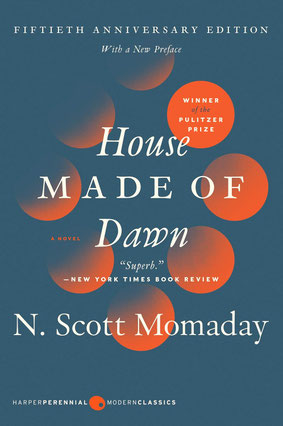
N. Scott Momaday, „House Made of Dawn”, Harper Collins Publishers Perennial Classics zum 50jährigen Erscheinen der Erstausgabe, New York 2018, 185 S., biografischer Anhang 17 S., ISBN 978-0-06-290995-4
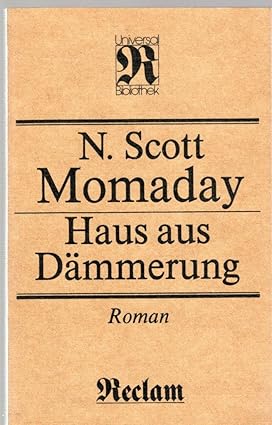
Mir hat eine deutsche Übersetzung von Jeannie Ebner vorgelegen, stellenweise etwas unkorrekt (so bei der Sex-Szene zwischen Angela und Abel), aber ansonsten einfühlsam und mitdenkend. Die deutschsprachige Ausgabe des ostdeutschen Reclam-Verlags hat den Vorteil eines Essays von Eva Manske, die nicht nur auf den Roman und auf die Biographie von Momaday eingeht, sondern die kulturelle Situation indigener Menschen in USA sowie die indigene Literatur insgesamt beleuchtet.
N. Scott Momaday, „Haus aus Dämmerung“, Reclams Universal-Bibliothek Band 1223, Verlag Philipp Reclam jun., Leipzig 1988, Lizenzausgabe des Ullstein Verlags Westberlin, der Essay von Eva Manske erschien nur bei Reclam, 221 S., ISBN 3-379-00252-6
4. Januar 2026 Copyright Christel Heybrock
Bear and Snake, Abel Runs
N. Scott Momaday’s classic novel *House Made of Dawn* (1968)
The book earned N. Scott Momaday the Pulitzer Prize in 1969 and brought him instant fame. Momaday is counted among America’s great Indigenous authors, yet critics and literary scholars have struggled to fully grasp this narrative work—one that appears poetic at first glance, yet is undeniably unsettling. American studies scholar Brigitte Georgi even wrote an entire book about the novel, which ranks among the most challenging works of Indigenous literature—though I do not know whether this difficulty is perceived only by white readers or by Indigenous people as well.
One certainly fails to grasp much if one simply reads through it casually, perhaps out of boredom. The book is difficult for several reasons. Word by word and sentence by sentence, a linguistic density emerges in which the depicted reality—particularly in the descriptions of landscapes—seems to vibrate with charged energy, all without explicitly aiming to move beyond the level of visual imagery. The same applies to the characters and their actions: the text describes, down to the finest detail, exactly what one would see if the characters were standing right there in reality. Yet, why do they act the way they do? When Abel’s grandfather Francisco picks his grandson up from the bus stop and Abel falls down, completely drunk, the bus is both seen and heard: “…its windows caught for a moment the light of the sun…”, “…its tires began to sing upon the road…”—but what does the old man think about his deranged grandson returning from the war? What is going on inside Abel, who later in Los Angeles sometimes drinks senselessly, almost with a tendency toward self-annihilation?
Part of this perspective—one that perceives the visible yet cannot fully fathom it—is the fact that various characters repeatedly step forward as temporary first-person narrators (speaking both about others and themselves). Only Abel, the novel’s protagonist, is viewed exclusively from the outside; he never speaks about himself or others—he is simultaneously revealed and withheld. One is reminded of the fundamental importance of silence in the Indigenous mindset. Words, incantations, and prayers are used not to dissect meanings, but to envelop them.
Linked to this is the central challenge for the reader: the novel’s complex structure, which reveals itself as an iridescent tapestry woven from the present, fragments of memory, myths, rituals, and the overwhelming canyon landscape of the Rio Grande Valley and the Indian pueblos of New Mexico. Viewed broadly, a continuous narrative arc does emerge—spanning Abel’s return from the war, his attempt to gain a foothold in Los Angeles after years in prison, and finally his ultimate homecoming and his grandfather’s death (which may well be followed by Abel’s own). Yet this relatively straightforward progression is repeatedly interrupted and reassembled like a mosaic through narrative segments that shift between an autonomous narrator’s perspective and the first-person voice of a character involved in the action. Often, at the start of such a passage, the reader does not know who is speaking or to whom the information should be attributed. This system goes so far that Momaday incorporates verbatim passages from his own works—*The Journey of Tai-me* and *The Way to Rainy Mountain*—into the novel. These passages concern the Kiowa origin myth and their sense of self-identity; it is somewhat surprising that such a significant element of the narrative is voiced by a figure as dubious as the peyote priest Tosamah. Consequently, he even claims Momaday’s real-life Indigenous grandmother, Aho, as his own.
A colorful festival: half Christian, half Indigenous
Chronologically, the plot unfolds in 1945—between July 20 and August 2—and in 1952, over the course of a month between January 26 and February 28. Yet, what might sound like a tightly structured narrative is anything but, owing to numerous breaks and shifts in perspective. When Abel returns home to Jemez in the Cañon de San Diego in 1945 (where Momaday spent a significant part of his childhood and youth), he has already been deeply unsettled by his wartime experiences. His grandfather Francisco—the archetype of a grounded Native American spiritually at one with the landscape—has no conception of this, and Abel remains silent; his culture holds no tradition for communicating incomprehensible horror, so he bottles it up inside and attempts to resume life as before. He has sexual encounters with, among others, Angela—a white woman from Los Angeles—and participates in the Santiago Festival. This event, a blend of Christian and Indigenous traditions, is described by Momaday in vivid detail based on personal experience, yet is also fleshed out through the perspective of Father Olguin, the local pastor, who is in possession of letters written by a morally highly questionable saintly predecessor...
The festival—during which a small horse escorts a *Porciuncula* (a statuette of the Madonna) into a church, following the prior sacrifice of a rooster and the symbolic overcoming of a bull representing pagan delusion—is no mere harmless folk entertainment, even though the visitors flocking from afar perceive it as such. The rooster—a magnificent white specimen buried neck-deep in a hollow in the ground—must be snatched up by riders at a gallop before being sacrificed. This feat is accomplished by a white outsider, a shockingly ugly albino who thus embodies "whiteness" in a concentrated form, for he is not Indigenous. In Father Olguin’s old records, his predecessor notes that the child baptized—born to Manuelita and Diego Fragua in January 1875—was an "albino whiter than any child I have seen before tho‘ it had been of the white race." This albino, who had previously behaved enigmatically and stalked Francisco while he worked in the fields at dusk (though the reason remains unclear), "sacrifices" the white rooster by pinning Abel against a house wall and repeatedly striking him in the face with the bird until it dies, splattering blood everywhere.
Yet, after the festival, Abel and the albino stand peacefully together in a bar before stepping out into the darkness. The albino attempts to attack Abel again by grappling with him, but Abel drives a knife into his body, killing him. End of Part One.
Seven Years Later in Los Angeles
Part Two takes place seven years later in the vastly different setting of Los Angeles and focuses in detail on a ceremony led by the peyote priest Reverend John Big Bluff Tosamah—Priest of the Sun, Son of Hummingbird. The events that follow—barring interruptions caused by flashbacks or shifts in location and perspective—unfold within Tosamah’s immediate and extended circle; his sleazy squalor and outbursts of violent rage stand in stark contrast to the magnificent canyon landscape and its inhabitants.
A scene of complete contrast follows seamlessly upon Tosamah’s remarks regarding the Kiowa creation myth: Abel finds himself in the dark, gravely injured on a riverbank; his hands are broken, he is in pain all over, barely able to move, and shivering with cold. Amidst his semi-consciousness, images from his life in Los Angeles keep surfacing; piecing together these glimpses—along with other details interspersed throughout the text—reveals the following: after killing the albino, Abel was sentenced to years in a Los Angeles prison following a trial he did not understand. He has since been released and is being supervised—or rather, hounded—by a rehabilitation program that secures him a factory-line job. It was likely there that he met Benally, a Native American from a different reservation who has adapted—out of necessity—to the white working world and who understands Abel. Benally repeatedly tries to mediate and keep him going. Milly, a young white woman with a troubled past, is also connected to Abel, yet he fails to put down roots. Someone from Tosamah’s circle—or perhaps several people acting together—beats Abel nearly to death. He somehow drags himself to Benally, who summons an ambulance to take him to the hospital. Once Abel has partially regained his senses, Benally takes him to the train station in the rain so he can return to the reservation.
This narrative arc, repeatedly interrupted by starkly contrasting passages, ultimately raises the question of what role violence plays in the novel. There is the war, about which nothing is revealed other than a few visual impressions from Abel’s memory. There is violence among the indigenous population of the canyon—violence born of necessity, the violence of hunters feeding their families. In one passage, a bear is killed and subsequently fed to the community. It exemplifies the characteristic relationship between indigenous hunters and "wild" animals: bear and hunter track and observe one another—almost as if in a silent dialogue—across vast distances, until the animal is killed by a gunshot.
Bear and Snake
In the novel, the bear represents a force of threatened authenticity and primal, natural energy. Angela, a white woman, associates Abel with a bear; at the moment of orgasm with him, she has a vision of a bear. Yet even before she knows Abel—when he first comes to the house to chop wood—the narrative notes: "She would have liked to touch the soft muzzle of a bear, the thin black lips, the great flat head. She would have liked to cup her hand to the wet black snout, to hold for a moment the hot blowing of the bear’s life." Years later, when Abel lies in the hospital, beaten nearly to death, Benally calls Angela—a woman he does not know. She arrives with her young son—a boy who constantly talks about Native Americans and to whom she tells the myth of the bear and the snake, both of whom mated with two sisters.
Unlike the bear, the snake possesses treacherous powers of transformation and the force of evil. After Abel kills the albino and is asked during the trial to explain his actions, he can only say that he had simply dismembered a snake—a *culebra*. For Abel, this is not murder, but a legitimate act. Martinez—a police officer from Tosamah’s circle of heavy drinkers who constantly provokes and attacks others—is also referred to as a *culebra*; is he the man who nearly killed Abel?
Momaday counters violence with a form of "soft power"—the very thing that gives the book its title: Indigenous spirituality. "House Made of Dawn" is a line from a Navajo text—a prayer, a healing song, a spiritual invocation asking for a cure that is ultimately granted:
"House made of dawn,
House made of evening light,
House made of dark cloud…
Dark cloud is at the door…
Male deity!
...I have prepared a smoke for you.
Restore my feet for me
Restore my legs for me,
Restore my body for me,
Restore my mind for me…”
Until, finally, the words are:
“… Happily I recover.
Happily my interior becomes cool. …
no longer sore, may I walk…
With lively feelings, may I walk…
Happily may I walk,
May it be beautiful before me…
In beauty it is finished.”
Benally sings this invocation for Abel—softly, at night, on a rise in the land—while, a short distance away, Tosamah’s people are celebrating. It does not save Abel, to be sure, but the weight Momaday assigns to the song demonstrates that, in Part Three—titled "The Night Chanter"—this text is juxtaposed with the near-murder of Abel as a pivotal event.
Part Four covers only February 27 and 28, 1952: Abel is in the home of his grandfather, who is dying and does not survive the night. Abel spiritually prepares the body for burial. He braids the white hair, dresses the deceased in ceremonial wine-red and white, scatters pollen and meal to the four cardinal directions, and wraps him in a blanket before leaving the house; at the break of dawn, he wakes Father Olguin, who is to conduct the funeral. Then he runs out of the village; pausing at the last house, he removes his shirt and covers his torso and arms with black ash. He is exhausted, yet he runs. The book begins with Abel running, and it ends that way. He is running toward no specific destination; the running is a spiritual state through which Abel integrates himself into the tradition of the "Dawn Runners"—a run of the dead that his grandfather had once introduced to him and that may well refer to a 17th-century Pueblo Indian rebellion against Spanish rule. However, Dawn Running is still practiced by Indigenous people today as a form of mental and physical strengthening, leaving it unclear whether Abel dies or recovers during the run.
But is it not the same thing? Is Abel, by joining the run of the dead, not—in the broadest sense—returning to his true self? Does he, like Momaday’s protagonist Locke Setman in the novel *The Ancient Child*, dissolve as an individual into myth? “He was running, and under his breath he began to sing. There was no sound, and he had no voice, he had only the words of a song. …House made of pollen, house made of dawn.”
The novel’s great circle closes between Abel’s running in the prologue and the events of February 28, 1952—and circular structures are deeply rooted in Indigenous thought. What makes *House Made of Dawn* so highly artful is its mosaic structure, in which circular forms are broken, only to close again somewhere else—whether with a shorter or longer radius. It is a book like a hoop dance; the latter, too, is not primarily about the virtuosity of dancers manipulating ten or twenty hoops of varying sizes, but is, rather, a spiritual prayer. Yet it is not only the complex structure that marks Momaday as an author of fundamentally Indigenous thought, but also the poetry of the details. This, too, is ultimately an act of devotion, akin to a prayer or an invocation.
N. Scott Momaday, *House Made of Dawn*, Harper Collins Publishers Perennial Classics (50th Anniversary Edition), New York 2018, 185 pp., 17-page biographical appendix, ISBN 978-0-06-290995-4
I consulted a German translation by Jeannie Ebner; while slightly inaccurate in places (such as the sex scene between Angela and Abel), it was otherwise sensitive and perceptive. The German-language edition published by the East German Reclam-Verlag has the advantage of including an essay by Eva Manske, who not only discusses the novel and Momaday’s biography but also sheds light on the cultural situation of Indigenous people in the USA and Indigenous literature as a whole.
N. Scott Momaday, *Haus aus Dämmerung*, Reclams Universal-Bibliothek Vol. 1223, Verlag Philipp Reclam jun., Leipzig 1988; a licensed edition from Ullstein Verlag (West Berlin)—Eva Manske’s essay appeared only in the Reclam edition; 221 pp., ISBN 3-379-00252-6
January 4, 2026 Copyright Christel Heybrock
Translation by Google