N. Scott Momaday (1934-2024)
Navarre Scott Momaday nimmt aus vielen Gründen unter den indigenen Autoren Nordamerikas eine herausragende Stellung ein. Zum einen gehört er zu den umfassend gebildeten und interessierten Autoren überhaupt - die Grundlage wurde sicherlich in seiner Kindheit gelegt: Als Sohn eines Kiowa-Malers und einer Schriftstellerin mit europäischen und Cherokee-Vorfahren, verbrachte er seine frühe Kindheit in Arizona und die Schulzeit im Schmelztiegel New Mexiko, wo der Umgang mit Navajo, Apachen, spanisch- und englischsprachigen Menschen selbstverständlich war. Auch die Ausbildung scheint umfassend gewesen zu sein: von der Militärakademie in Virginia (wo er William Faulkner und John Dos Passos kennenlernte) zur Politikwissenschaft, zu Jura und schließlich zur wissenschaftlichen Auseinandersetzung mit englischer Literatur und Lyrik.
Momaday, der mit seinem ersten Roman „House Made of Dawn“ den Pulitzer-Preis erhielt, gilt als Erneuerer indigener Literatur, beziehungsweise als deren Gründer auf moderner englischsprachiger Basis, aber er ist viel mehr als das. Sein umfassendes Weltbild basiert auf dem tief verwurzelten Bewusstsein indigener Identität, er machte sogar einen Ort aus für diese Verwurzelung: den Devil‘s Tower im Nordosten Wyomings, ein von vielen indigenen Nationen verehrtes Naturwunder, das an einen riesigen versteinerten Baumstamm erinnert. Als Säugling hatte man ihn dorthin gebracht und ihm den Namen Tsoai-talee (Rock-Tree Boy) gegeben. Der Name und der Felsen sind Bestandteil von Momadays Literatur und persönlicher Spiritualität – beides ist nicht zu denken ohne seine Beziehung zum Land und zur Erde als kreativer Instanz schlechthin.
Titel, die hier besprochen werden:
"Earth Keeper"
Der Dreier-Komplex
- The Journey of Tai-Me 1967
- The Way to Rainy Mountain 1969
- House Made of Dawn 1968
"The Ancient Child", ein Roman
"The Names", ein Memoir über Momadays Familiengeschichte
Von seinen zahlreichen Büchern möchte ich gleich hier als erstes einen schmalen Band vorstellen, der womöglich die Quintessenz seines Schaffens enthält. So unscheinbar das kleine Werk daherkommt – es ist in Sprache und Bewusstsein ebenso einfach wie vollendet:
Zu einem Ort gehören –
die bedrohte Erfüllung
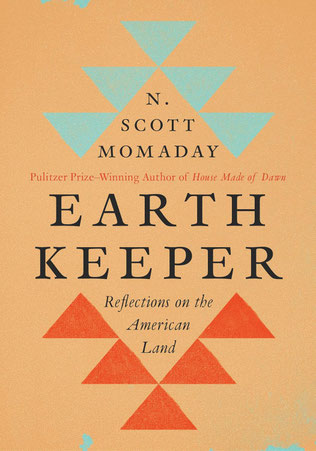
N. Scott Momaday: „Earth Keeper. Reflections on the American Land“
“Dies ist eine Art spiritueller Autobiographie”, schreibt der Kiowa-Indianer N. Scott Momaday (1934-2024) in seiner Vorbemerkung des gerade mal 65 Seiten umfassenden Bändchens. „Wenn ich über mein Leben und das meiner Vorfahren nachdenke, bin ich überzeugt, dass ich und sie zum amerikanischen Land gehören…“ Im Englischen ist das Wort „gehören“ an dieser Stelle unübersetzbar: „…that I, and they, belong to the American land. This is a declaration of belonging. And it is an offering to the earth.“ In “belonging” steckt auch das Wort “to long for” – sich sehnen, und so ist das kleine Buch eine “Zugehörigkeits-Erklärung” mit einer umfassenden Sehnsucht als Fundament.
Die Kultur der Indianer Nordamerikas, nicht nur der Kiowa, ist spirituell und zugleich real auf das Land bezogen, und „Land“ meint alles: die Erde, die Weite, die Luft, den Himmel bis hin zu den Sternen, aber auch die Steine, Tiere, Pflanzen und Menschen – alle sind lebendig, beseelt und ohne Hierarchie ebenbürtig. Wahrscheinlich hat es nie ein indigenes Volk gegeben, dessen Mitglieder das anders empfunden hätten, aber es gibt wohl auch keinen indianischen Autor, der das in einer so einfachen, klassischen, meditativen Sprache formuliert wie Momaday. Es sind Sätze, die gleichsam leise zittern in der Stille von Bildern und Empfindungen, Sätze, die in sich selber zu atmen scheinen wie die Erde, an die sie sich wenden.
Momaday hat diesen zutiefst berührenden Text in „Dawn“ und „Dusk“ gegliedert und durch ein Vorwort und einen kurzen Epilog gerahmt. Es ist erstaunlich, wie kurz und verdichtet die einzelnen Stücke jeweils sind, die meisten erreichen nicht einmal eine Seite. In der „Dawn“-Hälfte, der „Morgendämmerung“, erinnert er sich an seine Vorfahren und die eigene Kindheit, vor allem aber an den alten Indianer Dragonfly (Libelle), den er gar nicht gekannt und von dem nur der Vater erzählt hat: Wie Dragonfly sich frühmorgens, das Haar geflochten und das Gesicht bemalt, auf einen Hügel stellte und mit erhobenen Armen betend den neuen Tag begrüßte: „… and a bird sang from the dawn. This happened a long time ago. I was not there. My father was there when he was a boy. He told me of it. And I was there.”
Es ist die mythische Bewusstseinsebene von Momadays Sprache, und sie ist identisch mit Poesie schlechthin. Poesie nicht nur als ästhetische Magie, sondern als Instanz, die Grenzen zwischen Traum und Realität bewusst überschreitet. Das magische Bewusstsein, das auf dieser Grenze balanciert wie der Artist auf dem Seil, scheint seine Stärke und seine Ruhe eben aus beiden Welten zu beziehen und daraus eine unerschütterliche Sicherheit zu gewinnen. Die bewundernswerte Resilienz, mit der die fast ausgerotteten Völker Nordamerikas den Kopf heben und auf dem „Wir sind noch da“ bestehen, hat eine ihrer Wurzeln sicherlich aus der Gewissheit, dass die zersplitterte Realität der Weißen eben nicht die ganze Realität ist.
Im Textteil „Dusk“ (Abenddämmerung) setzt sich Momaday auch damit auseinander, mit der Zerstörung der Erde als eines mythischen Organismus. In kurzen, blitzartig aufscheinenden Sätzen tritt „weißes“ Handeln auf als das, was es ist: verantwortungslos. Momaday beobachtet ein Wapiti, das in schneebedeckter Landschaft hervor tritt und in einem Wald verschwindet – ein Bild von unaussprechlicher Schönheit. „Am nächsten Morgen hörte ich das Kreischen von Kettensägen in der Ferne“, fügt er lakonisch hinzu. Er ruft die Jahrzehnte zurück, in denen sein Volk fast verhungerte, nachdem weiße Siedler den Büffel ausgerottet hatten: „Es war eine Zeit tiefer Scham … aber die Erde verlangt keine Scham, sie will Liebe.“
Wie sieht Momaday aus dem „Dusk“ heraus die Zukunft? „Der Planet erwärmt sich, das Eis des Nordens schmilzt… Tausende von Arten wurden ausgerottet, unsere eigene Art ist bedroht. Die Erde und ihre Bewohner befinden sich in einer Krise, und im Zentrum ist es eine moralische Krise. Der Mensch ist dabei, seine Menschlichkeit über Bord zu werfen.“ Das vielleicht Erstaunlichste: Momaday sieht den verhängnisvollen Prozess mit nüchterner Klarheit und bleibt doch völlig unangefochten bei sich selbst. Sein indianischer Name „Felsen Baum Junge“ (Rock-Tree Boy, auf Kiowa: Tsoai-talee) ist mehr als eine Bezeichnung, er ist seine Identität: „and I will carry that name to the end of the world and beyond… I will tell the ancient stories and I will sing the holy songs. I belong to the land.”
Man liest diese kurzen Texte nicht aus, ihre Schönheit ist wie ein Atem, der einen sanft berührt, wie eine leise Stimme, die zu tieferem Sehen auffordert. Es ist die Quintessenz von Momadays Schreiben überhaupt.
HarperCollins, New York 2020, 65 S., ISBN 978-09-06-300933-2
21. Dezember 2021 Copyright Christel Heybrock
N. Scott Momaday (1934–2024)
Navarre Scott Momaday holds a preeminent position among North American Indigenous authors for many reasons. For one, he ranks among the most broadly educated and intellectually curious of writers—a foundation surely laid during his childhood. The son of a Kiowa painter and a writer of European and Cherokee ancestry, he spent his early years in Arizona and his school days in the cultural melting pot of New Mexico, where daily interaction with Navajo, Apache, Spanish, and English speakers was a matter of course. His education was equally extensive: ranging from a military academy in Virginia (where he encountered William Faulkner and John Dos Passos) to political science, law, and, ultimately, the scholarly study of English literature and poetry.
Momaday, who won the Pulitzer Prize for his debut novel *House Made of Dawn*, is regarded as a renovator of Indigenous literature—or rather, as the founder of a modern, English-language tradition within it—yet he is far more than that. His expansive worldview is rooted in a deep-seated awareness of Indigenous identity; he even identified a specific site for this rootedness: Devil’s Tower in northeastern Wyoming. This natural wonder, revered by many Indigenous nations, resembles a colossal petrified tree trunk. He was taken there as an infant and given the name Tsoai-talee (Rock-Tree-Boy). Both the name and the rock formation are integral to Momaday’s literature and personal spirituality—neither of which can be conceived apart from his connection to the land and to the earth as the ultimate creative force.
Titles discussed here:
"Earth Keeper"
The trilogy
"The Ancient Child," a novel
"The Names," a memoir about Momaday’s family history
Among his numerous books, I would like to begin by introducing a slim volume that arguably encapsulates the essence of his work. Unassuming though this small piece may appear, its language and sensibility are as simple as they are consummate:
Belonging to a Place – A Threatened Fulfillment
N. Scott Momaday: *Earth Keeper: Reflections on the American Land*
“This is a kind of spiritual autobiography,” writes the Kiowa Native American N. Scott Momaday (1934–2024) in the preface to this slim volume of just 65 pages. “When I reflect on my life and that of my ancestors, I am convinced that I, and they, belong to the American land...” The English word “belong” carries a nuance that is untranslatable here: it contains the concept of “longing”—a deep yearning—making this small book a declaration of belonging founded upon a profound sense of longing.
The culture of North American Native peoples—not just the Kiowa—is rooted in the land, both spiritually and tangibly. “Land” here encompasses everything: the earth, the vast expanses, the air, and the sky reaching up to the stars, as well as the stones, animals, plants, and human beings. All are alive, possessed of a spirit, and equal, without hierarchy. There has likely never been an indigenous people whose members felt otherwise, yet there is arguably no Native American author who articulates this in language as simple, classic, and meditative as Momaday’s. These are sentences that seem to tremble softly amidst the stillness of images and sensations—sentences that appear to breathe, much like the earth to which they are addressed.
Momaday has structured this deeply moving text into sections titled “Dawn” and “Dusk,” framing them with a preface and a brief epilogue. It is remarkable how concise and distilled the individual pieces are; most do not even span a full page. In the "Dawn" section, he recalls his ancestors and his own childhood—but above all, the old Native American Dragonfly, whom he never actually knew and only heard about from his father: how Dragonfly would stand on a hill at daybreak—hair braided, face painted—and greet the new day in prayer with upraised arms: "… and a bird sang from the dawn. This happened a long time ago. I was not there. My father was there when he was a boy. He told me of it. And I was there."
This represents the mythical level of consciousness in Momaday’s language—a language that is poetry in its purest form. It is poetry not merely as aesthetic magic, but as a force that consciously transcends the boundaries between dream and reality. This magical consciousness—balancing on that boundary like an acrobat on a tightrope—seems to draw its strength and serenity from both worlds, gaining an unshakable sense of certainty in the process. The admirable resilience with which the nearly exterminated peoples of North America lift their heads and insist, "We are still here," surely stems in part from the conviction that the fragmented reality of the white man is not the whole of reality.
In the "Dusk" section, Momaday also grapples with the destruction of the Earth—viewed as a mythical organism. In brief, lightning-flash sentences, "white" actions are revealed for what they are: irresponsible. Momaday observes an elk emerging into a snow-covered landscape and vanishing into a forest—an image of ineffable beauty. "The next morning, I heard the whine of chainsaws in the distance," he adds laconically. He recalls the decades when his people nearly starved after white settlers wiped out buffalo: “It was a time of profound shame… but the earth dos not want shame. It wants love.”
How does Momaday view the future from the vantage point of “Dusk”? “The planet is warming, and the northern ice is melting… Thousands of species have been destroyed. Our own is at imminent risk. The earth and its inhabitants are in crisis, and at the center it is a moral crisis. Man stands to repudiate his humanity.” Perhaps most astonishing of all: Momaday views this disastrous process with sober clarity, yet remains completely centered within himself. His Native American name, “Rock-Tree Boy” (Kiowa: *Tsoai-talee*), is more than a label; it is his identity: “and I will carry that name to the end of the world and beyond… I will tell the ancient stories and I will sing the holy songs. I belong to the land.”
One does not simply finish reading these short texts; their beauty is like a breath that gently touches you, like a quiet voice urging you to see more deeply. It is the very essence of Momaday’s writing
HarperCollins, New York 2020, 65 pp., ISBN 978-09-06-300933-2
December 21, 2021 Copyright Christel Heybrock
Translations by Google