Die Orte widerstehen der Zeit
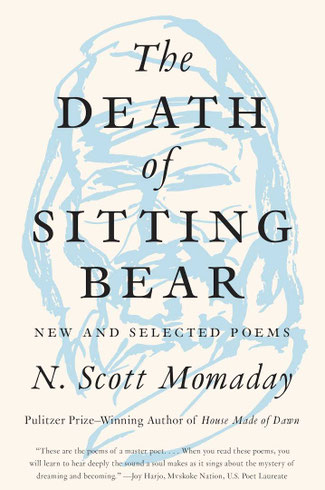
N. Scott Momaday: „The Death of Sitting Bear" , new and selected poems
Scroll down for English version
Rund 200 Gedichte und Prosatexte, darunter rund 20, die bereits in früheren Publikationen erschienen - Kiowa-Autor Scott Momaday hat in diesem schön gestalteten Band erneut die Poesie und Tiefgründigkeit indigener Welterfahrung formuliert: seine Sicht auf das menschliche und das Leben überhaupt, auf Erde, Kosmos – und in kurz aufblitzenden Fragmenten auf andere Kulturen einschließlich der weißen Zivilisation. Momaday ist ein umfassend interessierter, gebildeter und belesener Autor, der sich mitten in diesem reichen Gedankenumfeld stets seiner mythischen Wurzeln bewusst ist.
Da trifft klassisches indigenes Denken auf die grundsätzlich rationale, fremde Perspektive anderer Zivilisationen, bei denen Fantasie und Imagination stets separate Kategorien bilden. Für Momaday jedoch sind beispielsweise die Stimmen seiner Kinder immer noch anwesend an dem Ort, an dem sie einst spielten: „Now when I go by, they are there.“ Denn Orte widersetzen sich der Zeit – sie speichern die Anwesenheit von Menschen, sie speichern Ereignisse über potentiell unendliche Dauer hinweg – die Orte vergessen nichts.
Für Momaday sind atmosphärische Kräfte wie Sturm, Regen, Gewitter, Nacht und Tageslicht lebendige Energien und Äußerungen der Erde als eines Lebewesens. Diese Wahrnehmung von umfassender Differenziertheit hat nichts Idyllisches, Romantisches an sich und ist gleichwohl erfüllt von intensiver Schönheit. Das Titelgedicht, verbunden mit einem kurzen erläuternden Prosatext, ist eine Würdigung des großen Kiowa-Kriegers Sitting Bear (1800-1871, nicht zu verwechseln mit dem Lakota-Sioux-Häuptling Sitting Bull), ausgehend von einem historischen Foto. Auch hier die irritierende Auffassung indigenen Denkens – der Krieger als ein Mann in herausgehobener Position, weil er nicht nur tötet, sondern vor allem selbst seinen Tod akzeptiert und bereit ist, sein Leben zu opfern.
Indigenes Denken reicht tief hinab in physischen Schmerz und Tod, in die Ambivalenz alles Lebenden, es ist eine Haltung jenseits von Eskapismus, in der auch feinste Wahrnehmungen zwischenmenschlicher Bindungen und Konflikte ihren Platz haben. Einige sehr einfach zu lesende Gedichte formulieren mit scheinbar banaler Beiläufigkeit die innige Liebe zwischen Mann und Frau: „“I give you sweetgrass/ That you may burn it/ That smoke may touch you…/That the medicine smoke of sweetgrass/ May welcome me to you!“
In dem Zyklus „A Century of Impressions“, der aus 50 jeweils dreizeiligen Strophen besteht (eine formale Strenge, die Momadays Formbewusstsein deutlich macht) ist ebenfalls von Sweetgrass die Rede, aber es ist eine Rundumsicht auf den Zyklus der Natur und den des menschlichen Lebens, in dem auch eine technische Umwelt eingebunden ist. Der Zyklus endet mit der hinreißend einfachen Andeutung von Sehnsucht: „when you went away/ I burned sweetgrass and cedar/ when will you return“. Das Fortgehen – das Brennen – das Verlangen nach Wiederkehr, die noch nicht stattgefunden hat – es ist eine der charakteristischen Kreisbewegungen indigenen Denkens.
Und welch widersprüchliche Nuancen sich in einer menschlichen Bindung äußern, lässt sich nach langsamem, mitdenkendem Lesen in dem ebenso einfachen wie komprimierten Gedicht „Octave“ entdecken. Vier „Strophen“ von jeweils nur zwei Zeilen, denn es geht um zwei Personen, die miteinander durchs Leben gehen und damit eine „Oktave“ herstellen. Schon in der ersten Doppelzeile stockt einem der Atem: „There have been broken promises, a few,/ And semblances of innocence seen through.“ Was denn – gebrochene Versprechen, hinter denen dennoch Unschuld durchscheint? Welche Beziehung könnte da anders sein - es ist pure Realität in zwei simplen Zeilen. Und das letzte Zeilenpaar: „I wish us well and take your tender hand/ As we approach an unfamiliar land.“ Das Wagnis, sich in unvertraute Zukunft zu begeben, indem man mit einer geliebten Person vorangeht – ein unabsehbares Risiko, aber es ist unumgänglich. Momadays Lyrik beschwört die vibrierende Fülle aller Lebensrealitäten, wie sie in indigenem Bewusstsein präsent sind.
Mit Illustrationen von N. Scott Momaday, 167 S., HarperCollins, New York 2020, ISBN 9780062961150
27. April 2023 Copyright Christel Heybrock
Places Withstand Time
N. Scott Momaday: *The Death of Sitting Bear* – New and Selected Poems
In this beautifully designed volume, Kiowa author Scott Momaday has once again articulated the poetry and profundity of the Indigenous experience of the world—encompassing his view of human existence and life in general, of the earth and the cosmos, and, in brief, fleeting glimpses, of other cultures, including white civilization. Momaday is an author of wide-ranging interests and deep learning who, amidst this rich intellectual landscape, remains constantly aware of his own mythical roots.
Here, traditional Indigenous thought encounters the fundamentally rational, alien perspective of other civilizations—cultures in which fantasy and imagination are treated as distinct categories. For Momaday, however, the voices of his children remain present at the very spot where they once played: "Now when I go by, they are there." For places withstand the passage of time; they preserve the presence of human beings and store events over a potentially infinite duration—places forget nothing.
To Momaday, atmospheric forces such as storms, rain, thunder, night, and daylight are living energies—expressions of the earth as a living being. This perception of profound complexity holds nothing idyllic or romantic, yet it is imbued with intense beauty. The title poem—accompanied by a brief explanatory prose piece—pays tribute to the great Kiowa warrior Sitting Bear (1800–1871; not to be confused with the Lakota Sioux chief Sitting Bull), drawing inspiration from a historical photograph. Here, too, we encounter the striking perspective of Indigenous thought—the warrior as a man of elevated status, not merely because he kills, but above all because he accepts his own death and is prepared to sacrifice his life.
Indigenous thought delves deep into physical pain and death, into the ambivalence of all living things; it is an attitude far removed from escapism, one that makes room for the subtlest perceptions of interpersonal bonds and conflicts. Some highly accessible poems articulate the profound love between man and woman with seemingly casual simplicity: “I give you sweetgrass / That you may burn it / That smoke may touch you… / That the medicine smoke of sweetgrass / May welcome me to you!”
The cycle “A Century of Impressions”—comprising fifty three-line stanzas, a formal rigor that highlights Momaday’s sense of structure—also speaks of sweetgrass, yet it offers a panoramic view of the cycles of nature and human life, encompassing even the technological environment. The cycle concludes with a breathtakingly simple expression of longing: “when you went away / I burned sweetgrass and cedar / when will you return.” Departure, burning, the yearning for a return that has not yet occurred—this embodies one of the characteristic circular movements of Indigenous thought.
And the contradictory nuances inherent in a human bond reveal themselves—after a slow, contemplative reading—in the poem “Octave,” a work as simple as it is condensed. It consists of four “stanzas” of just two lines each, reflecting the two people moving through life together and thereby creating an “octave.” The very first couplet takes one’s breath away: “There have been broken promises, a few, / And semblances of innocence seen through.” What is it, then—broken promises through which innocence nonetheless shines? What relationship could be any different? It is pure reality captured in two simple lines. And the final couplet: “I wish us well and take your tender hand/ As we approach an unfamiliar land.” The act of venturing into an unknown future by moving forward with a loved one—an incalculable risk, yet an inevitable one. Momaday’s poetry evokes the vibrant richness of all life’s realities as they exist within Indigenous consciousness.
With illustrations by N. Scott Momaday, 167 pp., HarperCollins, New York 2020, ISBN 9780062961150
April 27, 2023 Copyright Christel Heybrock
Translation by Google
Wörter, Träume, Beschwörungen
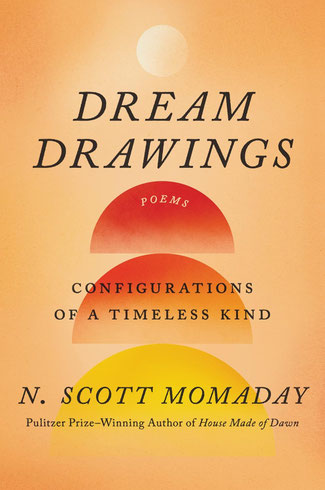
N. Scott Momaday „Dream Drawings. Configurations of a Timeless Kind“
Scroll down for English version
Die „poems“ und Texte in diesem schmalen Band von gerade mal 110 Seiten sind so fern vom Wirklichkeitsverständnis der westlichen Zivilisation, wie es indigene Literatur nur eben sein kann – Momaday ist Kiowa-Indianer mit tiefer, sehr bewusster Verwurzelung in indigenem Denken. Als weißer Leser steht man davor, schüttelt manchmal ratlos den Kopf und sagt sich zugleich: „Mein Gott, ist das schön!“
Momaday stößt vor bis zu den Ursprüngen von Sprache überhaupt – zur magischen Funktion von Wörtern, zu Beschwörungen, zum dauerhaften Festhalten magischer Vorkommnisse durch Sprache, zur Menschwerdung durch Sprache: „We became human when we acquired language“, aber die Basis der Wörter liegt noch tiefer: „I could tell you a story without words. I could look you a story in the eyes.“ Die Basis der Wörter ist die Energie des Irrationalen, des Unerklärlichen, des Lebens schlechthin, eines Stroms, der alles durchzieht, alles mit sich nimmt und alles prägt. Eine Energie, die zwar gespürt und durch Wörter eingefangen werden kann, aber nicht rational verstehbar ist und das auch nicht sein muss.
Eine der grundsätzlichen Fähigkeiten indigenen Denkens ist die Gleichsetzung von Imagination und Realität. So heißt es in dem Text „The Spiritual Gravity of Place“ (S. 6): „I have been there, though I have not…“ , und an anderer Stelle: „I know these voices as well as I know my own, for I have heard them in my dreams.“ Realität und Mythos sind eins, geheimnisvolle Gestalten können wahrgenommen werden von Lebenden, obwohl sie nicht real, aber dennoch existent sind und reale Auswirkungen auf das Leben haben. Und es geht auch um eben diese Auswirkungen: Vergangene, vor der Geburt einer lebenden Person liegende Ereignisse treten wie in einer Spiralbewegung plötzlich wieder hervor und prägen aktuelles Geschehen. Das Denken, die Wahrnehmung, das Bewusstsein scheinen sich in einer ewigen Rotation zu drehen, zu verschwinden, wiederzukehren. Das betrifft selbst die Wörter: „Had they not been preserved in writing, it is perhaps of no matter…“, denn das einmal Gedachte, Gesprochene hat sich wie ein Schwarm in die Luft erhoben und wird wieder hörbar „in times of need“ – in Zeiten der Not, denn es sind die magischen Wörter, deren heilende Energie hilft.
Die Definition eines Ursprungs beschäftigt Momaday immer wieder. Der Ursprungsmythos der Kiowa? „The realm of dreams. It is the original place, the place of beginning.“ Und an anderer Stelle: „The story does not end. Rather it evolves on a wheel of telling. It begins again. In like manner, dreams do not end…“ Auch was die indigene Kunst des Geschichtenerzählens betrifft, sieht Momaday einen Ursprung – es gebe eine Art Urerzählung, zeitlos und universal: „…there is only one story, it is timeless and universal, and … it is composed of many stories in the one.“ Aus dieser Definition wird auch klar, wieso er Gedichte und kurze Prosatexte in diesem Band als gleichwertig zusammenfügt (sie sind nicht immer gleichwertig, es gibt durchaus auch Flachstellen), aber seine Texte seien „fragments of the original story, that which is told in the landscape of words and dreams“. Wenn Magie die Beschwörung von Kräften ist, die nicht verfügbar sind, dann ist Momadays Lyrik von magischer Energie durch die Intensität ihrer Sprache.
Aber Momaday ist nicht nur Geschichtenerzähler, Lyriker und „Magiker“, sondern auch Zeichner mit eigenartigem Duktus. Seine Figuren – Tiere, Menschen – erscheinen dunkel, massig, aber unscharf in ihrer Begrenzung und wie hingewischt, als verschwänden sie vorm Auge des Betrachters als ungreifbare, vorbeiziehende Schemen. „Dream Drawings“ – das Wort für Zeichnung – drawing – erweist seinen Doppelsinn, das Ziehen, Herbeiziehen, vielleicht auch das Vorbeiziehen… magischer Kräfte.
Mit Illustrationen von N. Scott Momaday, 107 S., Harper Perennial, New York 2022, ISBN 978-0-06-321811-6
14. April 2023 Copyright Christel Heybrock
Words, Dreams, Incantations
N. Scott Momaday: *Dream Drawings: Configurations of a Timeless Kind*
The poems and texts in this slim volume of barely 110 pages are as far removed from Western civilization’s understanding of reality as indigenous literature can possibly be—Momaday is a Kiowa Indian with deep, highly conscious roots in indigenous thought. As a white reader, one stands before them, sometimes shaking one’s head in bewilderment, while simultaneously thinking: "My God, how beautiful this is!"
Momaday delves into the very origins of language—the magical function of words, incantations, the preservation of magical occurrences through language, and the process of becoming human through language: "We became human when we acquired language." Yet the foundation of words lies even deeper: "I could tell you a story without words. I could look you a story in the eyes." The foundation of words is the energy of the irrational, the inexplicable, of life itself—a current that permeates, carries along, and shapes everything. It is an energy that can be sensed and captured in words, yet cannot be rationally understood—nor does it need to be.
One of the fundamental capacities of indigenous thought is the equation of imagination with reality. As the text "The Spiritual Gravity of Place" (p. 6) states: "I have been there, though I have not..." and elsewhere: "I know these voices as well as I know my own, for I have heard them in my dreams." Reality and myth are one; mysterious figures can be perceived by the living—figures that, while not "real" in the conventional sense, nonetheless exist and exert real effects on life. And it is precisely these effects that matter: events from the past—predating the birth of a living person—suddenly re-emerge, as if in a spiral movement, to shape current events. Thought, perception, and consciousness seem to spin in an eternal rotation—vanishing and returning. This applies even to the words: "Had they not been preserved in writing, it is perhaps of no matter..." For once a thought has been conceived or a word spoken, it rises into the air like a swarm, becoming audible again "in times of need"—for it is these magical words whose healing energy provides aid.
Defining an origin is a recurring theme for Momaday. The Kiowa origin myth? "The realm of dreams. It is the original place, the place of beginning." And elsewhere: "The story does not end. Rather it evolves on a wheel of telling. It begins again. In like manner, dreams do not end..." Momaday also perceives an origin within the indigenous art of storytelling—a kind of primal narrative, timeless and universal: "...there is only one story, it is timeless and universal, and ... it is composed of many stories in the one." This definition clarifies why he combines poems and short prose pieces in this volume as equals (though they are not always of equal quality; there are certainly some lackluster passages); yet he views his texts as "fragments of the original story, that which is told in the landscape of words and dreams." If magic is the conjuring of forces otherwise unavailable, then Momaday’s poetry is imbued with magical energy through the sheer intensity of its language.
Yet Momaday is not merely a storyteller, poet, and "magician," but also a draftsman with a distinctive style. His figures—animals and humans alike—appear dark and massive, yet their outlines are blurred and seemingly sketched with a sweeping stroke, as if they were vanishing before the viewer's eyes like intangible, passing apparitions. "Dream Drawings" – the word for *Zeichnung*—*drawing*—reveals its double meaning: the act of drawing, of drawing something in, or perhaps even the passing by... of magical forces.
With illustrations by N. Scott Momaday, 107 pp., Harper Perennial, New York 2022, ISBN 978-0-06-321811-6
April 14, 2023 Copyright Christel Heybrock
Translation by Google