Ein Volk findet sich bei seiner Wanderung
N. Scott Momaday: „The Way to Rainy Mountain” 1968
Deutsch: “Der Weg zum Regenberg” 1991
Scroll down for Englsh version
An die Vorstellung muss man sich als weißer, sesshafter Europäer erstmal gewöhnen, dass ein ethnischer Verband zum Volk wird und seine kulturelle Identität entwickelt – durch Migration. Kiowa-Schriftsteller Scott Momaday ist Mitglied dieses Volkes, und die Wanderung seiner Vorfahren vom kahlen, kalten Norden des amerikanischen Kontinents nach Süden und Osten in Gegenden, in denen die Menschen aufblühen und sich finden konnten, hat ihn immer fasziniert. Was ihn als Autor groß gemacht hat, ist eben das Hinabtauchen in die Mythen und Geschichten, die auf dieser Wanderung zum „Rainy Mountain“ entstanden.
Sicherlich verfolgten die Menschen zunächst kein festes Ziel, sondern eine unbestimmte Suche, und außer dem täglichen Überlebenskampf waren es Sprache und Geschichten, die sie miteinander verbanden. Als europäischer Leser könnte man den „Rainy Mountain“ als poetischen Namen für einen fiktiven Ort auffassen, aber das ist er nicht. Die Wirklichkeitsauffassung der nordamerikanischen Indigenen ist oft mit Poesie identisch. Wünsche, Träume und ein Begriff von Schönheit sind etwas, was nicht erfunden oder ausgedacht wird, sondern sich als natürliche Ebene existierender Dinge erweist. Insofern: Der „Rainy Mountain“ ist ein separat sich erhebender Hügel nordwestlich der teils abenteuerlich zerklüfteten Wichita Mountains in Oklahoma. Als dominanter Einzelfelsen ist er für viele Plains-Indianer eine geografische und zugleich mythische Landmarke.
Aber auch der seltsame Ursprungsmythos der Kiowa resultiert offenbar aus der realen Notwendigkeit ihrer Migration, nämlich aus Kälte und Enge – sie seien einer nach dem andern aus einem hohlen Holzklotz oder Baumstamm gekrochen („a hollow log“), bis eine schwangere Frau darin feststeckte und niemand sonst mehr herauskam, daher seien die Kiowa ein zahlenmäßig kleines Volk geblieben. Und selbst auf ihrer Wanderung kamen sie in prekäre Situationen:
„Long ago there were bad times,“ schreibt Momaday. “The Kiowas were hungry and there was no food.” Auf der Suche nach Nahrung für seine weinenden Kinder kam ein Mann durch einen Cañon, als plötzlich Blitz und Donner ausbrachen, und eine Stimme fragte: „Warum verfolgst du mich? Was willst du?“ Der erschrockene Mann sah sich vor einem Wesen mit Hirschfüßen und gefiedertem Körper und antwortete, die Kiowa seien hungrig. „Take me with you“, sagte das Wesen, „and I will give you whatever you want.” Es war Tai-me, und es hielt nicht nur dieses Versprechen, sondern auch das kleine Volk zusammen, das in der Verehrung von Tai-me seinen zentralen Mythos fand – die Kraft des Überlebens, den Glauben an sich selbst.
Das schmale Buch „The Way to Rainy Mountain” präsentiert alle Geschichten noch einmal, die Momaday in “The Journey of Tai-me” gesammelt hatte, und setzt sie in Bezug zu historischen Ereignissen und seinen eigenen Erlebnissen, so dass hinüber und herüber ein dichtes Netz an Mythen, Geschichte und persönlicher Erfahrung gewebt wird. Ein Netz, das sich dennoch verblüffend einfach und übersichtlich vorm Leser ausbreitet – Nachdenken und Beziehungen knüpfen muss er schon selber.
Jedes der 24 Themen ist nur eine Doppelseite lang, wobei auf der linken Seite der Mythos referiert wird, während die rechte Seite geteilt ist in zwei kurze Absätze in unterschiedlichen Satzzeichen: die historischen Fakten in Normalsatz, Momadays persönliche Äußerung kursiv. Dieser ganze Komplex wird von einem Prolog und einem Epilog gerahmt und ist selber in drei Abteilungen gegliedert: „The Setting Out“ (der Aufbruch), „The Going On“ (Wanderung und Reife) und schließlich „The Closing In“ (das Ende) - womit keine ruhige, stabile Sesshaftigkeit gemeint ist, sondern das durch die brutale Kolonisation verursachte Scheitern, der Abstieg von dem rund ein Jahrhundert dauernden Höhepunkt als Nation.
Sowohl die äußere als auch die innere Struktur der kurzen Kapitel unterliegt einer Dreiteilung, wobei die äußere Teilung in drei Kapitel für Übersicht, die innere Dreiteilung auf jeweils einer Doppelseite jedoch für eine subtile Vernetzung sorgt. Dabei ist, wie gesagt, der Leser gefragt, der selbst die Beziehungen knüpfen muss, etwa so (Kapitel XV):
- zwischen der Geschichte, in der Many Bears‘ Frau ihre Familie verlässt wegen des jungen Kriegers Quoetotai
– der Erwähnung des Malers George Catlin, der 1834 zu den Kiowa kam und von der klassischen Größe und Schönheit der Männer fasziniert war
– und Momadays persönlicher Betrachtung eines solchen Catlin-Porträts, einer Betrachtung, die selbst wieder mit einer Imagination schließt: „Diesen Mann möchte ich sehen wie Catlin ihn erblickte, wenn er auf mich zukommt oder in der Ferne schreitet und sich allein gegen den Himmel erhebt.“
Die Verknüpfung dieser drei Stufen im Kopf des Lesers macht die mythischen Geschichten lebendig, die ja viele unlösbare Irrealitäten enthalten. Durch die kurzen historischen Konnotationen bekommen sie einen gewissen realen Hintergrund - aber Momadays persönliche Reaktionen darauf sind von großer Poesie und Vorstellungskraft, in ihren Schlussbemerkungen oft an die staunenswerte Energie von japanischen Dreizeilen-Haikus erinnernd. Das, was einst prähistorische Imagination war, wird über die Stufe historischer Realität schließlich wieder zu Imagination – auf anderer, nämlich poetisch-literarischer Ebene.
Wer sich auf diese Stufen des Mitdenkens einlässt, wird es vielleicht angenehm finden, dass alle mythischen Geschichten in „The Way to Rainy Mountain“ bereits wörtlich im “Tai-me“-Band erzählt werden und nicht mehr unbekannt sind. Darüber hinaus hat Momaday Teile seiner Einführungstexte seitenweise wörtlich wiederholt im Nachfolgeroman “House Made of Dawn“, in dem es ein, wenn auch kompliziert strukturiertes, fortlaufendes Geschehen gibt - es ist also gerechtfertigt, die drei Bücher zusammen zu sehen als ein Gesamtwerk in drei sich verdichtenden Stufen.
Momaday, der seine literarische und persönliche Existenz aus der Kiowa-Nation und ihren Menschen bezieht und intensiv auch aus der Geschichte seiner Familie, hat „The Way to Rainy Mountain“ seinen Eltern gewidmet, Al und Natachee, einem Maler und einer Schriftstellerin. Wobei Al mit seinen ganzseitigen Schwarzweiß-Illustrationen wesentlichen Anteil an einer Vorstellung der Mythen hat: Großmutter Spinne etwa mit ihren acht pelzigen Beinen oder der in ein (elegant-schauriges) Krokodil verwandelte Bruder, der unvorsichtig etwas Fremdes gegessen hat – das Motiv taucht als beunruhigende Erscheinung bei Momadays Großvater Mammedaty in anderer Form wieder auf. Diese expressiven Illustrationen (Linolschnitte? Holzschnitte?) sind stilistisch von Momadays eigenen Zeichnungen völlig verschieden und faszinieren nicht durch traumhafte Unschärfen oder halbtransparente Überlagerungen, sondern durch schwungvolle Konturenschärfe.
A People Finds Itself Through Migration
N. Scott Momaday: *The Way to Rainy Mountain* (1998)
As a white, sedentary European, one must first get used to the idea that an ethnic group becomes a people—and develops its cultural identity—through migration. Kiowa writer Scott Momaday is a member of this people, and he has always been fascinated by his ancestors' migration from the barren, cold north of the American continent toward the south and east—into regions where the people could flourish and discover their identity. What distinguishes him as an author is precisely his immersion in the myths and stories that emerged during this journey to "Rainy Mountain."
To be sure, the people initially pursued no fixed destination, but rather an undefined quest; aside from the daily struggle for survival, it was language and stories that bound them together. A European reader might interpret "Rainy Mountain" as a poetic name for a fictional place, but it is not. For North American Indigenous peoples, the perception of reality is often synonymous with poetry. Desires, dreams, and concepts of beauty are not things that are invented or fabricated; rather, they reveal themselves as a natural dimension of existing things. In this sense, "Rainy Mountain" is a solitary hill rising northwest of the Wichita Mountains in Oklahoma—a range characterized by its dramatically rugged terrain. As a dominant, standalone landform, it serves as both a geographical and a mythical landmark for many Plains Indians.
Yet the Kiowa’s peculiar origin myth also evidently stems from the very real necessity of their migration—specifically, the pressures of cold and overcrowding. Legend has it that they crawled out of a hollow log one by one until a pregnant woman became stuck inside, preventing anyone else from emerging; this is said to explain why the Kiowa remained a small people. Even during their migration, they encountered precarious situations:
“Long ago there were bad times,” writes Momaday. “The Kiowas were hungry and there was no food.” While searching for food for his weeping children, a man was passing through a canyon when lightning and thunder suddenly erupted and a voice asked, “Why are you following me? What do you want?” Startled, the man found himself facing a being with the feet of a deer and a feathered body; he replied that the Kiowa were hungry. “Take me with you,” the being said, “and I will give you whatever you want.” It was Tai-me, and it kept not only that promise but also held together the small tribe, which found its central myth—the power of survival and belief in itself—in the veneration of Tai-me.
The slim volume *The Way to Rainy Mountain* presents all the stories Momaday had previously collected in *The Journey of Tai-me*, placing them in the context of historical events and his own experiences. In doing so, it weaves a dense web of myth, history, and personal experience—a web that nonetheless unfolds before the reader with astonishing simplicity and clarity, leaving it to the reader to reflect and draw connections.
Each of the twenty-four topics spans just a single double-page spread: the myth is recounted on the left-hand page, while the right-hand page is divided into two short paragraphs distinguished by typography—historical facts appear in standard type, whereas Momaday’s personal reflections are in italics. This entire complex is framed by a prologue and an epilogue and is itself divided into three sections: "The Setting Out" (the departure), "The Going On" (journey and maturation), and finally "The Closing In" (the end)—referring not to a state of calm, stable settlement, but rather to the failure caused by brutal colonization and the decline from a national zenith that lasted roughly a century.
Both the external and internal structures of the short chapters follow a tripartite pattern; the external division into three chapters provides an overview, while the internal three-part structure—spanning a double-page spread in each instance—creates subtle interconnections. As noted, this requires the reader to forge the connections themselves—for example, in Chapter XV:
– between the story in which Many Bears’ wife leaves her family for the young warrior Quoetotai
– the mention of the painter George Catlin, who visited the Kiowa in 1834 and was fascinated by the men’s classical stature and beauty
– and Momaday’s personal contemplation of one such Catlin portrait, a reflection that itself concludes with an act of imagination: "I would like to see this man as Catlin saw him, as he approaches me or strides in the distance, standing alone against the sky."
Linking these three levels in the reader’s mind brings the mythical stories to life—stories that are, in many ways, inextricably containing elements of the unreal. Brief historical allusions lend them a certain grounding in reality—yet Momaday’s personal responses to them are imbued with great poetry and imagination; his concluding remarks often evoke the astonishing energy of Japanese three-line haikus. What began as prehistoric imagination passes through the stage of historical reality only to return to the realm of imagination—albeit on a different, specifically poetic-literary level.
Readers willing to engage with these successive layers of reflection may appreciate the fact that all the mythical tales in *The Way to Rainy Mountain* are recounted verbatim in the *Tai-me* volume, meaning they are already familiar. Furthermore, Momaday repeats portions of his introductory texts—sometimes word-for-word, page after page—in his subsequent novel, *House Made of Dawn*, which features a continuous (albeit complexly structured) narrative; it is therefore justifiable to view the three books as a unified body of work comprising three stages of increasing depth.
Momaday—who derives his literary and personal identity from the Kiowa nation and its people, as well as deeply from his own family history—dedicated *The Way to Rainy Mountain* to his parents, Al and Natachee, a painter and a writer respectively. Al’s full-page black-and-white illustrations play a crucial role in visualizing these myths: for instance, Grandmother Spider with her eight furry legs, or the brother transformed into an (elegantly eerie) crocodile after carelessly eating something alien—a motif that reappears in a different guise as a disturbing apparition in the life of Momaday’s grandfather, Mammedaty. These expressive illustrations (linocuts? woodcuts?) are stylistically distinct from Momaday’s own drawings; they captivate not through dreamlike blurring or semi-transparent layering, but through the sharp, sweeping clarity of their contours.
Translation by Google
... und die deutsche Übersetzung
Scrolldown for English version
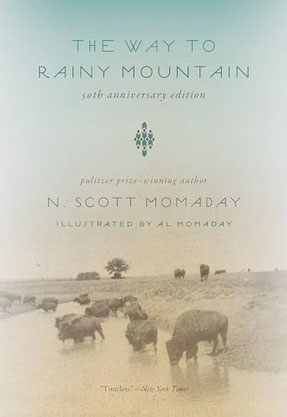
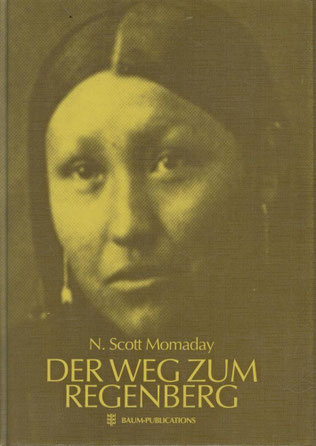
Sowohl die englischsprachige Ausgabe als auch die deutsche Übersetzung liegen mir in unterschiedlich gestalteter bibliophiler Ausstattung vor. Im Gegensatz zu dem schmalen Band, der 2019 zum 50. Jahr der Ersterscheinung bei der University of New Mexico Press erschien, ist die deutsche Übersetzung von 1991 ein liebevolles Hardcover mit dem schönen Gesicht von Momadays Großmutter Aho auf dem Einband, mit Texten und Illustrationen auf cremefarbenem weichem Papier in dunkelbraunem Satz. Peter Baum von den leider recht klein gebliebenen Baum-Publications ließ es sich nicht nehmen, selber zu übersetzen und einen Anhang mit Erläuterungen und kurzem Lebenslauf von Momaday anzufügen. Beide Ausgaben schließen mit einem Gedicht vom „Rainy Mountain Cemetery“:
…“The early sun, red as a hunter’s moon,
Runs in the plain. The mountain burns and shines;
And silence is the long approach of noon…”
“…Die frühe Sonne, rot wie der Mond des Jägers,
Läuft über die Prärie. Die Berge brennen, leuchten;
Und Stille ist des Mittags langes Nahen…“
(Deutsch von Christel Heybrock)
„The Way to Rainy Mountain“, illustrated by Al Momaday, 50th Anniversary Edition, University of New Mexico Press, Albuquerque 2019, 88 S., ISBN 978-0-8263-6121-9
“Der Weg zum Regenberg”, ins Deutsche übertragen von Peter Baum, Umschlag-Entwurf nach einer alten Fotografie von Aho, 99 S., Baum-Publications, Idstein 1991, ISBN 3-9802155-2-0
21. September 2025 Copyright Christel Heybrock
... and the German translation
I have both the English-language edition and the German translation before me, each featuring a distinct, bibliophile design. In contrast to the slim volume published by the University of New Mexico Press in 2019 to mark the 50th anniversary of the original release, the 1991 German translation is a lovingly crafted hardcover edition; it features the beautiful face of Momaday’s grandmother, Aho, on the cover, with text and illustrations printed in dark brown ink on soft, cream-colored paper. Peter Baum—of Baum-Publications, a house that has unfortunately remained quite small—insisted on doing the translation himself and included an appendix with explanatory notes and a brief biography of Momaday.
Both editions conclude with a poem about the “Rainy Mountain Cemetery”:
…“The early sun, red as a hunter’s moon,
Runs in the plain. The mountain burns and shines;
And silence is the long approach of noon…”
“The Way to Rainy Mountain,” illustrated by Al Momaday, 50th Anniversary Edition, University of New Mexico Press, Albuquerque 2019, 88 pp., ISBN 978-0-8263-6121-9
“Der Weg zum Regenberg”, translated into German by Peter Baum, cover design based on an old photograph of Aho, 99 pp., Baum-Publications, Idstein 1991, ISBN 3-9802155-2-0
September 21, 2025 Copyright Christel Heybrock
Translation by Google