Indigenes Leben – die
andere Zivilisation
Russell Means und Bayard Johnson mit einer Einführung in die Gedankenwelt der Lakota
Scroll down for English version
Zwei bekannte Namen:
Russell Means (1939-2012), Aktivist, Filmschauspieler, Autor, Zeichner.
Bayard Johnson (1952-2016), Drehbuchautor, Filmproduzent, Romancier.
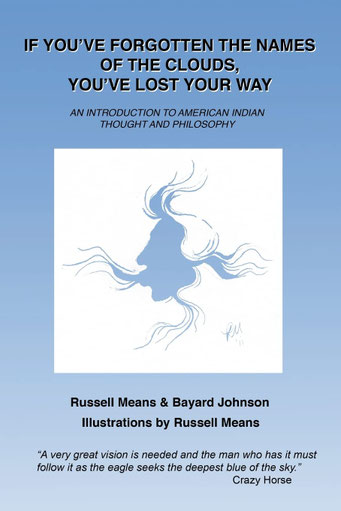
Die beiden taten sich zusammen in dem schmalen, aber aufschlussreichen Bändchen „If You’ve Forgotten the Names of the Clouds, You’ve Lost Your Way“. Der poetische Satz ist keineswegs der Titel eines Lyrikbandes, sondern öffnet die Tür zur Lebensauffassung der Lakota-Sioux, zu denen auch Means gehörte. Gegen Ende seines Lebens (Means starb an Speiseröhrenkrebs) wollte er erhalten, was ihn und die Lakota-Kultur geprägt hatte. Man kann wohl davon ausgehen, dass zwar die Idee sowie die Zeichnungen von ihm stammen, die Texte in der Mehrzahl aber das Werk Bayard Johnsons sind.
Auf knapp 100 Seiten und in 45 Kurzkapiteln werden die großen Themen indigenen Alltagslebens angeschnitten: Sprache, Familie und Clanbindungen, Leadership, Konfliktlösungen, Ethik, die Rolle von Frauen und die Beziehung zu den Weißen. Das Bändchen richtet sich sowohl an indigene Leser, die an ihre Kultur erinnert werden sollen, als auch an kenntnislose Weiße, von denen indianisches Leben brutal überrannt, aber nur in Einzelfällen in seiner Substanz überhaupt wahrgenommen wurde. Nun ist es nicht der erste Versuch von Indianern, weißen Lesern indigenes Denken zu vermitteln. Weit ausführlicher und argumentativ besser untermauert haben sich bedeutende Autoren wie Charles Eastman (Ohíyes’a), John und Archie Fire Lame Deer (Tahca Ushte) oder Joseph Marshall III. geäußert. Auch strukturell kann man Means‘ und Johnsons Texten vorwerfen, dass sie bunt durcheinander gewürfelt wurden und dass nicht alle Kapitel logischerweise da enden, wo sie begannen, bei ihrem Thema nämlich.
Dennoch zieht man in vielen Punkten einen unschätzbaren Erkenntnisgewinn aus dem kleinen Band, vielleicht gerade, weil in der Reibung zwischen den Kulturen ein Drive und eine Nachdrücklichkeit entstehen, die den Leser nicht unbeteiligt lassen. So verblüfft bereits die im Titel angedeutete indigene Fähigkeit visueller Wahrnehmung, bei der Weiße nicht mithalten können: „In the Lakotah language… there are 52 different kinds of clouds that we have names of“, was eine auf natürlichen Kenntnissen basierende Wettervorhersage ermöglicht – lebenswichtig in einer Umgebung wie den Great Plains und Symptom dafür, dass „…we are part of a mosaic or web of life.“ Das Eingebundensein in das Gewebe des Lebens bildet das Grundvertrauen indigener Menschen, wohingegen die englische Sprache anstelle differenzierter Wolkenbegriffe eine Unzahl an Begriffen für Tötungen habe, Begriffe, für die es in der Lakota-Sprache keine Äquivalente gebe.
Reibungsflächen entstehen aber bereits durch Sprache selbst, und hier äußern sich Means/Johnson aufschlussreich über die Bedeutung gesprochener anstelle geschriebener Sprache, wobei man wissen muss, dass Lakol ursprünglich keine Schriftsprache war, sondern erst in den letzten Jahrzehnten – wie viele andere indigene Sprachen – in eine Schriftform überführt wurde. Fast im selben Atemzug, in dem die Autoren die Wertschätzung oraler Sprache erläutern, holen sie auch zum Rundumschlag gegen weiße Wissenschaft aus: „Written language crosses into the domain of word-accountants, ‚experts‘ who spend their lives compiling catalogues of words… trying to affix an exact, almost numerical value to every utterance and human emotion.“
Was haben Sprache und Ethik miteinander zu tun?
Nicht nur, dass Schriftsprache zu Gedächtnisverlust führt, weil das genaue Erinnern über Generationen hinweg nicht mehr gefordert wird, sondern die Schrift entzieht der Sprache auch ihre Körperlichkeit, entzieht ihr die Freiheit des Ausdrucks hinsichtlich Stimme und Gestik. Und folgerichtig wird auch die Grenze zur Ethik berührt, denn Schrift ermöglicht die Wiedergabe falscher Behauptungen, die über Generationen hinweg ungefragt tradiert werden können. Das Argument, dass sich ja auch mündlich trefflich lügen ließe, steht zwar im Hintergrund, wird aber gar nicht erst widerlegt, weil es in der Lakota-Kultur keine Rolle spielte. Wenn Autoren wie Tahca Ushte oder Black Elk betonen, indigene Gesellschaften seien einst ohne Haftanstalten, Polizei und Gesetze ausgekommen, weil es schlicht keine Verbrecher gegeben habe – dann klingt das für weiße Leser vollkommen unglaubwürdig. Bei genauerem Hinsehen ist es jedoch plausibel, denn in kleinen, von äußeren Umständen stets bedrohten Gesellschaften sind Zusammenhalt und Vertrauen lebensnotwendig. Eine bloße Lüge kann die Existenz einer ganzen Gemeinschaft gefährden. Eine Lüge in oraler Sprache über Generationen hinweg zu tradieren, wie es in Schriftsprache möglich ist, würde nicht funktionieren.
Im Gegensatz zu der weißen Vorstellung, bei indigenen Menschen handle es sich um “Wilde“, waren und sind Ethik und Verhaltensnormen fest verankert, sie sind Garanten für das Überleben indigener Individuen und Gemeinschaft. Dass man sich dabei als Nachkommen der Vorfahren sieht, die in der täglich begangenen Erde bestattet und auch spirituell lebendige Gegenwart sind, schließt nur den Kreis von notwendigen und liebevoll erfüllten Verhaltensvorgaben. Means/Johnson: „Our Ancestors are our constant witness and companion… In this way, an American Indian is never a solitary or lonely individual. Existential angst is unknown… We are part of something greater than ourselves. This makes us responsible.” Denn: “Honor is not purely individual… but it incorporates our…. families, our clans, the Ancestors, and extends out to include the entire Universe.”
Diese Verantwortlichkeit sich selbst wie den Vorfahren und dem Universum gegenüber erstreckt sich auf den zwischenmenschlichen Umgang wie auf den Umgang mit Tieren, Pflanzen und der Erde selbst. Verantwortung als Lebenshaltung führt beispielsweise dazu, dass bei der Jagd ebenso wie beim Sammeln von Pflanzen und Früchten stets nur gemäß dem aktuellen Bedarf entnommen und eine Fundstelle niemals völlig ausgebeutet wird - um zu verhindern, dass die „wilde“ Gesellschaft da landet, wohin sich die zivilisierte derzeit dramatisch bewegt, an den Punkt nämlich, an dem irgendwann nichts mehr übrig ist. Aber Verantwortung erstreckt sich auch auf simple Höflichkeit. Die Autoren zitieren Luther Standing Bear (1868-1939): „Conversation was never begun at once… A pause giving time for thought was the truly courteous way of beginning und conducting a conversation…” Wenn man sich dagegen das Gegröle und sinnlose Gequatsche zivilisierter weißer Zeitgenossen vor Augen hält… Means/Johnson: „The very essence of being an American Indian is expressed in our languages.”
Starke Frauen, Hüterinnen des Lebens
Den fundamentalen Gegensatz zwischen indigener und weißer Zivilisation sehen die Autoren jedoch zwischen Patriarchat und Matriarchat: „This book is an introduction …to matriarchy…“ Nicht nur sei die Frau dem Mann keineswegs unterlegen wie im Patriarchat, sondern sie wird fast als höheres Wesen gesehen: „Because Woman is more Holy than Man, she lives longer, she can withstand more pain, she has more endurance, and she has a unique 6th sense that cannot be explained.“ Das hat aber nicht zur Folge, dass die Frau auf einen Sockel gehoben oder womöglich auf „Händen getragen“ wird, ganz im Gegenteil. Da sie die Vernünftige und Einsichtige ist, wird von ihr erwartet, dass sie Launen und schlechtes Benehmen ihres Ehemanns als kindische Entgleisungen hinnimmt, ohne zu klagen.
Dabei dürfte das Leben einer Frau in der traditionellen indigenen Gesellschaft aufreibend gewesen sein – für praktisch jede Alltagsarbeit außer für die Jagd war sie verantwortlich. Means und Johnson haben ihre Texte bewusst als grundsätzlichen ideellen Gegensatz zur weißen Gesellschaft angelegt und auf die feinen, widersprüchlichen Details verzichtet, wie sie das reale Leben mit sich bringt: Feuerholz sammeln, Wasser vom Fluss holen, Kinder zur Welt bringen, Tipis auf- und abbauen, Büffelhäute weichklopfen, Mokassins herstellen … Das wird nicht erwähnt, ebenso wenig wie die Tatsache, dass so manche Frau mit Mitte dreißig vielleicht froh war, wenn der Gatte noch eine „Haushaltshilfe“ dazu nahm, obwohl in der indigenen Gesellschaft eine Frau jederzeit auf die Hilfe anderer Frauen zählen konnte. Zudem – und das wird denn doch hervorgehoben - war es die Frau, die sich scheiden lassen konnte. Sie setzte dem Gatten dann einfach seine Habseligkeiten vors Tipi, und die Autoren geben zu, dass es vornehmlich zwei Gründe für eine Scheidung gab: Entweder war der Ehemann ein lausiger Versorger oder ein lausiger Liebhaber.
Der Gegensatz zwischen Patriarchat und Matriarchat lässt sich auf den Gegensatz von zirkulärem indigenen und linearem weißen Denken zurückführen. Der weiße Patriarch ist ein ständig vorwärtsstrebender, gieriger Raffer, der seine Macht definiert als Herrscher über Untergebene und ständig um seine Position fürchten muss. Während der Indigene sein Tun reflektiert, Folgen abschätzt und sich in einem sinnvollen, funktionierenden System aus Vergangenheit und Zukunft, aus Opferbereitschaft und Selbstbehauptung sieht. Viele Weiße, fasziniert von den Leistungen indigener Männer, hätten Indigene in einem unrealistischen Bild gesehen – die Autoren halten fest, dass beispielsweise die Büffeljagd keineswegs so dramatisch abgelaufen sei wie von Weißen geschildert. Nichts da mit ganzen Herden, auf die beritten mit Pfeil und Bogen vorgerückt worden sei. Man habe vielmehr von Kojoten abgeguckt, wie man – einzelne! – Büffel zur Strecke bringen konnte, indem man sie bis zur Erschöpfung in die Enge trieb. Vieles, was Means und Johnson schildern, ist weit weniger heroisch und kriegerisch als die Wahrnehmung weißer Gegner. Auch hatte Leadership nichts mit Machtausübung und Unterwerfung zu tun, sondern mit Klugheit, Diskussionsführung und Überzeugung – ohne das Einverständnis aller wurde nichts in die Tat umgesetzt, es gab keine „demokratischen“ Überstimmungen durch Mehrheiten.
Die Lakota-Art der Konfliktlösung
Interessant eine spezielle Konfliktlösung mittels einer quer durch den Raum gespannten Decke. Vor und hinter der Decke saßen die Streitparteien, ohne einander zu sehen. Jede Partei musste sich, ohne etwas erwidern zu dürfen, die Vorwürfe der Gegner anhören und umgekehrt. Anschließend wurden beide nacheinander gefragt, welche Problemlösung sie nun für die beste hielten. Es scheint Fälle gegeben zu haben, in denen der Groll fester saß als die Einsicht. Dann konnte die weiterhin grollende Partei eine Clanabspaltung gründen, mit der weitere Kontakte verhindert wurden.
Es ist höchst eindrucksvoll zu sehen, dass die Lakota-Ethik zwar Harmonie und Balance in jeder Hinsicht anstrebte, aber nie die Widersprüche der Realität aus dem Blick verlor. Fundamentale Rollen spielten der Heyoka und Iktomi, der janusgesichtige Trickster. Zwei Figuren, die alles Tun ins Gegenteil verdrehten und dadurch sowohl für Belustigung als auch für Irritation sorgten. Während Iktomi eine mythische Figur blieb, wurde der Heyoka von bestimmten Personen real gelebt. Die Autoren identifizieren den Heyoka mit dem zerstörerischen Patriarchat - doch in der indigenen Gesellschaft hatten beide Figuren nicht die Funktion rücksichtsloser Destruktion, sondern die von Lehrmeistern. Der Heyoka machte seinen Mitmenschen bewusst, dass es Gut und Böse gibt und dass die Wirklichkeit mehrere Seiten hat. Dass das Leben Klugheit, Wachsamkeit und Selbstdistanz erfordert. In der von den Weißen kolonisierten Gegenwart jedoch habe der Heyoka allein die Macht übernommen.
Der aktive Rebell und AIM-Aktivist Russell Means wäre nicht er selbst gewesen, wenn er am Ende seines Lebens bei der pessimistischen Sicht geblieben wäre. Er zitiert die Kogi-Indianer in Südamerika, die aus ihrer isolierten Welt hervortraten, um zu warnen vor dem Verlust des einst intakten Lebenssystems. „It is still not too late. The living Earth can be saved… But the Little Brothers (die Weißen) will have to change their way of living.” Andernfalls stünde “the end of all life on Earth“ bevor. Das Schlusszitat stammt von Chief Seattle, der sich an die Weißen wandte: “Your time of decay may be distant, but it will surely come…for even the white man … cannot escape our common destiny. We may be brothers after all. We shall see.”
Russell Means & Bayard Johnson: “If You’ve Forgotten The Names Of The Clouds, You’ve Lost Your Way”, an Introduction to American Indian Thought and Philosophy, Illustrations by Russell Means, 100 S., Treaty Publications, Porcupine SD 2013, ISBN-13: 978-1482068108
3. Februar 2026 Copyright Christel Heybrock
Indigenous Life – The Other Civilization
Russell Means and Bayard Johnson: An Introduction to the Lakota Worldview
Two well-known names:
Russell Means (1939–2012): activist, film actor, author, illustrator.
Bayard Johnson (1952–2016): screenwriter, film producer, novelist.
The two joined forces in the slim yet insightful volume *If You’ve Forgotten the Names of the Clouds, You’ve Lost Your Way*. This poetic phrase is by no means the title of a book of poetry; rather, it opens the door to the worldview of the Lakota Sioux—a people to whom Means himself belonged. Toward the end of his life (Means died of esophageal cancer), he sought to preserve the elements that had shaped both him and Lakota culture. It is reasonable to assume that while the concept and the illustrations originated with him, the majority of the text is the work of Bayard Johnson.
Spanning just under 100 pages and divided into 45 short chapters, the book touches upon the major themes of indigenous daily life: language, family and clan ties, leadership, conflict resolution, ethics, the role of women, and the relationship with white people. The volume is addressed both to indigenous readers—intended to serve as a reminder of their own culture—and to white readers lacking such knowledge, by whom Native American life has been brutally overrun and, save for a few isolated instances, rarely perceived in its true essence. Of course, this is not the first attempt by Native Americans to convey indigenous modes of thought to white readers. Significant authors such as Charles Eastman (Ohíyes’a), John and Archie Fire Lame Deer (Tahca Ushte), and Joseph Marshall III have expressed themselves on these matters in far greater detail and with more robust argumentation. Structurally, too, one might criticize Means and Johnson’s texts for being a hodgepodge—tossed together in a jumble—and for the fact that not all chapters logically conclude where they began: namely, with their stated subject matter.
Nevertheless, in many respects, one gains invaluable insights from this slim volume—perhaps precisely because the friction between these cultures generates a certain drive and urgency that compels the reader to engage. For instance, one is immediately struck by the indigenous capacity for visual perception—hinted at in the title—with which white people simply cannot compete: “In the Lakotah language… there are 52 different kinds of clouds that we have names for.” This enables weather forecasting based on intimate knowledge of the natural world—a matter of survival in an environment like the Great Plains, and a testament to the fact that “…we are part of a mosaic or web of life.” This embeddedness within the fabric of life constitutes the fundamental bedrock of trust for indigenous peoples; conversely, the English language—rather than possessing a nuanced vocabulary for clouds—is said to possess a myriad of terms for killing—terms for which there are no equivalents in the Lakota language.
Yet points of friction arise from language itself; here, Means and Johnson offer illuminating observations regarding the significance of spoken versus written language—though it is worth noting that Lakota was not originally a written language, but was rather transcribed into written form only in recent decades (much like many other indigenous languages). Almost in the same breath in which the authors articulate their reverence for oral tradition, they launch a sweeping broadside against Western academia: “Written language crosses into the domain of word-accountants—‘experts’ who spend their lives compiling catalogues of words… trying to affix an exact, almost numerical value to every utterance and human emotion.”
What is the connection between language and ethics?
Not only does written language lead to memory loss—because the precise act of remembering is no longer required across generations—but writing also strips language of its physicality, depriving it of the freedom of expression inherent in voice and gesture. Consequently, this also touches upon the realm of ethics, for writing enables the reproduction of false claims that can be handed down unquestioned over generations. The counterargument—that one can, after all, lie just as effectively orally—lurks in the background; yet, it is not even addressed, simply because it played no role within Lakota culture. When authors such as Tahca Ushte or Black Elk emphasize that indigenous societies once managed without prisons, police, or laws—because, quite simply, there were no criminals—this sounds utterly implausible to white readers. Upon closer inspection, however, it proves plausible; for in small societies constantly threatened by external circumstances, cohesion and trust are vital necessities. A mere lie can jeopardize the very existence of an entire community. To perpetuate a lie orally across generations—as is possible through written language—would simply not work.
In contrast to the white misconception that indigenous peoples are "savages," ethics and behavioral norms were—and remain—deeply ingrained anchors; they serve as guarantors for the survival of indigenous individuals and communities. The fact that one views oneself, in this context, as a descendant of ancestors—who are buried in the very earth trodden upon daily and who remain a spiritually living presence—merely completes the circle of necessary and lovingly fulfilled behavioral precepts. Means/Johnson: “Our Ancestors are our constant witness and companion… In this way, an American Indian is never a solitary or lonely individual. Existential angst is unknown… We are part of something greater than ourselves. This makes us responsible.” For: “Honor is not purely individual… but it incorporates our…. families, our clans, the Ancestors, and extends out to include the entire Universe.”
This sense of responsibility—towards oneself, one’s ancestors, and the universe—extends to interpersonal interactions as well as to one’s dealings with animals, plants, and the Earth itself. Responsibility as a way of life dictates, for instance, that during the hunt—just as when gathering plants and fruits—resources are always harvested strictly according to immediate need, and a site is never completely depleted. This serves to prevent the “wild” society from ending up where the “civilized” one is currently heading so dramatically: namely, to the point where, eventually, nothing remains. Yet responsibility also extends to simple courtesy. The authors quote Luther Standing Bear (1868–1939): “Conversation was never begun at once… A pause giving time for thought was the truly courteous way of beginning and conducting a conversation…” When one contrasts this with the raucous shouting and mindless chatter of civilized white contemporaries… Means/Johnson: “The very essence of being an American Indian is expressed in our languages.”
Strong Women, Guardians of Life
However, the authors identify the fundamental contrast between indigenous and white civilizations as lying between patriarchy and matriarchy: “This book is an introduction …to matriarchy…” Not only is the woman by no means inferior to the man—as she is in a patriarchy—but she is viewed almost as a higher being: “Because Woman is more Holy than Man, she lives longer, she can withstand more pain, she has more endurance, and she has a unique 6th sense that cannot be explained.” Yet this does not result in the woman being placed on a pedestal—or perhaps even “carried on hands,” as the saying goes—but quite the opposite. Since she is the rational and sensible one, she is expected to accept her husband’s moods and poor behavior as childish lapses, without complaint.
In reality, however, a woman’s life in traditional indigenous society was likely grueling—she was responsible for practically every daily chore, with the sole exception of hunting. Means and Johnson deliberately framed their texts as a fundamental ideological counterpoint to white society, omitting the subtle, contradictory details that real life entails: gathering firewood, fetching water from the river, giving birth to children, pitching and striking tipis, softening buffalo hides, making moccasins… None of this is mentioned—nor is the fact that many a woman in her mid-thirties might have been grateful if her husband took on an additional “domestic helper,” even though, in indigenous society, a woman could always count on the assistance of other women. Furthermore—and this point is indeed highlighted—it was the woman who had the power to initiate a divorce. She would simply place her husband’s belongings outside the tipi; the authors admit that there were primarily two grounds for divorce: either the husband was a lousy provider or a lousy lover.
The contrast between patriarchy and matriarchy can be traced back to the dichotomy between circular, indigenous modes of thought and linear, white modes of thought. The white patriarch is a constantly forward-striving, greedy accumulator who defines his power as that of a ruler over subordinates—a position he must constantly fear losing. The indigenous man, by contrast, reflects upon his actions, weighs their consequences, and views himself as an integral part of a meaningful, functioning system—one woven from the threads of past and future, and balanced between self-sacrifice and self-assertion. Many white observers, fascinated by the feats of indigenous men, have tended to view indigenous peoples through the lens of an unrealistic fantasy; the authors note, for instance, that the buffalo hunt unfolded in a manner far less dramatic than white accounts have portrayed. Gone is the myth of entire herds being charged down by mounted warriors armed with bows and arrows. Instead, indigenous hunters learned from coyotes how to bring down—specifically—*individual* buffalo by cornering and driving them to the point of utter exhaustion. Much of what Means and Johnson describe is far less heroic and warlike than the perceptions held by their white adversaries. Furthermore, indigenous leadership had nothing to do with the exercise of power or the subjugation of others; rather, it was rooted in wisdom, the skillful facilitation of dialogue, and the power of persuasion—for without the unanimous consent of the collective, nothing was ever put into action; there were no "democratic" decisions imposed by a majority vote.
The Lakota Way of Conflict Resolution
A particularly interesting method of conflict resolution involved a blanket stretched across a room. The disputing parties sat on opposite sides of the blanket, unable to see one another. Each party was required to listen to the accusations leveled by their opponents—without being permitted to offer any rebuttal—and vice versa. Subsequently, both parties were asked, one after the other, what solution to the problem they now considered best. There appear to have been instances where resentment ran deeper than insight; in such cases, the party that remained aggrieved could initiate a clan split, thereby severing all further contact
It is profoundly impressive to observe that, while Lakota ethics strove for harmony and balance in every respect, they never lost sight of the inherent contradictions of reality. Two figures played fundamental roles: the *Heyoka* and *Iktomi*—the Janus-faced trickster. These two figures inverted every action, thereby provoking both amusement and bewilderment. While Iktomi remained a mythical figure, the role of the *Heyoka* was actively embodied by certain individuals in real life. The authors identify the *Heyoka* with a destructive patriarchy; yet, within indigenous society, neither figure served the function of ruthless destruction, but rather that of a teacher. The *Heyoka* made his fellow human beings aware that both good and evil exist, and that reality possesses multiple facets—that life demands wisdom, vigilance, and the capacity for self-detachment. In the present day—a world colonized by white society—however, the *Heyoka* is said to have seized absolute power.
The active rebel and AIM activist Russell Means would not have been true to himself had he, at the end of his life, remained wedded to such a pessimistic outlook. He quotes the Kogi people of South America, who emerged from their isolated world to warn against the loss of a once-intact life system. “It is still not too late. The living Earth can be saved… But the Little Brothers (the white people) will have to change their way of living.” Otherwise, “the end of all life on Earth” would be imminent. The concluding quote comes from Chief Seattle, who addressed the white people: “Your time of decay may be distant, but it will surely come…for even the white man … cannot escape our common destiny. We may be brothers after all. We shall see.”
Russell Means & Bayard Johnson: “If You’ve Forgotten The Names Of The Clouds, You’ve Lost Your Way,” an Introduction to American Indian Thought and Philosophy, Illustrations by Russell Means, 100 pp., Treaty Publications, Porcupine SD 2013, ISBN-13: 978-1482068108
February 3, 2026 Copyright Christel Heybrock
Translation by Google