
Unerfüllte Vision eines Volkes
John G. Neihardt: „Black Elk Speaks”, with a new introduction by Philip J. Deloria and annotations by Raymond J. DeMallie
Scroll down for English version
Diese “Complete Edition” ist tatsächlich eine Glanzleistung. Nicht nur, dass der Bericht des Oglala-Sioux-Visionärs Black Elk (Heháka Sápa) von sorgfältigen Anmerkungen, sechsseitiger Literaturliste und Index begleitet wurde – auch ein höchst informativer Anhang macht aufmerksam auf die Situation, in der Black Elk zu dem weißen amerikanischen Lyriker John G. Neihardt sprach und ihm praktisch sein Leben anvertraute. Und nicht zuletzt kann sich der Leser anhand der Zeichnungen von Black Elks Freund Standing Bear eine gewisse (freilich karge) Vorstellung machen von der Vision des Sehers und ihrer Umsetzung in ein wirklich großes Ritual. Es scheint Teil der Lakota-Spiritualität (gewesen) zu sein, dass eine Vision nur dann wirksam wird, wenn der Seher sie nicht für sich behält, sondern seinem Volk mitteilt, indem sie rituell realisiert wird. Von einer solchen, optisch und akustisch erfahrbaren Umsetzung, bei der jedes Detail tiefe spirituelle Bedeutung hat, kann sich wohl kein weißer Leser und mittlerweile vielleicht auch kein Indigener mehr eine Vorstellung machen.
Die historische Realität ist die, dass Black Elk, geboren 1863, im Alter von neun Jahren schwer krank wurde und für etliche Tage ins Koma fiel. Seine Eltern rechneten mit seinem Tod, nicht ahnend, dass sein Körper zwar stillgelegt, sein Gehirn aber offenbar auf Hochtouren arbeitete. Mit neun Jahren empfing der Junge die Vision von der Herkunft, den Gefahren, der Stärke und der möglichen Zukunft seines Volkes, verbunden mit der unausgesprochenen Verpflichtung, den zentralen Baum des Lebens wieder zum Blühen zu bringen. Der Junge hatte zwar alles überdeutlich gesehen, aber nicht verstanden und für Jahre vergessen, bevor er sich als Erwachsener seiner spirituellen Kraft und ebenso der Verpflichtung bewusst und zum Heiler wurde.
Doch die Verhältnisse hinsichtlich der Zukunft seines Volkes entwickelten sich desaströs. Zwar hatte ein Verband von Sioux, Arapaho und Cheyenne dem arroganten Indianerschlächter General George A. Custer 1876 am Little Big Horn eine vernichtende Niederlage beschert, aber die Rache der weißen Eroberer führte am 29. Dezember 1890 zum finalen Massaker weißer Soldaten an wenigen Hundert halb verhungerter Indianer am Wounded Knee River. Black Elk hatte an beiden Ereignissen teilgenommen, und der Zusammenbruch indianischer Lebensweise scheint ihn derart entmutigt zu haben, dass er sich 1904 katholisch taufen ließ und seither als Laienhelfer jesuitischer Missionare arbeitete.
Zufall oder nicht, dass 1930 zwei Männer zusammenkamen, die einander ihre historische Bedeutung sichern sollten – der amerikanische Lyriker John Neihardt, der für den abschließenden Teil eines großen Zyklus Informationen über die indianische Geistertanzbewegung von 1890 suchte – und eben Black Elk, der seinerzeit mit der Bewegung vertraut gewesen und dessen große Vision noch niemand vollständig zugänglich geworden war. Das Treffen der beiden Männer, und das macht die Angelegenheit problematisch, konnte nicht ohne Vermittlung stattfinden: Black Elk sprach kein Englisch, wegen historischer Fakten hatte er noch einige ältere Männer herangezogen, sein Sohn übersetzte, und Neihardt kam mit seinen Töchtern, von denen die eine Black Elks Äußerungen stenografierte. Black Elk sagt darin selbst, er habe nicht restlos alles formuliert, weil vieles für Worte nicht geeignet sei – und es ist die Frage, wie weit Neihardt bei aller Einfühlung tatsächlich verstand, was er auf dem Transkript sah.
Es ist der Edition hoch anzurechnen, dass der Anthropologe Raymond J. DeMallie zu Wort kommt, der sich später intensiv mit Black Elk und seinem Bericht auseinandersetzte, und die kritische Frage nach der Authentizität stellt. Schließlich hatte er herausgefunden, dass Neihardt einige Passagen ausgelassen, andere dafür den Vorstellungsmöglichkeiten weißer Leser angepasst hatte. Und es sind gerade diese Passagen, die aus Black Elks extrem nüchternem Text Evidenzerfahrungen für Weiße machen. Es ist ein grundsätzliches Problem der Rezeption fremder Kultur – wie weit ist Verstehen überhaupt möglich? Wir wissen zwar über die Mentalität der Sioux vieles aus indigenem Schreiben – etwa von Charles Eastman oder Vater und Sohn John und Archie Fire Lame Deer. Aber wir wüssten es nicht, ohne dass den beiden Lame Deer der österreichische Autor Richard Erdoes zur Seite gestanden hätte und dass Eastman (Ohíyes‘a) eine weiße Missionsschule besucht und dass später seine christliche weiße Ehefrau seine Texte redigiert hätte. Besonders im Fall von Eastman wird nie festzustellen sein, was von ihm und was von seiner Frau formuliert wurde. Weiße Autoren hielten in Ermangelung indigener Schriftsprachen sicherlich vielfach die Äußerungen von Indigenen nach eigenem Gusto fest.
Tröstlich wiederum, dass DeMallie die wechselseitige spirituelle Haltung sowohl von Neihardt als auch von Black Elk betont – da hatten sich über Grenzen hinweg wohl doch zwei verwandte Geister gefunden. Aber abgesehen von der höchst komplexen Situation der Entstehung und der anschließenden Rezeptionsgeschichte des 1932 erstmals erschienenen Buches, fragt man sich als Leser doch mitunter, wem von beiden die größere kulturelle Leistung zuerkannt werden muss – Neihardt, der trotz seines Engagements stets in seiner eigenen Welt blieb – oder Black Elk, der die niederschmetternden Jahrzehnte der Zerstörung hatte verkraften müssen? Der sich gescheitert sah, was den Auftrag seiner Vision betraf, die Zukunft seines Volkes zu sichern? Der aus seinem tragischen Scheitern heraus letztendlich durch den Bericht an einen fremden Weißen doch etwas von der Substanz seiner Kultur rettete?
John G. Neihardt, “Black Elk Speaks”, The Complete Edition, 369 S., University of Nebraska Press 2000, ISBN 978-0-8032-8391-6
Der Text ist online verfügbar bei dem Netzwerk TAIRP
https://indigenous-tairp.com/books/black-elk-speaks-1?context=featured
21. Februar 2024 Copyright Christel Heybrock
The Unfulfilled Vision of a People
John G. Neihardt: *Black Elk Speaks*, with a new introduction by Philip J. Deloria and annotations by Raymond J. DeMallie
This "Complete Edition" is truly a tour de force. Not only is the account of the Oglala Sioux visionary Black Elk (Heháka Sápa) accompanied by meticulous annotations, a six-page bibliography, and an index, but a highly informative appendix also draws attention to the specific circumstances under which Black Elk spoke to the white American poet John G. Neihardt—effectively entrusting his life story to him. And, not least, through the drawings of Black Elk’s friend Standing Bear, the reader can form a—albeit necessarily limited—conception of the seer’s vision and its realization in a truly grand ritual. It appears to be (or to have been) an integral part of Lakota spirituality that a vision becomes effective only when the seer does not keep it to himself but shares it with his people by bringing it to life through ritual enactment. It is doubtful whether any white reader—or, by now, perhaps even any Indigenous person—can truly conceive of such a realization: a sensory experience, both visual and auditory, in which every single detail holds profound spiritual significance.
The historical reality is that Black Elk, born in 1863, fell gravely ill at the age of nine and slipped into a coma for several days. His parents resigned themselves to his death, unaware that while his body lay dormant, his mind was evidently working at full intensity. At the age of nine, the boy received a vision regarding the origins, the perils, the strength, and the potential future of his people—a vision accompanied by the unspoken obligation to make the central Tree of Life bloom once more. Although the boy had perceived everything with crystal clarity, he did not understand it, and for years he forgot it entirely; only as an adult did he become fully conscious of his spiritual power—and of the accompanying obligation—and emerge as a healer.
However, circumstances regarding the future of his people took a disastrous turn. Although an alliance of Sioux, Arapaho, and Cheyenne had inflicted a crushing defeat upon the arrogant "Indian butcher" General George A. Custer at the Little Big Horn in 1876, the vengeance of the white conquerors culminated on December 29, 1890, in a final massacre by white soldiers against a few hundred half-starved Native Americans at Wounded Knee Creek. Black Elk had participated in both events, and the collapse of the Native American way of life seems to have so disheartened him that, in 1904, he was baptized into the Catholic faith and subsequently worked as a lay assistant to Jesuit missionaries.
Coincidence or not, in 1930 two men came together who were destined to secure each other’s historical significance: the American poet John Neihardt—who was seeking information on the Native American Ghost Dance movement of 1890 for the concluding volume of a major poetic cycle—and Black Elk himself, who had been intimately involved with the movement at the time and whose great vision had, until then, remained fully accessible to no one. The meeting between the two men—and this is what renders the matter problematic—could not take place without intermediaries: Black Elk spoke no English; moreover, to ensure factual accuracy, he had enlisted the aid of several other elders. His son served as interpreter, while Neihardt arrived accompanied by his daughters, one of whom transcribed Black Elk’s words in shorthand. Within the text itself, Black Elk states that he did not articulate absolutely everything, as much of it was ill-suited for expression in words—leaving open the question of to what extent Neihardt, for all his empathy, truly grasped the meaning of what he saw on the transcript.
It speaks highly of this edition that it gives a voice to the anthropologist Raymond J. DeMallie—who later engaged intensively with Black Elk and his account—and that it raises the critical question of authenticity. After all, he had discovered that Neihardt had omitted certain passages while adapting others to suit the sensibilities of white readers. And it is precisely these passages that transform Black Elk’s extremely sober narrative into experiences of profound revelation for a white audience. This represents a fundamental problem in the reception of foreign cultures: to what extent is true understanding even possible? We have, of course, learned a great deal about the Sioux mentality through indigenous writings—for instance, those of Charles Eastman or the father-and-son duo, John and Archie Fire Lame Deer. Yet we would not possess this knowledge were it not for the fact that the Austrian author Richard Erdoes assisted the two Lame Deers, or that Eastman (Ohíyes’a) attended one of the white mission schools, and that his white Christian wife later edited his texts. Particularly in Eastman’s case, it will likely never be possible to determine which passages were formulated by him and which by his wife. In the absence of indigenous written languages, white authors undoubtedly frequently recorded the statements of indigenous people according to their own tastes.
It is, however, a comforting thought that DeMallie highlights the shared spiritual outlook of both Neihardt and Black Elk—suggesting that, despite the boundaries separating them, two kindred spirits had indeed found one another. Yet, setting aside the highly complex circumstances surrounding the creation—and subsequent reception history—of this book, first published in 1932, the reader is occasionally left to wonder: to which of the two should the greater cultural achievement be ascribed? To Neihardt—who, despite his commitment, remained firmly rooted in his own world? Or to Black Elk—who had to endure the devastating decades of his people’s destruction? Who viewed himself as a failure regarding the sacred charge of his vision: to secure the future of his people? —who, emerging from his tragic failure, ultimately managed to salvage something of the substance of his culture through his account given to a white stranger?
John G. Neihardt, *Black Elk Speaks*, The Complete Edition, 369 pp., University of Nebraska Press 2000, ISBN 978-0-8032-8391-6
The text is available online via the TAIRP network: https://indigenous-tairp.com/books/black-elk-speaks-1?context=featured
February 21, 2024 Copyright Christel Heybrock
Translation by Google
Die Rote Straße und der Blühende Baum
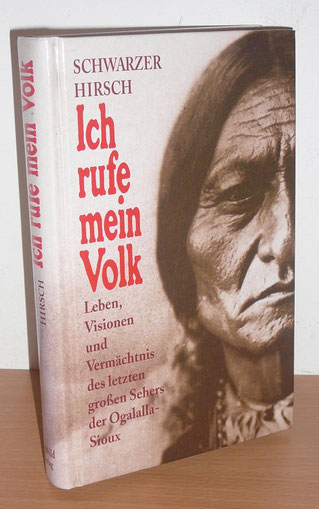
Schwarzer Hirsch: „Ich rufe mein Volk. Leben, Visionen und Vermächtnis des letzten großen Sehers der Ogalalla-Sioux“
Scroll down for English version
Zögerlich, aber konstant haben sich die Bekenntnisse des Oglala-Sioux-Medizinmanns Black Elk (auf Lakota: Heháka Sápa) in der Übermittlung des amerikanischen Lyrikers John G. Neihardt auf dem internationalen Buchmarkt durchgesetzt. Die erste Ausgabe 1932 hatte keine durchgreifende Resonanz gefunden, mittlerweile zählt das Buch zu den Klassikern indigener US-Literatur, obwohl der Bericht von einem Weißen aufgezeichnet wurde. Die deutschsprachige Ausgabe geht wohl zurück auf eine Initiative des Psychoanalytikers Carl Gustav Jung, wer aber auf den Titel kam „Ich rufe mein Volk“, konnte ich nicht herausfinden – Black Elk hat an keiner Stelle seines Berichts sein Volk gerufen. Und auch auf den schwarzen “Hirsch“ sollten künftige deutschsprachige Ausgaben verzichten – der „elk“ ist im Unterschied zum „deer“ kein Hirsch, sondern ein Wapiti. Überhaupt würde man sich mittlerweile eine besser ausgestattete, nämlich kritisch kommentierte deutsche Ausgabe wünschen, die gut gemeinten Anmerkungen und mitunter putzigen Lautumschreibungen der Lakota-Sprache sind nicht mehr zeitgemäß.
Aber was ein deutschsprachiger Leser am Ehesten berücksichtigen sollte, betrifft eine grundsätzliche Haltung der Rezeption: Black Elks Prosa verlangt ein anderes Lesen, eine umfassendere Vorstellungsleistung als ein moderner Roman oder ein Report in welchem Medium auch immer. Wer dazu nicht imstande ist, an dem wird diese nüchterne, trotz ihrer spirituellen Inhalte stets sachbezogene Sprache einfach vorbeirauschen. Und in der Tiefe ist es wahrscheinlich unmöglich, als Vertreter der weißen Zivilisation wirklich nachzuvollziehen, was ein Lakota-Indianer in den Jahrzehnten des schrecklichsten Umbruchs und der Fast-Vernichtung seines Volkes empfunden, gedacht und erfahren hat.
Aus der Ausgabe des Weltbild Verlags geht in keiner Weise hervor, dass Black Elk selbst Repräsentant einer kulturell-mentalen Spaltung war: Nach dem offensichtlichen Zusammenbruch indigener Lebensweise in der Folge des finalen Massakers weißer Soldaten (29. Dezember 1890 am Wounded Knee) war er 1904 zum Katholizismus übergetreten und betätigte sich als Laienhelfer der Missionare. Dass er dann 1930 in mehreren Sitzungen seine einstige spirituelle Vision und die Substanz seines indigenen Denkens an Neihardt weiter gab und sie erstmals überhaupt umfassend formulierte, scheint aus dem Bedürfnis gekommen zu sein, etwas von dieser Substanz noch zu retten. War es womöglich auch Bedauern über die Fehlentscheidung zum Katholizismus? Die fundamentalen Unterschiede zwischen hierarchisch katholischem und zirkulär-gleichberechtigtem Denken der Indigenen dürften auch Black Elk zu schaffen gemacht haben – viele Indigene wurden durch diese Spaltung in ihrer Persönlichkeit zerstört.
Black Elks karge, auf verbale Ausschmückungen fast radikal verzichtende Sprache, in der er sein Leben, seine große spirituelle Vision und den gescheiterten Kampf seines Volkes erzählte, verlangt vom Leser die Opulenz eigener Vorstellungskraft: Was für ein mitreißendes, bewegendes Ritual muss es beispielsweise gewesen sein, Black Elks Vision tatsächlich realisiert gesehen zu haben - über Stunden und Tage hinweg mit Pferden, jungen Mädchen, geschmückten und bemalten Akteuren! Es gibt keine Berichte der damaligen Teilnehmer, und sie haben mit Sicherheit anders rezipiert, waren anders betroffen als irgendeiner von uns heutigen Lesern. Black Elks Lebensbericht, der einen spirituellen Auftrag erfüllt, indem er das Wohlergehen seines Volkes beschwört, ist vielleicht gerade wegen seines historischen Scheiterns eine dauerhafte Herausforderung an die weiße Zivilisation und ihre Zerstörungskraft.
Es bleibt auch eine mahnende Aufforderung an heutige Lakota, die einstige Ethik nicht zu vergessen, die ihre Kultur groß gemacht hat: das Wissen um die Ebenbürtigkeit alles Lebendigen. Das Wort von der „Red Road“, dem „roten“ Weg, der innerhalb von Black Elks Vision einen Zustand von Harmonie bezeichnet, hat seine Bedeutung notgedrungen etwas verschoben und deutet heute eher den rechten Weg an, den ein Lakota in seinem Leben verfolgen sollte, nämlich sich seiner Identität bewusst zu sein und danach zu handeln. Das Buch schließt mit der bewegenden spirituellen Anrufung des alten Mannes an die kosmische Institution, die wir in übersetzender Hilflosigkeit den Großen Geist nennen:
„… du bist älter als alle Not, älter als alles Gebet…Heute schicke ich eine Stimme für ein Volk in Verzweiflung… Du hast mir die Geist-Formen der Dinge gezeigt, so wie sie sein sollten… In der Mitte dieses heiligen Kreises hast du gesagt, ich solle den Baum zum Blühen bringen… Es könnte ja sein, dass eine kleine Wurzel des heiligen Baumes noch lebte. Nähre sie, auf dass sie Blätter und Blüten trage… Höre mich, nicht um meinetwillen, um meines Volkes willen… auf dass sie in den heiligen Ring zurückkehren und den guten roten Weg finden…“
Von einem anderen Seher stammt die Prophezeiung, dass nach vielen Generationen des Elends die indigenen Kulturen sich wieder erheben und die verwundete Erde heilen. Vielleicht trifft es ja so ein, denn die weiße Zivilisation ist zur Heilung der Erde nicht fähig.
(Black Elk Speaks), Übersetzung von Siegfried Lang, Bilder und Zeichnungen von Stehendem Bär (Standing Bear), Weltbild Verlag Augsburg 1997, 261 S., ISBN 3-89604-063-4
19. Februar 2024 Copyright Christel Heybrock
The Red Road and the Flowering Tree
Black Elk: "I Call My People: The Life, Visions, and Legacy of the Last Great Seer of the Oglala Sioux"
Hesitantly, yet steadily, the testimonies of the Oglala Sioux medicine man Black Elk (in Lakota: *Heháka Sápa*)—as transcribed by the American poet John G. Neihardt—have established themselves on the international book market. The first edition, published in 1932, failed to garner any significant response; today, however, the book is considered a classic of Indigenous American literature—despite the fact that the account was recorded by a white man. The German-language edition likely owes its existence to an initiative by the psychoanalyst Carl Gustav Jung; yet, I have been unable to discover who came up with the title "I Call My People"—for nowhere in his account does Black Elk actually call out to his people. Furthermore, future German editions ought to dispense with the designation "Black *Hirsch*" (Black Stag)—for the "elk," unlike the "deer," is not a *Hirsch* (red deer), but rather a *Wapiti*. Indeed, one would hope to see a better-appointed German edition produced today—specifically, one featuring critical commentary—as the well-intentioned annotations and the occasionally quaint phonetic transcriptions of the Lakota language are no longer appropriate for our times.
However, the most important thing a German-speaking reader should bear in mind concerns a fundamental attitude toward reception: Black Elk’s prose demands a different mode of reading—one requiring a greater imaginative effort—than does a modern novel or a journalistic report in any medium whatsoever. For those readers incapable of such an effort, this sober language—which, despite its spiritual subject matter, remains consistently grounded in fact—will simply rush past them unnoticed. And, at a deeper level, it is likely impossible for a representative of white civilization to truly comprehend what a Lakota Indian felt, thought, and experienced during those decades of cataclysmic upheaval and the near-annihilation of his people.
The edition published by Weltbild Verlag in no way reveals that Black Elk himself was the embodiment of a cultural and mental schism: Following the evident collapse of the indigenous way of life in the wake of the final massacre by white soldiers (December 29, 1890, at Wounded Knee), he had converted to Catholicism in 1904 and served as a lay assistant to the missionaries. The fact that, in 1930—across several sessions—he subsequently imparted his former spiritual vision and the essence of his indigenous worldview to Neihardt, articulating them comprehensively for the very first time, appears to have stemmed from a need to salvage at least some measure of that essence. Was it, perhaps, also born of regret over his misguided decision to embrace Catholicism? The fundamental disparities between hierarchical Catholic thought and the circular, egalitarian worldview of indigenous peoples must surely have weighed heavily on Black Elk—indeed, for many indigenous individuals, this very schism proved personally devastating.
Black Elk’s spare language—which almost radically eschews verbal embellishment—and through which he recounted his life, his profound spiritual vision, and the failed struggle of his people, demands that the reader supply the richness of their own imagination. What a stirring, deeply moving ritual it must have been, for instance, to have actually witnessed the realization of Black Elk’s vision—unfolding over hours and days, involving horses, young maidens, and performers adorned with regalia and body paint! No accounts from the participants of that era survive; yet, they undoubtedly experienced and perceived the event in a manner distinct from—and far more deeply affecting than—any of us readers today. Black Elk’s life narrative—which fulfills a spiritual imperative by invoking the well-being of his people—stands, perhaps precisely because of its historical failure, as an enduring challenge to white civilization and its destructive power.
It also remains a cautionary appeal to contemporary Lakota not to forget the ancient ethic that made their culture great: the recognition of the equal worth of all living things. The concept of the "Red Road"—the "red" path, which within Black Elk’s vision signifies a state of harmony—has inevitably shifted slightly in meaning; today, it tends to denote the *right* path that a Lakota should follow in life: namely, to be conscious of his identity and to act in accordance with it. The book concludes with the old man’s moving spiritual invocation to that cosmic entity which, in our helplessness to translate it, we call the Great Spirit:
“…You are older than all suffering, older than all prayer… Today I send forth a voice on behalf of a people in despair… You have shown me the spirit-forms of things, just as they ought to be… In the center of this sacred circle, you told me to make the Tree bloom… It may well be that a small root of the sacred Tree still lives. Nourish it, that it may bear leaves and blossoms… Hear me—not for my own sake, but for the sake of my people… that they may enter into the sacr[ed]…return to the sacred hoop and find the good red road…”
From another seer comes the prophecy that, after many generations of misery, indigenous cultures will rise again and heal the wounded Earth. Perhaps that is indeed how it will come to pass, for the white civilization is unable to heal Mother Earth.
(Black Elk Speaks), translated by Siegfried Lang, illustrations and drawings by Standing Bear, Weltbild Verlag Augsburg 1997, 261 pp., ISBN 3-89604-063-4
February 19, 2024 Copyright Christel Heybrock
Translation by Google