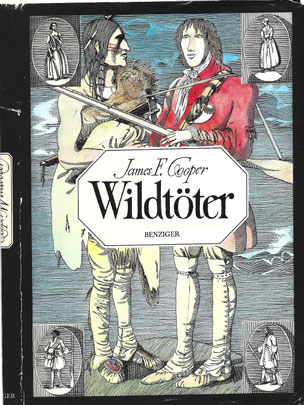
Indianer und Weiße am Glimmerglas-See
James Fenimore Cooper: „Wildtöter“ (Deerslayer)
Scroll down for English version
Die fünf Lederstrumpf-Romane von James F. Cooper (1789–1851) sind in der Reihenfolge ihrer Ersterscheinung:
-„The Pioneers, or the Sources of the Susquehanna”, 1823
(”Die Ansiedler”, 1824)
-“The Last of the Mohicans”, 1826
(“Der letzte Mohikaner”, 1826)
-“The Prairie“, 1827
(„Die Prairie“, 1845)
-„Pathfinder, or „The Inland Sea“, 1840
(“Pfadfinder”, 1840)
-“Deerslayer, or The First War-Path”, 1841
(“Wildtöter”, 1841)
Von den zahlreichen Büchern Coopers ist diese Reihe im Gedächtnis geblieben, wozu die Bearbeitungen als Jugendbücher, Spielfilme und andere Medien beigetragen haben. Die Bände bieten keine chronologische Handlungsfolge, vielmehr müsste der letzte Band „Wildtöter“ am Anfang der Reihe stehen, da es hier um die frühesten Ereignisse geht und die auftretenden Personen in ihrer Jugend stehen. Aber in den fast zwei Jahrzehnten zwischen erstem und letztem Band ist ein gewachsenes Können des Autors deutlich spürbar, liest sich doch der „Wildtöter“ erheblich flüssiger, eleganter und anschaulicher als etwa der so viel früher erschienene „Letzte Mohikaner“. Auch Naturschilderungen haben eine andere, sanfte Dynamik und ein Eigenleben, das jenseits von Topographie besteht. Die Fließgeschwindigkeiten des Wassers, die am Ufer überhängenden Zweige, perspektivische Veränderungen beim Paddeln – das alles hat die Konturen des Erzählens mit einem anderen Pulsieren erfüllt. Vermutlich lässt auch die neue deutsche Übersetzung von Günter Löffler die Sprache Coopers geschmeidiger und schlanker erscheinen - mir liegt zudem eine Ausgabe des Benziger Verlags 1977 vor als Lizenzausgabe des Verlags Neues Leben (Berlin/DDR, 1976) mit Zeichnungen von Klaus Ensikat, die den Lesegenuss erheblich steigern.
Der Titel „Wildtöter“ stellt zwar die Hauptperson der Lederstrumpf-Reihe in den Fokus, aber dieser Wildtöter, der als weißer Junge bei den Delaware-Indianern sozialisiert wurde und als Nathaniel Bumppo, Hawkeye (Falkenauge), Kundschafter, Waldläufer und was auch immer bezeichnet wird, ist in diesem Roman keineswegs die Hauptfigur. Das Buch hat wenige Nebenfiguren. Die Handlung erstreckt sich zwischen den weißen Männern Tom Hutter und Henry March, den beiden Schwestern Judith und Hetty, die als Töchter Tom Hutters gelten, sowie zwischen dem Delaware-Paar Chingachgook und Wah-tah-wah und den Huronen Rivenoak (der hier „Gespaltene Eiche“ heißt), Häuptling Puma und dessen Schwester Sumach - die Letzteren sind bereits Nebenfiguren, wenn auch entscheidend für den Handlungsverlauf. Wildtöter als weißer Delaware bildet die mentale Brücke zwischen Weißen und Indigenen, wobei er indianische und christliche Ethik miteinander verknüpft.
Ja, doch, spannend geht es durchaus auch zu, obwohl das Hin und Her des Plots nicht immer ganz logisch scheint. Folgendes passiert, und zwar meist auf dem Glimmerglas-See im heutigen Bundesstaat New York und an dessen Ufern. Der ältere Tom Hutter und der jüngere Henry March, genannt Hurry Harry, sind zwei Wildnis-affine, wenig zartfühlende Kerle. Harry hat ein Auge auf Tom Hutters schöne Tochter Judith geworfen, traut sich aber sich nicht richtig heran – er zögert mit Recht, denn sie hat mit ihm nichts im Sinn. Tom und seine beiden Töchter leben mitten im See in der „Burg“, einer Art Pfahlbau, und können sich per Kanu, vor allem aber mit einem großen Floß, der sogenannten „Arche“, ans Ufer bewegen. Harry ist zudem mit dem jungen Wildtöter Natty Bumppo befreundet, was den Leser etwas zweifeln lässt, denn hinsichtlich ihrer ethischen Einstellung sind die Beiden fast konträr – Harry der skrupellose Haudrauf, Wildtöter der klug Abwägende mit hohen sittlichen Ansprüchen, dem dann folgerichtig auch keine kämpferischen Fähigkeiten zugesprochen werden. Wildtöter seinerseits ist auch mit dem Delaware-Indianer Chingachgook aus dem Geschlecht der Uncas befreundet, der hier in seiner Jugend auftritt – in Coopers „Letztem Mohikaner“ ist Chingachgook ein alter Krieger und Uncas sein Sohn. Chingachgook wird von Wildtöter erwartet, da Huronen das Delaware-Mädchen Wah-ta-Wah entführt haben, Chingachgooks zukünftige Frau; Wildtöter will ihm behilflich sein, die Schöne aus Feindesland zurückzuholen.
Zwischen weißen Trappern, edlen Delawaren und wilden Huronen
Cooper, sicherlich inspiriert von realen Ereignissen um den Trapper Daniel Boone (1734-1820), dessen Tochter von Indianern geraubt wurde (Boone ist wohl auch das Vorbild für Tom Hutter), knüpft nun ein Netz aus Beziehungen und Begegnungen, labilen Bindungen und feindseligen Kontroversen, das zwar mit ethisch-religiösen Disputen getränkt wird, aber zu keinem konstruktiven Ende führt. Das Ende jedenfalls ergibt sich nicht zwingend aus der Handlung, sondern aus dem halbwegs herbeigezauberten Auftreten britischer Soldaten, die in einem – von Cooper sehr lakonisch behandelten – Massaker den ganzen Spuk beseitigen.
Die Handlung wäre natürlich zu geradlinig verlaufen, wenn es nur um die Befreiung der jungen Delaware Wah-ta-Wah durch Wildtöter und Chingachgook gegangen wäre. Für Tom und Harry spielt diese Angelegenheit, spielt auch die Bindung zwischen Wildtöter und Chingachgook keine Rolle. Sie haben herausgefunden, dass im Lager der Huronen am andern See-Ufer kaum Krieger, sondern hauptsächlich Frauen und Kinder anwesend sind – leichte Beute für sie, die beiden weißen Männer werden sie überfallen, skalpieren und die Skalps an die Briten verkaufen. Wildtöter rudert die beiden im Kanu ans Ufer und will selbst nicht mitmachen, nimmt aber den Mordplan hin. Die Sache geht gründlich schief. Es sind nicht die beiden Weißen, die sich an wehrlosen indigenen Familien gütlich tun, sondern die Huronen nehmen die beiden Männer gefangen und drohen ihnen mit dem Tod.
Wildtöter ist mit dem Kanu die Nacht über in Ufernähe geblieben und wird am Morgen von einem Huronen angegriffen, den er tötet. Es ist ein ehrenvoller Tod, und sterbend verleiht ihm der Krieger den Namen „Hawkeye“ – Falkenauge, unter dem Natty Bumppo in den Lederstrumpf-Romanen gelegentlich auftaucht. Einen zweiten Huronen kann Wildtöter ohne Blutvergießen vertreiben, und als er, zurück in der Burg, den Mädchen die Lage erklärt, wird nach einem Mittel gesucht, Tom und Harry lebend auszulösen. Es gibt da eine schwere alte Truhe, in der Tom seine Geheimnisse verwahrt, sie lässt sich aber nicht öffnen. Judith ist fasziniert von Wildtöters aufrichtiger, unerschrockener Art und bringt ihn zusammen mit ihrer geistig etwas behinderten Schwester Hetty zum vereinbarten Ufer-Treffpunkt mit Chingachgook. Der kann auch sekundenschnell an Bord genommen werden, aber er wird verfolgt von einer ganzen Huronenmeute, der man nur mühsam entkommt. Es ist klar, dass jetzt alle Vier mit Huronen-Angriffen rechnen müssen.
Chingachgook hat bei den Huronen offenbar Tom und Harry unverletzt, aber von baldigem Tod bedroht gesehen, und zu den mitunter etwas seltsamen Windungen der Handlung gehört es, dass Hetty sich vornimmt, die Männer im Alleingang zu retten. In der Abenddämmerung macht sie sich unbemerkt mit einem Kanu davon und landet am Ufer. Sie ist in der Dunkelheit praktisch nicht mehr sichtbar, aber auf der Arche vermutet man, wo sie sich aufhält, und versucht, sie zurückzurufen. Was für ein Dialog im Dunkeln, ohne dass Fragende und Antwortende einander sehen! Irgendwann ist Hetty verschwunden und antwortet nicht mehr. Unerschrocken ist sie überzeugt, den Huronen durch lautes Vorlesen aus der Bibel die Geiseln entreißen zu können, aber zuerst macht sie es sich im Wald bequem und schläft ein.
Als sie am Morgen von einem Bärenjungen geweckt wird, steht plötzlich auch Wah-ta-Wah vor ihr, die von Chingachgooks Rettungsplan überzeugt ist. Als Gefangene der Huronen, von denen einer sie für seinen Wigwam vorgesehen hat, gehörte Wah-ta-Wah selbst zu den potentiellen Skalpierungsopfern von Tom und Harry, denen sie knapp entkam. Es schließt sich eine irre Szene an, in der Hetty den Indianern mit der Bibel auf die Nerven geht.
Derweil auf Burg und Arche mitten im See: es gelingt, die Truhe zu öffnen, es kommen eine Menge Kleidungsstücke zum Vorschein, von denen keines Tom zu gehören scheint, sowie zwei Pistolen. Beim Ausprobieren explodiert eine in Hawkeyes Hand im Lauf. Schließlich kommt auch ein Elfenbein-Schachspiel mit Elefantenfiguren zum Vorschein. Aber da man mit Huronen-Angriffen rechnen muss, wird die Burg komplett ausgeräumt und alle Gegenstände einschließlich der Möbel auf die Arche gebracht. Tatsächlich legt auch ein Floß mit Huronen vom Ufer ab. Wildtöter zeigt ihnen eine der Elefantenfiguren – Tiere mit zwei Schwänzen haben sie noch nie gesehen, sie sind völlig weg davon und lassen sich auf den Deal ein – pro Elefant soll eine Person frei kommen. Für den Fall, dass die Huronen es sich doch noch anders überlegen und trotzdem angreifen, um weitere Schätze zu erbeuten, schlägt Hetty gemeinsames Bibelvorlesen vor. Wildtöter wird da nicht mithalten, er kann nicht lesen.
Die Huronen bringen Tom und Harry dank der Elefanten aber tatsächlich gefesselt zur Arche zurück. Doch auf beiden Seiten ist die Situation nicht entspannt. Die befreiten Geiseln planen Rache für die Demütigung. Die Huronen sind womöglich auf weitere Beute aus. Und Wah-ta-Wah ist noch immer bei ihnen gefangen. Um sie endlich zurückzuholen, machen sich Tom, Harry, Wildtöter und Chingachgook mit dem Kanu ins feindliche Lager auf – und finden es leer, die Huronen haben den Standort gewechselt. Chingachgook und Wildtöter entdecken sie aber, schleichen sich an, und Chingachgook gelingt die Flucht mit Wah-ta-Wah, doch dabei gerät Wildtöter in Gefangenschaft.
Wird Wildtöter durch ehrenvolle Folter sterben?
Nun sind Huronen, die von Cooper immer wieder als hinterlistige Brutalos geschildert werden, nicht einfach Mörder, sondern erstmal auf ihren Vorteil bedachte Diplomaten. „Gespaltene Eiche“ (Rivenoak) schlägt Wildtöter vor, seine weißen Freunde auszuliefern und selber dann bei den Huronen zu leben – einen Krieger wie ihn können sie gebrauchen. Den ungeheuerlichen Verrat lehnt der junge Mann natürlich ab, so dass ihm jetzt mit ehrenvoller Folter gedroht wird.
Das bekommt Hetty mit, die wegen ihrer Geistesschwäche von den Huronen nicht als Gefahr betrachtet wird und sich ungehindert zwischen den Fronten bewegt. Sie berichtet es Judith, die längst in Wildtöter verliebt ist und ihn unter allen Umständen retten will. Die beiden Mädchen im Kanu, Tom, Harry, Chingachgook und Wah-ta-Wah auf der Arche schwimmen aber erstmal auf die verlassene Burg zu, in der Huronen vermutet werden – vom Abzug der Bewohner hatten sie nichts mitbekommen und daher wohl einen tödlichen Angriff geplant. Und tatsächlich – als Chingachgook als Kundschafter die Burg betritt, stellt sich heraus, dass drei Huronen ins Innere gekommen sind.
Es entspannt sich eine langwierige, tödliche Auseinandersetzung, in der Cooper seine Detailfreude an Kampfszenen auslebt. So liefert sich Harry einen schrecklichen Nahkampf mit einem Huronen, während Tom den Feinden in die Hände fällt und gefesselt wird. Nachdem sich Kämpfe sowohl in der Burg als auch auf der Arche abgespielt haben, finden Judith und Hetty ihren Vater sitzend auf der Arche – nachdem er vor hatte, Frauen und Kinder zu skalpieren, haben die Huronen nun ihm dieses Schicksal zugefügt – er stirbt bald darauf an seiner schweren Verletzung und berichtet noch kurz zuvor, er sei nicht der leibliche Vater der beiden Mädchen. Er wird im See bestattet an derselben Stelle, wo auch die Mutter am Gewässergrund unter einem Erdhügel liegt. Irritierend angesichts von Coopers Detailfreude, dass hier ein doch sehr ungewöhnlicher Vorgang mit leichter Hand abgewickelt wird – das weiße Leichentuch der Mutter scheint noch hervorzublitzen, und um den Vater zu beerdigen, hätte es nicht mindestens einen Taucher benötigt? Und wieso hält diese Erdaufschüttung trotz der Bewegung des Wassers, die manchmal sogar die Arche abtreiben lässt?
Nach Toms Tod will Harry fortgehen, sein Heiratsangebot an Judith wird abgelehnt. Er verspricht aber, das britische Fort aufzusuchen und zum Schutz der Mädchen ein paar Soldaten anzufordern. Die Mädchen sollten wohl besser nicht allein in der „Wildnis“ bleiben, doch Hetty möchte nicht fortgehen, sie schlägt Judith vor zu heiraten, dann wäre doch ein Mann bei ihnen.
Bevor dieser Handlungsstrang weiter entwickelt wird, taucht plötzlich der bei den Huronen gefangene Wildtöter im Kanu auf – er ist nicht frei, sondern wurde mit einer Botschaft geschickt. Die Huronen, erneut clevere Diplomaten, fordern Wah-ta-Wah zurück und bieten den beiden weißen Schwestern ein Zuhause in ihrem Stamm an, der dann natürlich auch Toms Nachlass bekäme. Bis zum Mittag des nächsten Tages muss Wildtöter zurück sein. In allen Fällen wird das Angebot abgelehnt, was Wildtöter nun endgültig das Leben kosten wird. Dass er sein Wort halten und sich nicht davonstehlen wird, steht für ihn außer Frage.
Wenn der Tomahawk fliegt...
Aber zunächst räumt er mit Judith die große Truhe aus, um den ganzen Nachlass sowie Toms wahre Identität zu erkunden. Es stellt sich heraus, dass Tom unter falschem Namen gelebt hat und ein steckbrieflich gesuchter Pirat war – war er überhaupt mit der Mutter der Mädchen verheiratet? War er am Tod des leiblichen Vaters schuld?
Im Grunde wollen die Huronen den Foltertod Wildtöters vermeiden. Als er wie vereinbart bei ihnen zurück ist – was sie ihm hoch anrechnen – schlagen sie erneut einen Deal vor. Sumach, die Witwe des Mannes, den er getötet hat, steht nun ohne Ehemann da, eigentlich ist es seine Pflicht, sie zu heiraten. Aber er ist ein weißer Christ, und das geht gegen seine Natur. Die Ablehnung wird als empörende Arroganz verstanden, und Puma, Häuptling und Bruder der Witwe, schleudert wütend den Tomahawk gegen ihn. Toller Gag, der genau so in manchen Verfilmungen vorkommt: noch im Flug bekommt Wildtöter die Waffe in den Griff und schleudert sie auf demselben Weg zurück, wobei er den Mann tödlich an der Stirn trifft. Im allgemeinen Durcheinander kann Wildtöter entkommen und sich am Ufer ins Kanu retten, aber die Huronen haben vorsichtshalber das Paddel entfernt. Er versteckt sich liegend und hofft, dass das Boot vom Ufer weggetrieben wird. Als der Lärm verklungen ist, steht er auf und sieht sich um: „Gespaltene Eiche“ steht direkt vor ihm, er hat das Kanu ans Ufer gezogen. Die huronische Diplomatie erneuert das Heiratsangebot, die arme Sumach hat schließlich durch Wildtöters Hand nun auch ihren Bruder verloren, aber das Angebot wird wieder abgelehnt. Man erhöht den Druck, Wildtöter wird gefesselt an einen Baum gebunden, Sumach tritt vor ihn hin und versucht es noch einmal – vergeblich. Der Stamm ist wütend über die fortgesetzte Missachtung und beginnt mit dem Vorspiel der Folter, die zunächst nur aus Einschüchterungen und Beschimpfungen besteht.
Plötzlich erscheint Judith – in einem der Brokatgewänder aus der Truhe. Sie tritt in herrschaftlicher, ja königlicher Überlegenheit auf, und den Huronen verschlägt es die Sprache. Aber nicht lange – der Versuch, Wildtöter durch ein paar weitere Elfenbeinfiguren auszulösen, schlägt fehl, die Vorbereitungen der Folter gehen weiter. Erneute Verblüffung, als auch Wah-ta-Wah und Chingachgook auftauchen, um Wildtöter mitzunehmen. Die beiden haben gegen zornige Huronen freilich keine Chance – wie soll eine derart auf die Spitze getriebene Handlung enden? Mit dem absehbaren Tod aller Hauptfiguren?
Nein, zwar mit einem Massaker, aber nicht an dem der Hauptfiguren. Harry hat im britischen Fort die Soldaten alarmiert, und die greifen nun ein. Einige Huronen können fliehen, viele werden getötet, mit einer fast beiläufigen Lakonie lässt Cooper die Spannung in Vernichtung auslaufen: „Dann verrichteten die Bajonette ihr blutiges Werk“, heißt es schließlich ungerührt, als ginge es um eine Banalität.
Bei den Kämpfen ist Hetty verletzt worden und stirbt nach einer rührenden Abschiedsszene mit Judith. Die handelnden Personen erwarten ein anderes Leben, das sie nun auseinander treibt. Judith springt über den Schatten ihrer anerzogenen Schicklichkeit und macht Wildtöter einen Heiratsantrag, den er ins Leere laufen lässt. Sie geht wortlos und allein davon. Wildtöter wird aufseiten der Briten kämpfen, Chingachgook und Wah-ta-Wah gehen zu den Delawaren zurück. Als Wildtöter nach 15 Jahren zufällig wieder in der Gegend ist, findet er außer den zerfallenden Spuren des Massakers auch ein Band von Judith in der Arche. Er steckt es an den Ladestock seines Gewehrs. Im Fort erkundigt er sich nach ihr, aber außer nebulösen Andeutungen kann niemand ihm sagen, was aus ihr geworden ist. Cooper schließt mit schmerzlich-versöhnlichen Worten: „Wir leben in einer Welt der Vergehen und der Selbstsucht. Kein Bild, das dies übersieht, kann wahr sein. Zum Glück blinzelt wie die Sonne hinter Wolken jener reine Geist durch, nach dessen Vorbild der Mensch geschaffen sein soll. Seine Strahlen liegen verklärend auf aller Niedertracht.“ Nun ja.
James Fenimore Cooper: „The Deerslayer”, Deutsch “Wildtöter”, neu übersetzt von Günter Löffler, Benziger Verlag, Zürich/Köln 1977, Lizenzausgabe des Verlags Neues Leben, Berlin, DDR, 1976, Schutzumschlag, Einband und Illustrationen im Text: Klaus Ensikat, 332 S., ISBN 3 545 32135 5
27. Februar 2025 Copyright Christel Heybrock
Native Americans and White Settlers at Glimmerglass Lake
James Fenimore Cooper: *The Deerslayer*
The five Leatherstocking Tales by James F. Cooper (1789–1851), listed in the order of their original publication, are:
*The Pioneers, or the Sources of the Susquehanna* (1823)
*The Last of the Mohicans* (1826)
*The Prairie* (1827)
*The Pathfinder, or The Inland Sea* (1840)
*The Deerslayer, or The First War-Path* (1841)
Of Cooper’s numerous books, this series has endured in the public consciousness, aided by adaptations for young readers, feature films, and other media. The volumes do not follow a chronological narrative sequence; in fact, the final volume, *The Deerslayer*, ought to stand at the beginning of the series, as it deals with the earliest events and portrays the characters in their youth. Yet, the author’s growing mastery is clearly palpable across the nearly two decades separating the first and last volumes; *The Deerslayer* reads far more fluidly, elegantly, and vividly than, for instance, *The Last of the Mohicans*, which appeared so much earlier. The descriptions of nature, too, possess a different, gentle dynamic and a life of their own that transcends mere topography. The speed of the flowing water, the branches overhanging the shore, the shifting perspectives while paddling—all of this has infused the contours of the storytelling with a different kind of pulse. Presumably, Günter Löffler’s new German translation also makes Cooper’s language appear smoother and more streamlined; I also have at hand a 1977 Benziger Verlag edition—licensed from Verlag Neues Leben (Berlin/GDR, 1976)—featuring illustrations by Klaus Ensikat that significantly enhance the reading experience.
While the title *The Deerslayer* places the central figure of the Leatherstocking series in the spotlight, this Deerslayer—a man raised as a white boy among the Delaware Indians, known variously as Nathaniel Bumppo, Hawkeye, scout, woodsman, and so forth—is by no means the main character of this particular novel. The book has few secondary characters. The action revolves around the white men Tom Hutter and Henry March; the two sisters Judith and Hetty (considered Tom Hutter’s daughters); the Delaware couple Chingachgook and Wah-tah-wah; and the Hurons Rivenoak (referred to here as "Split Oak"), Chief Puma, and his sister Sumach—the latter group being secondary characters, albeit crucial to the plot’s progression. As a white man living among the Delaware, Deerslayer forms a mental bridge between white settlers and Indigenous people, blending Native American and Christian ethics.
Indeed, the story is certainly suspenseful, even if the plot’s twists and turns do not always seem entirely logical. The events unfold—mostly on Glimmerglass Lake (in present-day New York State) and along its shores—as follows: the older Tom Hutter and the younger Henry March (known as "Hurry Harry") are two rough-hewn fellows with a passion for the wilderness. Harry has his eye on Tom Hutter’s beautiful daughter Judith but lacks the confidence to make a move—and rightly hesitates, for she has no interest in him whatsoever. Tom and his two daughters live in the middle of the lake in the "Castle"—a sort of stilt house—and travel to the shore by canoe or, more often, on a large raft known as the "Ark." Harry is also friends with the young frontiersman Natty Bumppo—a pairing that gives the reader pause, given their diametrically opposed ethical outlooks: Harry is a ruthless brawler, whereas Bumppo is a thoughtful, prudent man of high moral principles who, fittingly, possesses no combat skills. For his part, Bumppo is friends with the Delaware Indian Chingachgook (of the line of Uncas), who appears here in his youth—unlike in Cooper’s *The Last of the Mohicans*, where Chingachgook is an elderly warrior and Uncas is his son. Bumppo is awaiting Chingachgook because the Hurons have abducted Wah-ta-Wah, a Delaware maiden and Chingachgook’s future wife; Bumppo intends to help him rescue the young woman from enemy territory.
Among white trappers, noble Delawares and wild Hurons
Cooper—surely inspired by real-life events involving the trapper Daniel Boone (1734–1820), whose daughter was abducted by Native Americans (and who likely served as the model for Tom Hutter)—weaves a web of relationships and encounters, fragile bonds and hostile conflicts. While this web is steeped in ethical and religious disputes, it leads to no constructive resolution. Indeed, the ending does not arise inevitably from the plot itself but rather from the somewhat contrived arrival of British soldiers, who put an end to the entire ordeal in a massacre that Cooper describes with great brevity.
The plot would naturally have been too straightforward had it focused solely on the matter of liberating the young Delaware woman Wah-ta-Wah by Deerslayer and Chingachgook. For Tom and Harry, this matter—and the bond between Deerslayer and Chingachgook—is of no consequence. They have discovered that the Huron camp on the far shore holds few warriors, consisting mainly of women and children—easy prey for the two white men, who plan to ambush them, scalp them, and sell the scalps to the British. Deerslayer rows the pair to shore in the canoe; while he refuses to participate himself, he acquiesces to their murderous plan. The scheme goes disastrously wrong. Far from preying upon defenseless Indigenous families, the two white men are themselves captured by the Hurons and threatened with death.
Deerslayer remains in the canoe near the shore overnight; in the morning, he is attacked by a Huron warrior, whom he kills. It is an honorable death, and as he expires, the warrior bestows upon him the name "Hawkeye"—the name by which Natty Bumppo occasionally appears in the *Leatherstocking Tales*. Deerslayer manages to drive off a second Huron without bloodshed; upon returning to the "Castle" and explaining the situation to the young women, they seek a way to ransom Tom and Harry alive. There is a heavy old chest in which Tom keeps his secrets, but it cannot be opened. Judith, fascinated by Deerslayer’s sincere and fearless nature, accompanies him and her sister Hetty—who has a mental disability—to the agreed-upon meeting point on the shore to rendezvous with Chingachgook. They manage to take Chingachgook aboard in a split second, but he is pursued by a pack of Hurons, and they escape only with great difficulty. It is clear that all four must now brace themselves for attacks by the Hurons.
Chingachgook has evidently seen Tom and Harry among the Huron—unharmed but facing imminent death—and one of the plot’s somewhat peculiar twists is Hetty’s resolve to rescue the men single-handedly. At dusk, she slips away unnoticed in a canoe and lands on the shore. Though virtually invisible in the darkness, those on the Ark guess her whereabouts and try to call her back. What a dialogue in the dark, with neither the questioner nor the respondent able to see the other! Eventually, Hetty vanishes and stops answering. Undaunted, she is convinced she can wrest the hostages from the Huron by reading aloud from the Bible, though she first settles down comfortably in the woods and falls asleep.
When a bear cub wakes her in the morning, she suddenly finds Wah-ta-Wah standing before her—who believes in Chingachgook’s rescue plan. As a Huron captive—one warrior having already earmarked her for his wigwam—Wah-ta-Wah had herself been among the potential scalping victims of Tom and Harry, narrowly escaping that fate. A bizarre scene follows in which Hetty gets on the Indians' nerves with the Bible.
Meanwhile, at the castle and the Ark out on the lake: they manage to open the chest, revealing a quantity of clothing—none of which seems to belong to Tom—as well as two pistols. When tested, one of the pistols explodes in Hawkeye’s hand. Finally, an ivory chess set featuring elephant-shaped pieces comes to light. However, anticipating a Huron attack, they completely clear out the castle, moving all items—furniture included—onto the Ark. Sure enough, a raft carrying Huron warriors is seen pushing off from the shore. Deerslayer shows them one of the elephant figurines—animals with two tails are something they have never seen before; they are completely captivated and agree to the deal: one person is to be released for each elephant. In case the Hurons change their minds and attack anyway to seize more treasure, Hetty suggests reading the Bible together. Deerslayer cannot participate in this, however, as he cannot read.
Thanks to the elephants, the Hurons do indeed bring Tom and Harry back to the Ark—bound, but alive. Yet the situation remains tense on both sides. The freed hostages plan revenge for the humiliation they suffered. The Hurons are likely intent on securing further spoils. And Wah-ta-Wah remains a captive in their hands. To finally rescue her, Tom, Harry, Deerslayer, and Chingachgook set out by canoe for the enemy camp—only to find it empty; the Hurons have relocated. However, Chingachgook and Deerslayer track them down and creep up on the camp; Chingachgook succeeds in escaping with Wah-ta-Wah, but in the process, Deerslayer is taken prisoner.
Is Deerslayer supposed to die by honorable torture?
In this context, the Hurons—whom Cooper consistently portrays as treacherous brutes—appear not merely as murderers, but as diplomats primarily concerned with their own advantage. "Rivenoak" proposes that Deerslayer hand over his white friends and come to live among the Hurons himself—for a warrior like him would be a great asset. Naturally, the young man refuses this monstrous act of betrayal, and is consequently threatened with "honorable" torture.
Hetty—whom the Hurons do not view as a threat due to her mental frailty, allowing her to move unhindered between the opposing sides—overhears this. She informs Judith, who has long been in love with Deerslayer and is determined to save him at all costs. Meanwhile, the two girls in their canoe, along with Tom, Harry, Chingachgook, and Wah-ta-Wah on the "Ark," head toward the abandoned castle, where they suspect the Hurons are lurking; unaware that the inhabitants had already departed, they had likely been planning a deadly assault. Sure enough, when Chingachgook enters the castle as a scout, he discovers that three Hurons have made their way inside.
A protracted, deadly skirmish ensues, allowing Cooper to indulge his penchant for detailed combat scenes. Harry engages in a brutal hand-to-hand fight with a Huron, while Tom falls into enemy hands and is taken prisoner. After fighting breaks out both in the castle and on the Ark, Judith and Hetty find their father sitting on the Ark; the Hurons have inflicted upon him the very fate he had intended for women and children—scalping. He dies shortly thereafter from his severe injuries, revealing just before the end that he is not the girls' biological father. He is buried in the lake at the same spot where their mother lies on the bed of the water beneath a mound of earth. It is puzzling, given Cooper’s usual attention to detail, that such an unusual procedure is handled so casually: the mother’s white burial shroud seems to remain visible, and wouldn't burying the father have required a diver, at the very least? And why does this earthen mound hold firm despite the movement of the water—which is sometimes strong enough to set the Ark adrift?
After Tom’s death, Harry wants to leave; his proposal of marriage to Judith is rejected. However, he promises to visit the British fort and request a few soldiers to protect the girls. It would likely be unwise for the girls to remain alone in the "wilderness," yet Hetty does not want to leave; she suggests that Judith get married, as that would provide them with a man’s presence.
Before this plotline develops further, Deerslayer—who had been held captive by the Hurons—suddenly appears in a canoe; he is not a free man but has been sent with a message. The Hurons, once again proving themselves clever diplomats, demand the return of Wah-ta-Wah and offer the two white sisters a home within their tribe—which would, of course, also inherit Tom’s estate. Deerslayer must return by noon the following day. The offer is rejected across the board—a decision that will ultimately cost Deerslayer his life. For him, keeping his word rather than sneaking away is a matter of absolute certainty.
But first, he and Judith empty the large chest to examine the entire estate and uncover the truth about Tom’s identity. It turns out that Tom had lived under an assumed name and was a wanted pirate—was he even married to the girls' mother? Was he responsible for the death of their biological father?
When the tomahawk is flying…
Fundamentally, the Hurons wish to avoid subjecting Deerslayer to a death by torture. When he returns to them as agreed—an act they greatly respect—they propose a new deal. Sumach, the widow of the man he killed, is now without a husband; strictly speaking, it is his duty to marry her. Yet he is a white Christian, and doing so goes against his nature. The refusal is perceived as outrageous arrogance, and Puma—a chief and the widow’s brother—furiously hurls his tomahawk at him. It is a brilliant moment, one that appears exactly this way in some film adaptations: while the weapon is still in mid-air, Deerslayer catches it by the handle and hurls it back along the same trajectory, striking the man fatally in the forehead. Amidst the ensuing chaos, Deerslayer manages to escape and scramble into the canoe at the water's edge, only to find that the Hurons have removed the paddle as a precaution. He lies low, hoping the boat will drift away from the shore. When the commotion dies down, he stands up and looks around: "Split Oak" is standing right in front of him—he had pulled the canoe back to the bank. The Hurons renew the marriage proposal—after all, poor Sumach has now lost her brother at Deerslayer’s hands as well—but the offer is rejected once more. They increase the pressure; Deerslayer is bound to a tree, and Sumach steps before him to try again—but to no avail. Enraged by this continued defiance, the tribe begins the prelude to torture, which initially consists merely of intimidation and verbal abuse.
Suddenly, Judith appears—wearing one of the brocade gowns from the chest. She carries herself with a regal, even majestic air of superiority, leaving the Hurons speechless. But not for long—an attempt to ransom Deerslayer with a few more ivory figures fails, and preparations for the torture proceed. There is renewed astonishment when Wah-ta-Wah and Chingachgook also appear to rescue Deerslayer. Naturally, the pair stands no chance against the angry Hurons—how is such an intensely escalating plot to end? With the foreseeable death of all the main characters?
No; while there is a massacre, it is not of the main characters. Harry has alerted the soldiers at the British fort, and they now intervene. Some Hurons manage to escape, while many are killed; with almost casual laconicism, Cooper allows the tension to dissolve into annihilation: "Then the bayonets did their bloody work," the text notes dispassionately, as if describing a triviality.
Hetty is wounded during the fighting and dies after a touching farewell scene with Judith. The characters face a different life that now drives them apart. Judith steps beyond the bounds of her ingrained propriety to propose marriage to Deerslayer, but he lets the offer go unheeded. She walks away alone and without a word. Deerslayer goes to fight on the British side, while Chingachgook and Wah-ta-Wah return to the Delawares. When Deerslayer happens to be back in the area fifteen years later, he finds not only the decaying traces of the massacre but also a ribbon belonging to Judith inside the *Ark*. He attaches it to his rifle's ramrod. At the fort, he asks about her, but—beyond vague hints—no one can tell him what became of her. Cooper concludes with words that are at once painful and conciliatory: “We live in a world of transgression and selfishness. No image that overlooks this can be true. Fortunately, like the sun emerging from behind clouds, that pure spirit—in whose image man is said to have been created—shines through. Its rays cast a transfiguring light upon all baseness.” Well, then.
James Fenimore Cooper: *The Deerslayer* (German title: *Wildtöter*), newly translated by Günter Löffler; Benziger Verlag, Zurich/Cologne 1977; licensed edition from Verlag Neues Leben, Berlin, GDR, 1976; dust jacket, binding, and in-text illustrations by Klaus Ensikat; 332 pp.; ISBN 3 545 32135 5
February 27, 2025 Copyright Christel Heybrock
Transltion by Google