Die Ganzheit der Welt und der rätselnde Leser
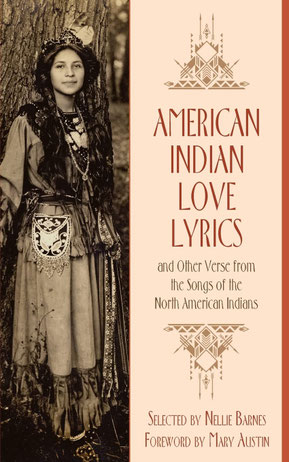
Nellie Barnes‘ Sammlung „American Indian Love Lyrics…”
Scroll down for English Version
Die Kollektion ist weit verbreitet in verschiedenen Ausgaben, aber wenn man nach bestimmten Fakten sucht, die eigentlich selbstverständlich sind, greift man ins Unbekannte. Mir liegt ein Reprint der MacMillan Company New York von 1925 vor: „American Indian Love Lyrics and Other Verse from the Songs of the North American Indians”, selected by Nellie Barnes, foreword by Mary Austin.
Nellie Barnes (= Nellie L. Davis, 1890-1967) und Mary Austin (1868-1934), beide an indigenen Kulturen Nordamerikas interessiert, korrespondierten miteinander, es scheint ein großes Konvolut in Manuskriptform in der Universität von Kansas zu geben. Indianerkennerin Mary Austin, deren umfangreiches literarisches Werk bald nach ihrem Tod in Vergessenheit geriet, wurde zwar im Zuge der feministischen Bewegung der 1970er Jahre wieder entdeckt, aber nicht hauptsächlich mit dem Fokus auf indianischen Kulturen. Von Nellie Barnes ist weitaus weniger bekannt, doch ihre schriftstellerische Tätigkeit und ihr Interesse an den Ureinwohnern machen ihre Nähe zu Mary Austin plausibel. Dabei lagen die beiden Frauen in ihrer Mentalität diametral auseinander, obwohl sie der Anspruch eint, die kulturellen Leistungen von Indianern denen der Weißen als gleichwertig gegenüber zu stellen.
Unter anderem dies ist der Grund für das Problem heutiger weißer Leser mit dieser Sammlung. Mary Austin, der inzwischen von indigener Seite der Vorwurf kultureller Aneignung gemacht wurde, verfolgte eine emotionale, zutiefst mitfühlende Identifikation mit den indigenen Texten, was sie zur Außenseiterin in der weißen Gesellschaft machte. Ihre Herangehensweise führt heute zu der Frage, wer eigentlich der Übersetzer der „Gedichte“ in diesem Band ist. Es handelt sich dabei zum Teil um berühmte rituelle Healing Songs wie den Navajo Night Chant („…restore my life for me…“). Die Textsammlung umfasst Beispiele aus verschiedenen indigenen Sprachen und Kulturen – Navajo, Dakota, Omaha, Pima, Pawnee, Hopi, um nur einige zu nennen – sie erscheinen hier alle auf Englisch. Hat Mary Austin sie übersetzt (was eine ungeheuerliche Leistung wäre) oder hat sie sie nachempfunden, gemäß ihrer eigenen Definition „re-expressed“, also nachgedichtet? In diesem Fall wäre uns der erwähnte Navajo Night Song in der Version Mary Austins allgemein geläufig, und zwar auch, wenn er in der englischsprachigen indigenen Literatur etwa in Scott Momadays „House Made of Dawn“ zitiert wird… Die Sache ist kompliziert.
Nellie Barnes hingegen wurde gewürdigt für ihre eher distanzierte, auf wissenschaftlichem Interesse basierende Auseinandersetzung mit den von ihr zusammengetragenen Texten in dieser Sammlung. In einem 22-seitigen Essay widmet sie sich deren strukturellen Besonderheiten, den Rhythmen, Versmaßen, Wiederholungen, den Beziehungen zwischen Wort und Musik, Wort und Tanz. Nun sitzt der weiße Leser aber doppelt ratlos über dem schmalen Buch – denn Barnes‘ Strukturanalyse trägt null zum Verständnis der Inhalte bei, sie hätte sich ohne Sinnverlust auch mit völlig abstrakten Lauten und Buchstabenkombinationen befassen können. Man gerät sogar in die Nähe dieser verzweifelten Vorstellung angesichts von Zitaten aus den Originalsprachen in ihrem Essay – hat sie deren Inhalt eigentlich selbst verstanden? Wenn ja, dann haben Inhalte sie einfach nicht interessiert.
Eine andere Auffassung von Wirklichkeit
Was erwartet man, wenn man ein Buch liest? Speziell, wenn man Texte aus einer anderen Kultur liest? Ich denke: vor allem, ein anderes Verstehen, eine andere Wirklichkeitsperspektive. Und da fordert einem dieses Buch eine Menge ab, denn die Songs und Prayers entschlüsseln sich nicht von allein, sie sind auch kulturell so verschieden, dass man erstmal recherchieren muss, um überhaupt zu ahnen, was hier gesagt wird. Und selbst dann – was man als weißer Leser rezipieren kann, ist die verschwommene Wahrnehmung eines fremden Horizonts. Man erkennt Umrisse, Oberflächen, Einzelheiten, man dringt mit Empathie behutsam ein in fremdes Terrain, manches scheint nachfühlbar, geradezu verwandt, aber es bleibt eine andere Geisteswelt, ein anderes Denken, eine andere Erkenntnisweise der Realität.
Doch Distanz kann letztlich auch zu einer Art Nähe führen. Der Versuch des Verstehens führt nicht zwangsläufig zu Vereinnahmung. Die Textsammlung ist nicht nach „Stämmen“ geordnet, sondern nach Themenkomplexen. Das ist in gewisser Weise pädagogisch, jedenfalls steigern sich die Schwierigkeitsgrade von der Thematik „Liebe und Freundschaft“ über Naturphänomene wie Regen, Sonne, Sterne bis hin zu heiligen Plätzen und Bittgesängen, die schließlich fremd anmuten, weil sie Bestandteil von Zeremonien waren.
So beginnt man die Lektüre mit zwei rührenden Aussagen junger Ojibwe-Männer, die nachts im Kanu das Ufer entlangfahren auf der Suche nach ihrer scheuen Liebsten, oder man teilt die Erwartung eines Zuñi, endlich mit dem Herzensmädchen in gemeinsamer Decke durchs Leben zu gehen (Liebespaare pflegten auf diese Weise dezent miteinander zu kuscheln). Eine Algonquin-Frau dagegen beklagt den Verlust ihres Liebsten, der sie vergessen hat: „But I will love none but him.“
Das sind aber auch fast die einzigen derart individuellen Stimmen; die Thematik gleitet bald hinüber zu allgemeineren sozialen Bindungen. Ein Dakota versichert dem Freund, an seiner Seite zu stehen „whatever hardships threaten“ – es ist ein Kriegslied. Ein Onondaga beklagt eine folgenschwere Niederlage, und erschütternd beweint ein Paiute den Tod seines Sohnes, für den er auf dem Berg ein Feuer entzünden wird. Dagegen ermutigt der Wind Song eines Kiowa die Kämpfer, die von liebenden Angehörigen erwartet werden, während er selbst ganz allein ist.
Trauer und Schmerz sind Anlass, durch Worte Heilung zu suchen, sie sind nicht nur Ausdruck von Empfindungen, sondern aktives Handeln, und weiter fortschreitend in der Lektüre ändert sich allmählich die Funktion von Sprache überhaupt. Sprache als rationale Mitteilung verschwindet, sie schält sich zunehmend heraus als Beschwörung, als Anrufung kosmischer Kräfte. Schließlich legt Sprache ihre magische Energie offen, etwa insistierend mittels rhythmischer Wiederholungen.
Singen – für den Hirsch, den Berg, den Tagesanbruch
So beschwört ein Navajo den Hirsch, den er erlegen möchte, durch die in jeder Strophe und am Ende gar dreimal wiederholte Zeile: “Comes the deer to my singing.“ Das Verhältnis indigener Menschen zu jagdbaren Tieren ist aus rationaler weißer Sicht eine der schwierigsten Beziehungen überhaupt, aber sie rührt ans Zentrum indigenen Denkens.
Prinzipiell sind alle Lebewesen gleichwertig, und niemand hat das Recht, einem andern das Leben zu nehmen. Doch als Vegetarier (auch Pflanzen sind beseelte Wesen!) hätten indigene Menschen nicht überlebt, Fleisch war ein Hauptnahrungsmittel. Wenn heute noch Schamanen Pflanzen nicht ohne deren Einverständnis als Heilsubstanzen nutzen, dann gilt das erst recht im Zusammenhang mit Jagdtieren – in gewisser Weise muss das Tier in sein Schicksal einwilligen, sich für das Überleben von Menschen zu opfern. In dem erwähnten Navajo Hunting-Song ist nicht mehr die Rede davon - was man aber als selbstverständlich voraussetzen sollte - dass der Jäger seine Beute respektiert und ihr dankt, dass er dem erlegten Mitgeschöpf ein kleines Opfer bringt wie Wasser oder Tabak, und auch nicht davon, dass die Nahrung eine tiefere Bedeutung hatte als nur das Sattwerden.
Der indigene Mensch steht nicht wie der weiße der „Natur“ gegenüber, sondern er ist Teil einer Landschaft, der Bäume, der Flüsse, der atmosphärischen Erscheinungen wie Wind und Regen. Ein Song der Pawnees richtet sich direkt „To the Trees and Streams“ als beseelter Mitgeschöpfe: „…long the line of trees./ Bending, swaying in the breeze”. In der zweiten Strophe kommt “bright with flashing light” der Fluss hinzu: „swiftly runs, swift the river runs“. Sind die Bäume in der ersten Strope eine dunkle Linie und der Fluss in der zweiten Strophe glitzerndes Licht, so kommt in der dritten Strophe das Plätschern des Flusses als akustische Erscheinung hinzu und wird als „Gesang“ mit den Bäumen zusammen gesehen: „…singing comes, soft the river’s song/ Rippling gently beneath the trees“.
Ein weiterer Pawnee-Song widmet sich den Bergen, und während Menschen auf dem Weg zum Gipfel deren Schärfe und Klarheit im Blick haben, verschwimmen in der dritten Strophe die Rollen von Betrachter und Betrachtetem: „Yonder peak that rose so sharp and clear,/ Behold us now on its head upliftet;/ Resting there at last we sing our song.“ Wird der Berg aufgefordert, die Menschen zu betrachten…? Und wenn sie schließlich singen, ist es für ihn.
Gesungen wird auch für Vögel, und mit dem Adler Kawas in einem Ritualgesang der Pawnee wird die Szene der Zeremonien eröffnet. „Upward turn my eyes, Kawas looks upon me,/ she turns with flapping wings, and far away she flies.” Der Adler ist Teil der komplizierten, mehrere Tage dauernden Hako-Zeremonie, die sich wie ein Mysterienspiel ordnet und im Grunde alles Lebendige als kosmische Familie darstellt, während weiterhin für Wachstum und Gedeihen gebetet und gesungen wird.
Die große Hako-Zeremonie wird auch an späterer Stelle wieder aufgegriffen, und zwar stets ohne den Zusammenhang zu erwähnen. Es werden einzelne Lieder aus der Zeremonie präsentiert wie separate „Gedichte“ an den Morgenstern (=) Venus) und die Morgendämmerung. Der Tagesanbruch wird als kosmischer Schöpfungsverlauf stellvertretend von Kawas dem Adler besungen:
Then Kawas stands and speaks forth:
“A child from Night is now born;
Tirá wa, father on high,
On Darkness moving, brings Dawn.”
Tirá wa entspricht dem universalen Schöpfergeist, er befindet sich in der Himmelskuppel, die über allem wacht – was für eine korrekte Vorstellung von der Größe der Welt, in die das menschliche Leben eingebettet ist! Wie umfassend kosmisch orientiert die Pawnee-Kultur war (und trotz Zwangschristianisierung vielleicht wieder ist), erhellt auch aus dem Song an die Pleiaden:
„Lo! They ascending, come to guide us,
Leading us safely, keeping us one;
Pleiades,
Teach us to be, like you, united.”
Die heiligen Rituale verschwinden zwischen den Texten
Die Pawnee sind nicht die einzige Nation, deren Zeremonien hier in lyrikartigen Textsplittern vorgestellt werden. Der weiße Leser ahnt es zuerst an Begriffen, die er nicht kennt, wie bei den Sternen Dehn-Dek und seiner Tochter Mah-oh-rah aus einem Schöpfungsmythos der Wyandot (Huronen). In anderen Fällen wie bei den Iroquois findet sich zwar beim Darkness Song der Verweis auf den Invitation Ritus, einen ähnlichen Morgenhymnus wie der zu Beginn der Hako-Zeremonie. Aber eine Vorstellung von der Gesamtheit des Ritus entsteht an keiner Stelle, auch wenn beim Invitation Song der Auftritt der Tierwelt absolviert wird, beginnend mit dem Gesang der Whip-poor-will (Nachtschwalbe) und gipfelnd mit dem Eagle Song:
„I hear the Eagle bird
Pulling the blanket back
Off from the eastern sky.”
Gerade beim Invitation Song ergibt sich, ausgehend vom lautmalerischen Auftritt der Wip-poor-will, die von einer Flöte angekündigt und begleitet wird, ein insistierender, prägnanter Rhythmus. Erneute Zweifel: inwieweit entspricht er dem Original? Die Iroquois haben sicherlich kein Ritual auf Englisch abgehalten. Und wenn Nellie Barnes gerade die Rhythmen und Metren der indigenen Texte untersuchte – was genau hat sie da untersucht? Dem Leser sind die Originaltexte ja nicht zugänglich - sollte sie diese analysiert haben, lassen sie sich in keiner Weise nachvollziehen. Hat sie die Rhythmen von Mary Austins Re-Expressionen analysiert? Dann könnte man kaum noch von einer metrischen Analyse sprechen.
Wie man diese Textsammlung auch dreht und wendet, irgendwie passen die Dinge nicht zusammen. Die Sammlung kann nur als Beispiel für den freundlich gemeinten Zusammenstoß der weißen und der indigenen Kultur definiert werden. Und da sollte man sich die Situation der beiden Autorinnen vor Augen halten. 1925 - das „Indianerproblem“ schien gelöst, im Jahr zuvor hatten Indianer sogar offiziell Bürgerrechte erhalten, wenn es auch bis in die 1960er Jahre dauerte, bis sie ihre Rechte voll wahrnehmen konnten. Indianer waren keine Gefahr mehr für die weiße Gesellschaft, sie spielten praktisch keine Rolle mehr und schienen in ihrem eigenen Land zu verschwinden. Die indigenen Nationen waren fast bis zur Auslöschung durch Krankheiten und Kämpfe dezimiert und zerschlagen, die Familien auseinander gerissen, die Kinder gewaltsam in christliche weiße Internate gesteckt, um die letzten indigenen Reste, vor allem ihre Spiritualität und Sprache in ihnen zu ersticken. (Wie wenig das gelungen ist, zeigt sich an der unschlagbaren Resilienz indigener Mentalität, die inzwischen wieder zu sich selbst findet.)
In dieser Endzeitsituation widmeten sich Mary Austin und Nellie Barnes (sie waren nicht gänzlich die einzigen) den fast schon untergegangenen indianischen Kulturen und vor allem ihren Sprachzeugnissen – um zu retten, was noch zu retten war. Sicherlich waren sie überzeugt von der prinzipiellen Gleichwertigkeit indianischer und weißer Kulturäußerungen, was dazu führte, dass sie den weißen Lesern vor Augen führen mussten, wie ähnlich die Denkweisen waren. Wie ähnlich die Verliebten einander suchten, wie ähnlich die Freude über den Tagesanbruch und die Herrlichkeiten der Natur, wie ähnlich Schmerz und Verlusterfahrungen einander waren. Dabei konnten zeremonielle Choreographien, Trommeln und Flötenspiel zwar erwähnt, aber die Texte nicht als Teil solch heidnischer Aufführungen präsentiert werden. Und schon gar nicht die sakralen Bindungen zwischen Mensch und Natur, die nicht auf einen “Gott“, sondern auf eine Gesamtheit kosmischer Erscheinungen fokussiert waren - auf eine, wie der Ethnologe Werner Müller formulierte, „Sakralisierung aller Realitäten“.
Vielleicht ist aus einer anderen historischen Situation die Leistung von Mary Austin und Nellie Barnes noch einmal neu zu bewerten – sie haben sicherlich zu einer Rettung beigetragen, nicht aber zum Verstehen fremder Denkweisen. Und dieser Punkt berührt die prekäre Kommunikation weißer und indigener Menschen bis heute. „Wir“ Weißen haben oft eine schrankenlose Bewunderung für die Lebensweise von Indigenen – unabhängig, frei, mutig, stolz, bedürfnislos und “naturverbunden“. Ja, so wären wir alle gern und schlüpfen deshalb mitunter in Indianerkostüme und Federhauben. Wir spielen Indianer und glauben uns ihnen gleich.
Ach Gott. Man kann Welten nicht verbinden, indem man manchmal so tut als ob.
„American Indian Love Lyrics and Other Verse from the Songs of the North American Indians”, selected by Nellie Barnes, foreword by Mary Austin, MacMillan Company Publishers, New York 1925, Reprint by Policy Studies Organization 2017, 190 S., ISBN 13-978-1-63391-518-3
14. März 2026 Copyright Christel Heybrock
The Wholeness of the World and the Perplexed Reader
Nellie Barnes’s Collection: *American Indian Love Lyrics…*
This collection is widely available in various editions; however, when one attempts to uncover specific facts—details that one might assume would be self-evident—one finds oneself venturing into the unknown. I currently have before me a 1925 reprint published by The Macmillan Company of New York: *American Indian Love Lyrics and Other Verse from the Songs of the North American Indians*, selected by Nellie Barnes, with a foreword by Mary Austin.
Nellie Barnes (née Nellie L. Davis, 1890–1967) and Mary Austin (1868–1934)—both deeply interested in the indigenous cultures of North America—maintained a correspondence; a substantial archive of their manuscripts is reportedly held at the University of Kansas. Mary Austin—an authority on Native American cultures whose extensive literary oeuvre fell into obscurity shortly after her death—was rediscovered during the feminist movement of the 1970s, though this resurgence of interest did not focus primarily on her work regarding indigenous cultures. Far less is known about Nellie Barnes; nevertheless, her literary endeavors and her interest in Native peoples make her close association with Mary Austin entirely plausible. Yet, despite sharing a common objective—namely, to present the cultural achievements of Native Americans as equal to those of white society—the two women were diametrically opposed in their mentalities.
This disparity, among other factors, lies at the root of the difficulties that contemporary white readers encounter with this collection. Mary Austin—who has since faced accusations of cultural appropriation from indigenous quarters—pursued an emotional, profoundly empathetic identification with the indigenous texts, a stance that rendered her an outsider within white society. Her particular approach raises a critical question today: who, precisely, is the actual translator of the "poems" contained in this volume? These pieces include, in part, renowned ritual *Healing Songs*—such as the Navajo *Night Chant* ("…restore my life for me…"). This collection of texts comprises examples from various indigenous languages and cultures—Navajo, Dakota, Omaha, Pima, Pawnee, and Hopi, to name just a few—all of which appear here in English. Did Mary Austin translate them (which would be a monumental feat), or did she recreate them—or, to use her own term, "re-express" them—essentially rendering them as original poetry? If the latter is the case, then the Navajo Night Song would be familiar to us primarily through Mary Austin’s version—even when it is quoted within English-language indigenous literature, such as in Scott Momaday’s *House Made of Dawn*. It is a complicated matter.
Nellie Barnes, on the other hand, has been praised for her rather detached approach to the texts she gathered for this collection—an approach grounded primarily in scientific interest. In a 22-page essay, she focuses on their structural peculiarities: their rhythms, meters, and repetitions, as well as the relationships between word and music, and word and dance. Yet the white reader is left doubly perplexed by this volume; for Barnes’s structural analysis contributes absolutely nothing to an understanding of the texts’ actual content—she could just as well have analyzed completely abstract sounds and letter combinations without any loss of meaning. The reader is even tempted toward this rather desperate conclusion when encountering citations from the original languages within her essay: did she, in fact, understand their content herself? If she did, then the actual meaning of the texts simply held no interest for her.
A Different Conception of Reality
What do you expect when reading a book? Especially when reading texts from a different culture? I would argue: above all, a different mode of understanding—a different perspective on reality. And in this regard, this book demands a great deal of the reader; for these songs and prayers do not yield their secrets easily. Indeed, they are so culturally distinct that one must first undertake some research simply to begin to grasp what is being expressed. And even then—what one, as a white reader, is able to perceive is merely the blurred impression of an alien horizon. One discerns outlines, surfaces, and details; one ventures gently and empathetically into unfamiliar terrain; some things seem relatable—even kindred—yet it remains a different mental world, a different mode of thought, a different way of apprehending reality.
Yet distance can, ultimately, also lead to a kind of closeness. The attempt to understand does not necessarily result in appropriation. This collection of texts is not organized by "tribes," but rather by thematic clusters. This approach is, in a sense, pedagogical; at any rate, the level of complexity escalates—moving from themes such as "Love and Friendship", through natural phenomena like rain, sun, and stars, to sacred sites and supplications, which ultimately strike one as truly alien because they were integral components of specific ceremonies.
Thus, one begins reading with two touching expressions from young Ojibwe men paddling their canoes along the shore at night in search of their elusive beloved, or one shares the anticipation of a Zuni man, hoping at last to go through life beneath a shared blanket with the girl of his heart (lovers traditionally used to cuddle discreetly in this manner). An Algonquin woman, by contrast, laments the loss of her beloved, who has forgotten her: “But I will love none but him.
Yet these are almost the only voices of such a distinctly individual nature; the thematic focus soon shifts toward broader social bonds. A Dakota man assures a friend that he will stand by his side “whatever hardships threaten”—it is a war song. An Onondaga man laments a devastating defeat, while—in a passage of heart-wrenching poignancy—a Paiute man mourns the death of his son, for whom he intends to kindle a fire upon the mountain. Conversely, the “Wind Song” of a Kiowa warrior serves to encourage his fellow fighters—who are awaited by loving kin—even as he himself stands utterly alone.
Grief and pain serve as the impetus for seeking healing through words; they are not merely expressions of emotion but acts of active engagement. As one proceeds further through the text, the very function of language undergoes a gradual transformation. Language as a vehicle for rational communication recedes, emerging instead—with increasing clarity—as a form of incantation, an invocation of cosmic forces. Ultimately, language reveals its inherent magical energy—often through the insistent power of rhythmic repetition.
Singing—for the deer, the mountain, the dawn
Thus, a Navajo hunter invokes the deer he intends to take through a line repeated in every stanza—and indeed three times at the very end: “Comes the deer to my singing.” From a rational Western perspective, the relationship between indigenous peoples and the animals they hunt is one of the most complex relationships imaginable; yet, it strikes at the very heart of indigenous thought.
In principle, all living beings are of equal worth, and no one has the right to take another’s life. However, indigenous peoples would not have survived as vegetarians—plants, too, are ensouled beings!—as meat constituted a staple of their diet. If shamans today still refrain from utilizing plants as medicinal substances without the plants' explicit consent, this principle applies with even greater force in the context of game animals: in a certain sense, the animal must consent to its fate—to be sacrificed for the survival of human beings. The aforementioned Navajo hunting song takes for granted—though it is a point worth emphasizing—that the hunter respects his quarry and offers it thanks; that he presents a small offering—such as water or tobacco—to the fellow creature he has taken; and, furthermore, that this sustenance held a significance far deeper than merely satisfying one’s hunger.
Unlike the Westerner, the indigenous person does not stand *opposed* to "Nature"; rather, he is an integral part of the landscape—of the trees, the rivers, and atmospheric phenomena such as wind and rain. A Pawnee song addresses itself directly "To the Trees and Streams," regarding them as ensouled fellow creatures: “…long the line of trees. / Bending, swaying in the breeze.” In the second stanza, the river enters the scene—"bright with flashing light": “swiftly runs, swift the river runs.” While the trees appear in the first stanza as a dark silhouette and the river in the second as shimmering light, the third stanza introduces the river’s murmuring as an acoustic phenomenon, perceiving it as a "song" that harmonizes with the trees: “…singing comes, soft the river’s song / Rippling gently beneath the trees.”
Another Pawnee song is dedicated to the mountains; and while people on their way to the summit keep their sharp contours and clarity in view, in the third stanza the roles of observer and observed begin to blur: “Yonder peak that rose so sharp and clear,/ Behold us now on its head upliftet;/ Resting there at last we sing our song.” Is the mountain being called upon to behold the people…? And when they finally sing, it is for the mountain.
Songs are also sung for birds, and the ceremonial proceedings open with Kawas the Eagle in a ritual chant of the Pawnee: “Upward turn my eyes, Kawas looks upon me,/ she turns with flapping wings, and far away she flies.” The eagle is an integral part of the complex, multi-day Hako ceremony—structured much like a mystery play—which fundamentally portrays all living things as a cosmic family, while prayers and songs continue to be offered for growth and prosperity.
The great Hako ceremony is revisited later on—always without mentioning its broader context. Individual songs from the ceremony are presented as distinct “poems” addressed to the Morning Star (i.e. Venus) and to the dawn. The breaking of day is celebrated in song—with Kawas the Eagle acting as its voice—as a cosmic process of creation:
Then Kawas stands and speaks forth:
“A child from Night is now born;
Tirá wa, father on high,
On Darkness moving, brings Dawn.”
Tirá wa corresponds to the universal Creator Spirit; he resides within the celestial dome that watches over all—what a profound and accurate conception of the vastness of the world in which human life is embedded! Just how comprehensively cosmically oriented the Pawnee culture was—and perhaps, despite forced Christianization, is once again—gets clear from the song addressed to the Pleiades:
„Lo! They ascending, come to guide us,
Leading us safely, keeping us one;
Pleiades,
Teach us to be, like you, united.”
The sacred rituals vanish amidst the texts
The Pawnee are not the only nation whose ceremonies are presented here in lyric-like textual fragments. The white reader first senses this through terms unfamiliar to him—such as the names of the stars Dehn-Dek and his daughter Mah-oh-rah, drawn from a Wyandot (Huron) creation myth. In other instances—such as with the Iroquois—the "Darkness Song" does indeed contain a reference to the "Invitation Rite," a morning hymn similar to the one performed at the beginning of the Hako Ceremony. Yet nowhere does a sense of the ritual’s totality emerge—even though, within the "Invitation Song," the procession of the animal kingdom is enacted, beginning with the song of the Whip-poor-will (nightjar) and culminating in the "Eagle Song":
„I hear the Eagle bird
Pulling the blanket back
Off from the eastern sky.”
Particularly in the "Invitation Song"—commencing with the onomatopoeic entrance of the Whip-poor-will, announced and accompanied by a flute—an insistent, distinct rhythm takes shape. Renewed doubts arise: to what extent does this correspond to the original? The Iroquois certainly did not conduct their rituals in English. And if Nellie Barnes was specifically investigating the rhythms and meters of indigenous texts—what, exactly, was she investigating? The original texts are, after all, inaccessible to the reader; even if she did analyze them, her findings cannot be verified in any way. Did she, perhaps, analyze the rhythms found in Mary Austin’s "re-expressions"? In that case, one could hardly speak of a genuine metrical analysis.
No matter how one turns or examines this collection of texts, things somehow fail to add up. The collection can only be defined as an example of the well-intentioned—yet ultimately discordant—collision between white and indigenous cultures. And here, one should bear in mind the situation of the two authors. It was 1925—the "Indian problem" seemed to have been solved; just the year before, Native Americans had even officially been granted citizenship rights, though it would take until the 1960s before they could fully exercise those rights. Native Americans were no longer a threat to white society; they played practically no role whatsoever and appeared to be vanishing within their own land. Indigenous nations had been decimated and shattered—almost to the point of extinction—by disease and warfare; families had been torn apart, and children forcibly placed in white Christian boarding schools in an effort to stifle the last vestiges of indigenous identity within them—above all, their spirituality and language. (Just how little this effort succeeded is demonstrated by the indomitable resilience of the indigenous spirit, which is now finding its way back to itself.)
Amidst this apocalyptic atmosphere, Mary Austin and Nellie Barnes (though they were not entirely alone in this endeavor) dedicated themselves to the Native American cultures that were on the verge of vanishing—and, above all, to their linguistic heritage—in order to salvage whatever could still be saved. They were undoubtedly convinced of the fundamental equality of Native American and white cultural expressions—a conviction that compelled them to demonstrate to their white readers just how similar these ways of thinking actually were: how similarly lovers sought one another; how similar was the joy felt at the break of day and the splendors of nature; how similar were the experiences of pain and loss. In doing so, while ceremonial choreography, drumming, and flute playing could be mentioned, the accompanying texts could not be presented as integral parts of such "pagan" performances. And certainly not the sacred bonds between humanity and nature—bonds that focused not on a singular "God," but rather on the totality of cosmic phenomena—on what the ethnologist Werner Müller termed a "sacralization of all realities."
Perhaps, from the vantage point of a different historical context, the work of Mary Austin and Nellie Barnes warrants a fresh assessment—they certainly contributed to an act of preservation, yet they did not foster an understanding of unfamiliar ways of thinking. And this point touches upon the precarious nature of communication between white and Indigenous people to this very day. "We" white people often harbor an unbounded admiration for the Indigenous way of life—independent, free, courageous, proud, unencumbered by material needs, and "at one with nature." Indeed, that is how we would all like to be; consequently, we sometimes don "Indian" costumes and feathered headdresses. We play at being Indians, believing ourselves to be their equals.
Good heavens. One cannot bridge worlds simply by occasionally pretending to do so.
“American Indian Love Lyrics and Other Verse from the Songs of the North American Indians,” selected by Nellie Barnes, foreword by Mary Austin, MacMillan Company Publishers, New York 1925; Reprint by Policy Studies Organization, 2017, 190 pp., ISBN 13-978-1-63391-518-3
March 14, 2026 Copyright Christel Heybrock
Translation by Google